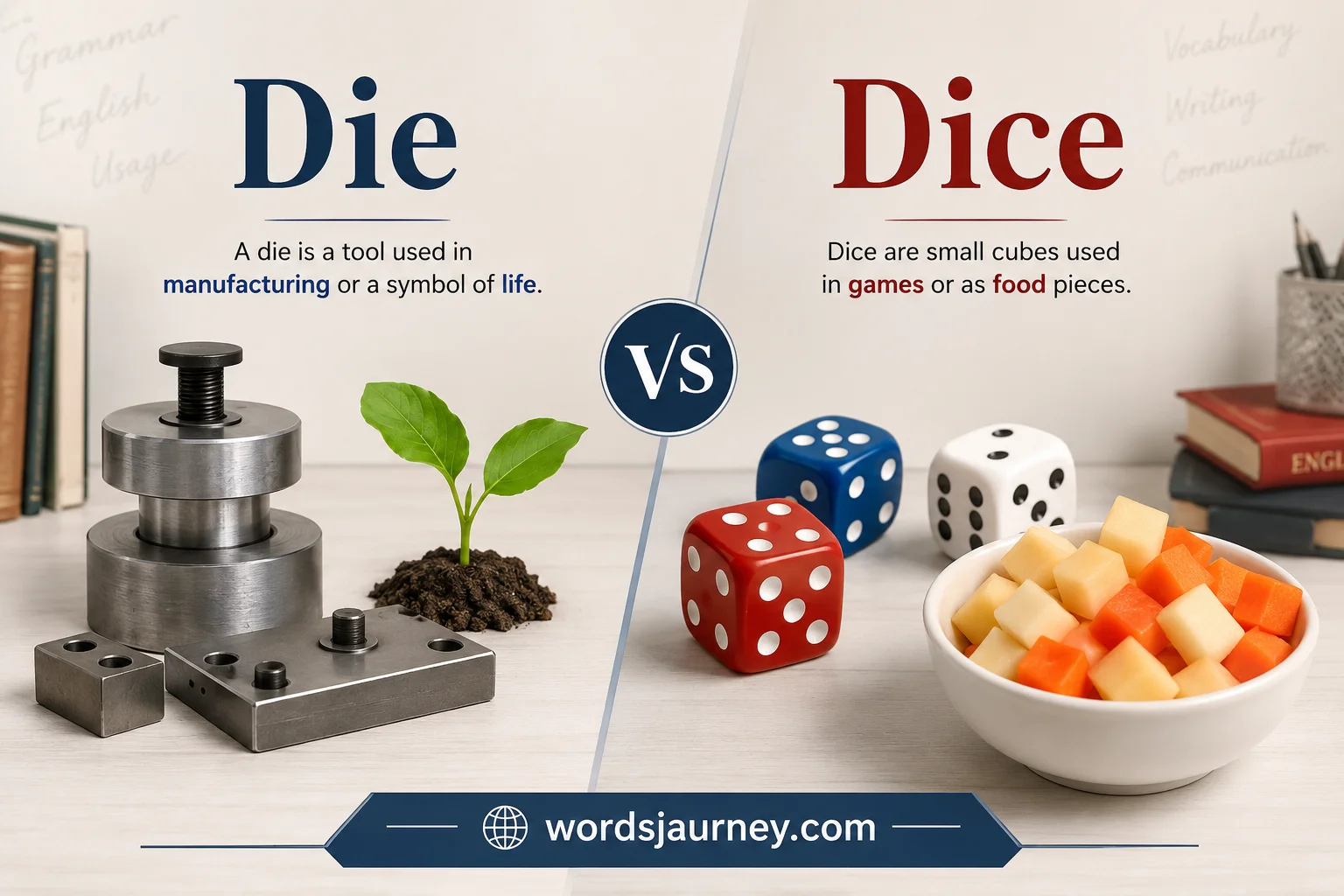
Have you ever paused while writing and wondered about the correct word choice? Many writers face confusion with similar terms in English usage. One common example is “Die vs Dice”, a topic that often creates grammar uncertainty in formal writing, business communication, and everyday conversation.
Understanding this difference improves consistency, strengthens clarity, and supports professional standards in both US and UK style guides. It also reflects attention to detail, which matters in academic work and corporate settings.
This article explains the clear distinction between die and dice in simple terms. You will learn when to use each word in singular and plural contexts, along with practical examples. The guide also highlights regional preferences and writing conventions used in different style manuals.
Whether you are preparing content for meetings, scheduling documents, calendars, project management reports, online booking systems, broadcasting scripts, or business communication, accurate grammar builds credibility and trust.
Search engines now prioritize semantic relevance, user intent, and clarity over keyword repetition. That means content must answer real questions naturally and completely. This guide follows those principles by focusing on practical understanding rather than filler text. By the end, you will confidently distinguish Die vs Dice, apply correct usage in professional and creative writing, and maintain strong linguistic accuracy in any context.
Die vs Dice: Why People Get Confused
At first glance, die and dice look almost identical. Only one letter changes. However, that small difference changes meaning completely.
There are three main reasons for confusion:
- Dice can be singular or plural in modern usage.
- Die has more than one meaning.
- Context determines which word is correct.
Because English evolves over time, some traditional grammar rules now overlap with modern usage. That’s why clarity matters.
What Does Die Mean?
The word die has two major meanings.
Die as a Verb
The most common meaning of die is simple. It means to stop living.
It applies to people, animals, plants, and even cells.
Examples:
- Many insects die in winter.
- The patient died peacefully.
- Plants die without sunlight.
- Old habits die hard.
Verb Forms of Die
Here are the correct forms:
| Form | Word |
| Base | die |
| Past | died |
| Past Participle | died |
| Present Participle | dying |
Notice that the past tense is died, not anything else. This is a common spelling mistake.
Common Expressions with Die
You’ll often see die used in phrases:
- die out (disappear over time)
- die down (become quieter)
- die from illness
- die of hunger
- die suddenly
Example:
Many languages die out when younger generations stop using them.
Die as a Noun
The word die can also be a noun in manufacturing.
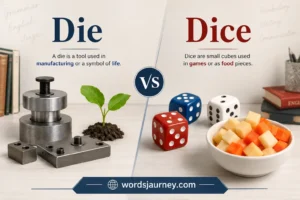
In this case, a die is a tool used to shape or cut materials.
It is common in:
- Metal stamping
- Coin production
- Plastic molding
- Industrial manufacturing
For example:
- Coins are shaped using a metal die.
- Car parts are formed with precision dies.
This meaning has nothing to do with death. It belongs to engineering.
What Does Dice Mean?
The word dice has two main uses.
Dice as a Noun
Traditionally, dice is the plural of die when talking about game pieces.
- One game cube = die
- More than one cube = dice
Examples:
- He rolled one die.
- She rolled two dice.
However, modern English often uses dice for both singular and plural in casual speech. Still, in formal writing, the traditional rule is preferred.
Dice as a Verb (Cooking Context)
In cooking, dice means to cut food into small cubes.
This verb is very common in recipes.
Examples:
- Dice the onions.
- Dice the tomatoes.
- Dice the potatoes evenly.
Dicing creates small, uniform pieces. This helps food cook evenly and look consistent.
Die vs Dice: Clear Comparison Table
| Word | Part of Speech | Meaning | Context |
| Die | Verb | Stop living | Health, life |
| Died | Verb | Past tense of die | Time reference |
| Die | Noun | Industrial shaping tool | Manufacturing |
| Dice | Noun | Plural of die (traditional) | Games |
| Dice | Verb | Cut into cubes | Cooking |
This table shows that context decides meaning.
Die vs Dice in Games
When discussing board games or casino games, the difference matters.
Traditional Rule
- One cube = die
- Two or more cubes = dice
Example:
- Roll the die.
- Roll the dice.
Modern Usage
In everyday conversation, many people say “dice” even for one cube. Dictionaries now accept this informal usage. However, formal writing still follows the traditional rule.
Die vs Dice in Cooking
Here, dice is always a verb.
It means cutting food into small cubes.
This technique:
- Improves texture
- Ensures even cooking
- Enhances presentation
Cooking Example
If a recipe says:
Dice the carrots.
It means:
Cut the carrots into small cube shapes.
Dicing is different from:
- Chopping (irregular pieces)
- Slicing (thin flat cuts)
- Mincing (very fine pieces)
Die vs Dice in Manufacturing
In engineering, a die is a precision tool.
It shapes materials under pressure.
Example:
- A coin blank is pressed between two dies.
- The die engraves the design.
- High force creates detailed patterns.
Without dies, mass production would not work efficiently.
This meaning is widely used in industrial settings.
Common Mistakes with Die and Dice
Here are frequent errors people make:
Mistake 1: Using Dice for Death
Incorrect:
- He will dice tomorrow.
Correct:
- He will die tomorrow.
Mistake 2: Using Die as Plural in Games
Incorrect:
- I rolled two die.
Correct:
- I rolled two dice.
Mistake 3: Mixing Cooking and Gaming Meanings
Dice in recipes means cutting food.
It does not relate to gambling.
Context solves this confusion.
Why Dice Became Acceptable as Singular
Historically, the singular form was die.
Over time, casual language shifted. Many speakers began using dice for both singular and plural.
Reasons for this change include:
- Simpler usage in conversation
- Influence of gaming communities
- Natural language evolution
Today, both forms appear in modern dictionaries. However, traditional grammar still prefers:
- One die
- Two dice
Read More: Imbed vs. Embed: The Real Difference and Why “Embed” Wins?
Memory Tricks to Remember the Difference
Here are simple ways to remember:
- Life meaning → die
- Game pieces → die (one), dice (many)
- Cooking action → dice
- Industrial tool → die
Think of context first. That habit prevents errors.
Quick Usage Summary
Use die when:
- Talking about life or death
- Referring to an industrial shaping tool
- Using traditional gaming grammar for one cube
Use dice when:
- Referring to more than one game cube
- Writing about cooking and cutting food
Read More: Gluing or Glueing: Which Spelling Is Correct and Why It Matters
Real-World Example Scenarios
Scenario 1: Medical Report
Correct sentence:
- The patient died after surgery.
Scenario 2: Board Game Review
Correct sentence:
- The game includes two dice.
Scenario 3: Cooking Blog
Correct sentence:
- Dice the vegetables evenly.
Scenario 4: Manufacturing Article
Correct sentence:
- The metal die shapes the product.
Each example shows how context determines usage.
Frequently Asked Questions (FAQs)
1. What is the main difference between die and dice?
A die is the singular form, while dice is the plural form. One die refers to a single game cube. Two or more dice refer to multiple cubes.
2. Is “dice” ever correct as singular?
Traditionally, die is singular in standard English. However, in modern informal usage, some people use dice for both singular and plural. In formal writing, especially in academic or business contexts, use die for one and dice for more than one.
3. Which spelling is preferred in US and UK English?
Both US and UK style guides recognize die as singular and dice as plural. The rule remains consistent across regions. Always follow the specific style guide required for your content.
4. How should I use die and dice in professional writing?
Use correct grammar in formal writing, business communication, project management documents, and meetings notes. Consistent usage improves clarity and strengthens credibility.
5. Can die and dice affect scheduling or reporting documents?
Yes, especially in educational content, game analysis, or data reports. Clear language ensures accuracy in online booking descriptions, broadcasting scripts, and structured communication.
6. Why is consistency important when using die vs dice?
Consistency supports readability and professionalism. It aligns with modern grammar standards, English usage rules, and style guide recommendations. It also improves user experience and content quality.
7. How can I remember the difference easily?
Think of die as one item. Remember that dice refers to more than one. This simple rule helps maintain accuracy in everyday writing.
Conclusion
Understanding Die vs Dice is essential for clear and professional communication. The difference is simple, yet it plays an important role in formal writing, business documents, academic work, and everyday English usage. Using the correct form shows attention to detail and strengthens overall clarity.
By applying the singular and plural rule consistently, you improve readability and maintain grammatical accuracy. Whether you are writing for project management, meetings, scheduling systems, or general content creation, correct word choice supports strong communication standards. Keep this rule in mind, and you will confidently use die and dice in any context.

Johnson Alex is a language-focused writer and the voice behind WordsJourney. He creates practical, easy-to-understand content that helps readers improve their vocabulary and express ideas with clarity and confidence.