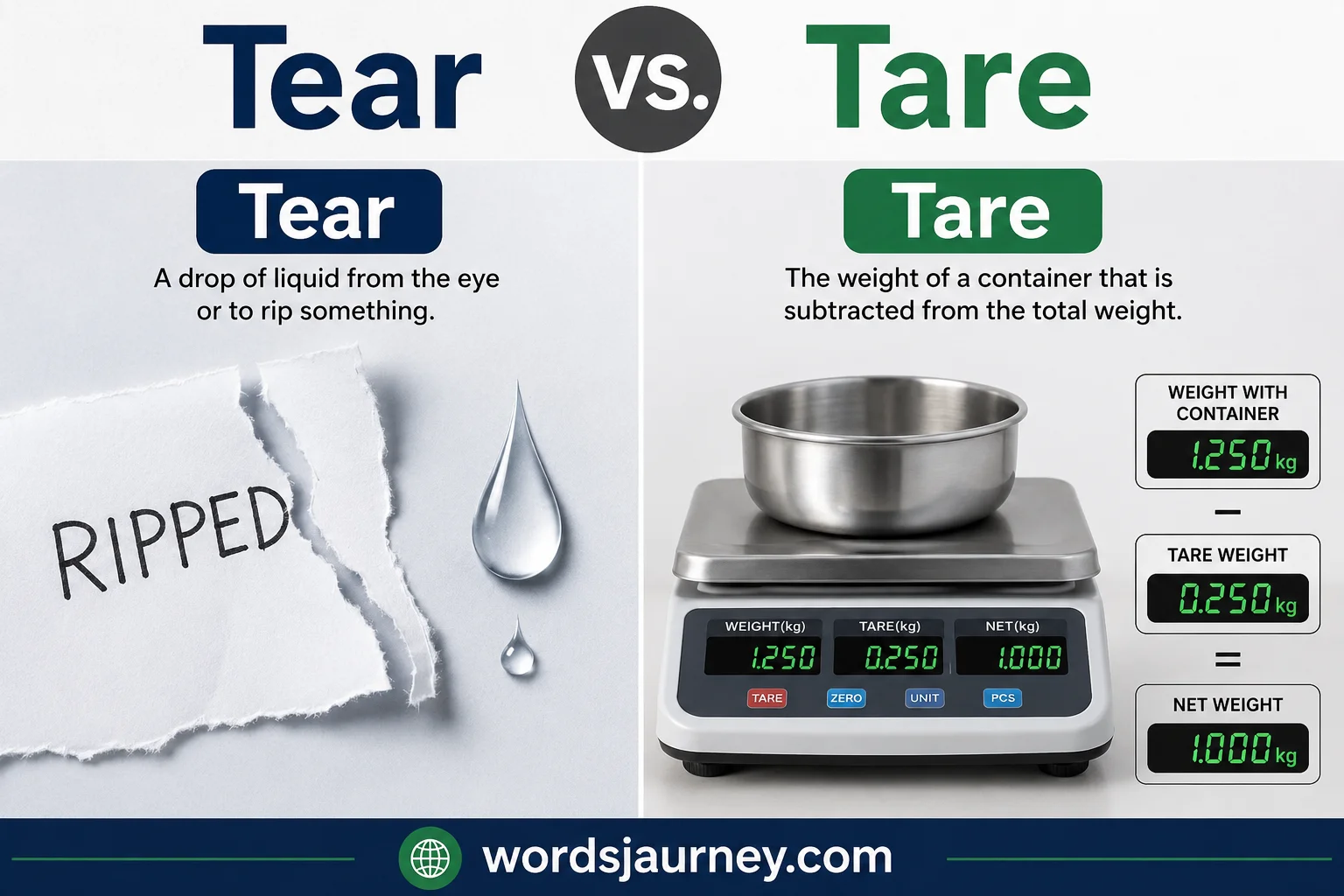
Have you ever paused while writing and wondered which word is correct? Many writers struggle with Tear vs. Tare because both sound identical but carry completely different meanings. This confusion often appears in English usage, especially in formal writing, business communication, and even everyday tasks like scheduling or project management.
In this guide, you’ll clearly understand the difference between these two terms and learn how to use each one with confidence. By focusing on grammar, context, and precision, you can improve clarity in emails, reports, meetings, and online booking systems.
Understanding language accuracy is essential in today’s digital world. Whether you are managing a calendar, coordinating time management, preparing documents for broadcasting, or handling professional correspondence, consistency matters. Search engines and readers both value content that demonstrates expertise, clarity, and semantic relevance.
That is why mastering word distinctions like tear and tare strengthens not only your writing skills but also your credibility in formal communication.
In this article, you will explore the precise meaning of tear and tare, their real-world applications, and practical examples to avoid common mistakes. We will break down definitions, usage scenarios, and memory tips in a simple yet authoritative way.
By the end, you will confidently apply these terms in academic writing, workplace documents, and everyday conversations. This clear understanding supports better readability, stronger grammar consistency, and improved communication across both personal and professional contexts.
Tears vs. Tare Overview
Before diving deeper, here’s a quick snapshot to ground you.
| Word | Part of Speech | Core Meaning | Common Use |
| Tear | Verb / Noun | To rip or a drop of liquid from the eye | Emotions, damage, accidents |
| Tare | Noun | Weight of packaging | Shipping, trade, weighing goods |
The key difference is simple:
Tear relates to damage or emotion.
Tare relates to weight and measurement.
Now let’s break each one down clearly.
Understanding Tear
Tear as a Verb
As a verb, tear means to rip, split, or damage something by force.
For example:
- You tear paper when you pull it too hard.
- Strong wind can tear a roof.
- A sharp object can tear fabric.
In everyday language, this meaning appears often. It usually describes accidental damage, physical force, or destruction.
Tear as a Noun
As a noun, tear has two main meanings.
First, it can mean a rip in something:
- There is a tear in your jacket.
- The book has a tear on the page.
Second, it can mean a drop of liquid from the eye, usually caused by emotion:
- She wiped away a tear.
- Tears filled his eyes.
This emotional meaning is extremely common in literature and conversation.
Facts About the Word Tear
- It functions as both noun and verb.
- It appears frequently in emotional writing.
- It is one of the most common homographs in English.
- Its pronunciation changes depending on the meaning.
Understanding Tare
Now let’s move to tare. This word belongs to a completely different field.
Tare as a Noun
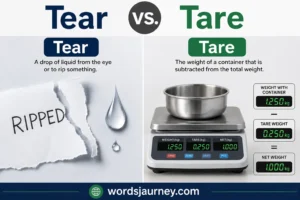
Tare refers to the weight of packaging or a container.
When you weigh something, you often don’t want the container’s weight included. The container might be a box, bottle, bag, or crate. That container weight is the tare weight.
Gross Weight, Tare Weight, and Net Weight
Understanding these three terms makes everything clearer.
- Gross weight = total weight (product + container)
- Tare weight = weight of the container
- Net weight = actual weight of the product
Here’s a simple table:
| Term | What It Includes |
| Gross Weight | Product + Container |
| Tare Weight | Container Only |
| Net Weight | Product Only |
For example:
If a package weighs 1,200 grams total, and the box weighs 200 grams, then:
- Tare weight = 200 grams
- Net weight = 1,000 grams
This concept is essential in shipping, trade, manufacturing, and retail.
Where Tare Is Used
You’ll commonly see tare in:
- Grocery stores
- Shipping labels
- Industrial weighing systems
- Laboratory measurements
- Online packaging operations
Modern digital scales often have a tare button. When you press it, the scale resets to zero while keeping the container on it.
That feature prevents manual subtraction errors.
Pronunciation Differences
Here’s where confusion increases.
In many accents, tear (rip) and tare sound the same. They are homophones in certain contexts.
However, tear (crying) can sound different from tear (rip) depending on pronunciation.
This creates overlap, especially in spoken English.
Because spelling does not match sound perfectly, mistakes happen in writing.
That’s why understanding meaning matters more than pronunciation alone.
Tear vs. Tare Comparison
Let’s compare them directly.
Meaning
- Tear = rip or emotional drop.
- Tare = weight of packaging.
Usage Context
- Tear appears in daily speech, emotions, accidents, storytelling.
- Tare appears in trade, measurement, logistics, and science.
Grammar Function
- Tear can be verb and noun.
- Tare is only a noun.
Frequency in English
According to linguistic usage data from major English corpora, tear is significantly more common in general writing than tare, since tare is specialized vocabulary.
Real-World Examples of Tear
Let’s see it used correctly in context.
Physical Meaning
- The dog can tear the sofa cushion.
- The paper tore during printing.
- Strong movement can tear fabric.
Emotional Meaning
- She felt a tear fall during the speech.
- Tears showed his relief.
- The movie made everyone cry.
Idioms with Tear
- Tear apart – to destroy or divide.
- Tear down – to demolish.
- Tear into – to criticize strongly.
- Tear up – to rip or become emotional.
These phrases appear often in conversations and media.
Real-World Examples of Tare
Now let’s apply tare properly.
Shipping Example
A shipment weighs 50 kg total.
The box weighs 5 kg.
So:
- Tare = 5 kg
- Net = 45 kg
This prevents overcharging customers.
Grocery Store Example
You bring a reusable container to a store.
The cashier presses the tare button.
The scale resets to zero.
Only the food weight gets measured.
Laboratory Example
Scientists measure chemicals in containers.
They subtract tare weight to ensure accuracy.
Precision matters in these fields. Even small errors can cause major issues.
Case Study: Why Tare Matters in Trade
In international shipping, incorrect tare calculation can create financial disputes.
For example:
If customs officials record gross weight instead of net weight, taxes may increase unfairly. That leads to delays and legal issues.
Accurate tare measurement ensures:
- Fair pricing
- Legal compliance
- Transparent transactions
- Reduced errors
This shows why tare is not just technical language. It has real economic impact.
Common Mistakes with Tear and Tare
Writing Errors
- Using “tare” when meaning “tear.”
- Confusing them in academic writing.
- Auto-correct changing words incorrectly.
Context Mistakes
If you write about emotions and use “tare,” readers will get confused.
Example of incorrect usage:
- She wiped away a tare. ❌
Correct:
- She wiped away a tear. ✔
Memory Tricks to Remember the Difference
Here’s a simple way to remember.
For Tear
Think of:
- Ripping
- Crying
- Damage
Both involve emotion or force.
For Tare
Think of:
- Weighing
- Scales
- Containers
If you see a scale, think tare.
Another trick:
Tare = Trade.
Both start with “T” and appear in commercial environments.
Why This Confusion Happens
Several reasons explain the mix-up:
- Similar spelling
- Similar pronunciation in some accents
- Lack of exposure to technical vocabulary
- Fast typing without proofreading
English contains many homophones. Tear and tare are just one example.
However, understanding context solves the problem quickly.
Quick Reference Guide
Here is a concise summary you can revisit anytime.
Tear
- Means rip or damage.
- Can describe emotions.
- Works as noun and verb.
- Common in daily writing.
Tare
- Means container weight.
- Used in measurement.
- Appears in trade and science.
- Always a noun.
When to Use Each Word
Use tear when:
- Describing damage.
- Talking about crying.
- Writing stories.
- Explaining physical force.
Use tare when:
- Discussing weight systems.
- Working with scales.
- Writing about shipping.
- Handling inventory measurement.
Expert Tip for Professional Writing
If you work in logistics, food packaging, or laboratory environments, always double-check spelling.
In business communication, small errors can reduce credibility.
Proofreading takes seconds. It prevents confusion.
Read More: Hastle or Hassle: The Correct Spelling and Complete Guide
Frequently Asked Questions About Tear vs. Tare
1. What is the main difference between Tear and Tare?
“Tear” has multiple meanings, including a drop of liquid from the eye or to rip something. “Tare” refers to the weight of packaging or container that is subtracted from the total weight. They sound the same but are used in completely different contexts.
2. When should I use “tear” in writing?
Use “tear” when referring to emotions, crying, or ripping something. For example, in storytelling, formal writing, or everyday communication, context will determine the correct meaning. Always check the sentence carefully for clarity.
3. Where is “tare” commonly used?
The word “tare” is frequently used in business communication, shipping, logistics, and inventory management. It is important in project management, online booking systems, and situations involving product weight calculations.
4. Is “tear” pronounced differently from “tare”?
No. Both words are pronounced the same way in most contexts. This is why they are considered homophones in English usage and often cause confusion in writing.
5. Does US or UK English change the meaning of Tear vs. Tare?
No. The meanings remain the same in both US and UK style guides. However, spelling and usage consistency should always follow the relevant regional standard in academic or professional writing.
6. How can I remember the difference easily?
Think of “tare” as connected to weight and measurements. It relates to containers and packaging. Think of “tear” as linked to emotions or fabric damage. Context will guide you correctly.
7. Why is understanding Tear vs. Tare important for professionals?
Correct usage improves grammar accuracy, strengthens business communication, and enhances credibility in reports, emails, meetings, and documentation. Clear language supports better time management, scheduling, and overall professional consistency.
Conclusion
Understanding the difference between Tear vs. Tare is essential for clear and professional communication. Although the words sound identical, their meanings are distinct and context-driven. One relates to emotions or ripping, while the other connects to weight calculations in commercial and logistical settings.
By applying correct English grammar, following trusted style guides, and maintaining consistency in formal writing, you reduce confusion and improve readability. Whether you are managing project tasks, preparing documents, or handling business communication, accurate word choice strengthens your credibility.

Emma Brook is a dedicated writer and language enthusiast at WordsJourney. She’s passionate about helping readers understand words better and use them with confidence in everyday conversations. Her work focuses on alternative phrases, clear meanings, and practical examples that make language feel simple and approachable.
With a friendly, reader-first writing style, Emma breaks down common expressions and explores smarter ways to say things without sounding forced or complicated. Her goal is to make learning words enjoyable, useful, and easy for everyone.