Ever paused mid-sentence and wondered which spelling fits Capital or Capitol? You’re not alone. This tiny switch can trip up even confident writers, especially in formal writing and business communication.
In a world of fast broadcasting, quick meetings, and nonstop online booking, clarity matters. Choosing the right word protects your message and your credibility.
This guide breaks down the difference between capital and capitol with clear rules, real examples, and quick memory tricks. You’ll see how these words show up in English usage, grammar, and everyday writing from project management updates to shared calendar invites.
We’ll also connect the dots to scheduling, time management, and workplace clarity so your writing stays precise and professional.
We’ll briefly note how style guides and regional preferences shape usage, including US vs. UK conventions.
By the end, you’ll know when to use each term, how to stay consistent, and how to avoid common mix-ups in emails, reports, and public-facing content. Clear words lead to clear outcomes and that’s a habit worth keeping.
Capital or Capitol: The Core Difference You Can Learn in One Minute
If you want instant clarity, start here.
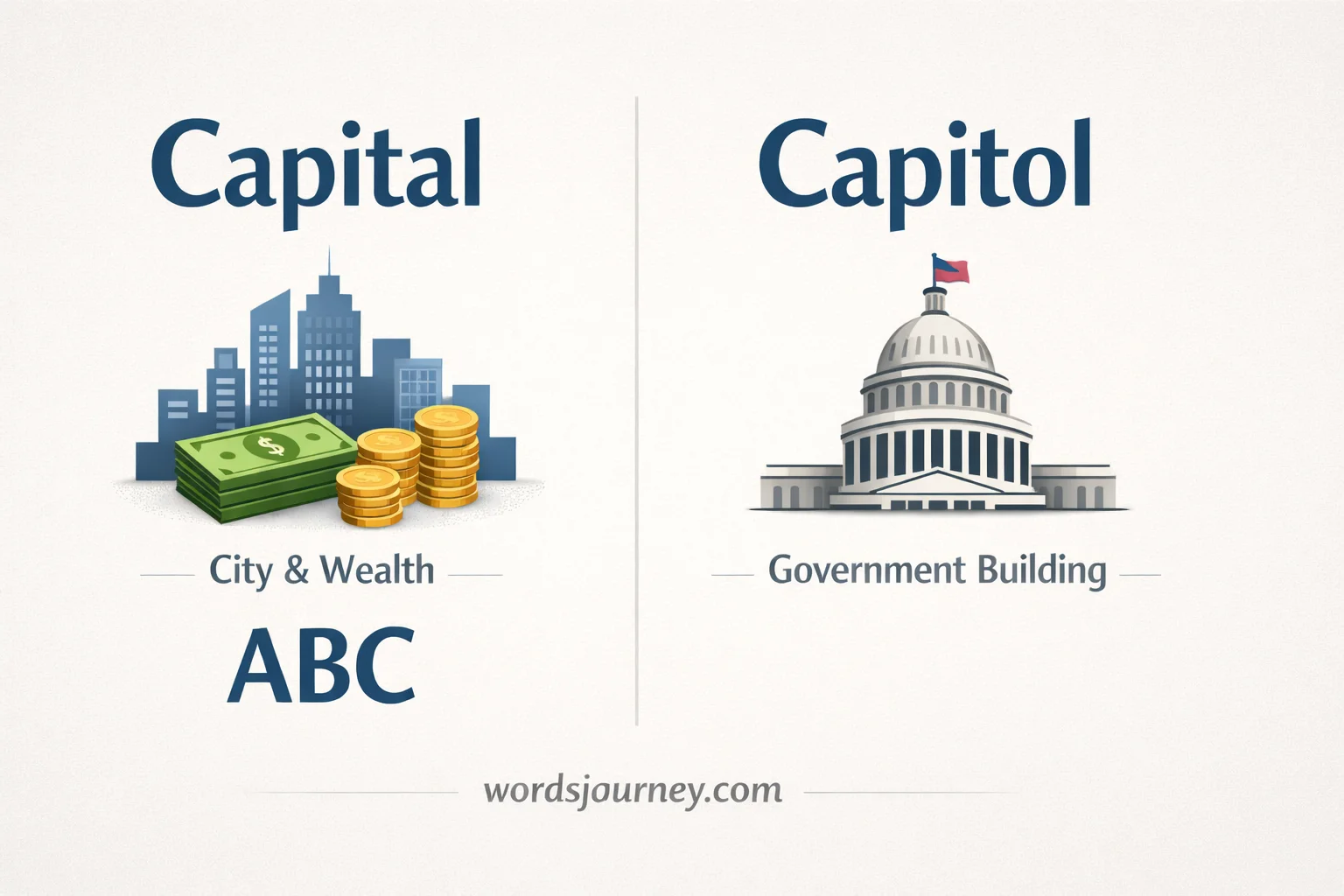
Capital does many jobs.
Capitol does one job.
| Word | What it Means | Where You Use It | Quick Example |
| Capital | A city, money, assets, advantage, uppercase letters | Geography, finance, writing, business | The capital of France is Paris. |
| Capitol | A government building | U.S. Congress and state legislative buildings | The U.S. Capitol stands in Washington, D.C. |
The simple rule
- Use capital for cities, money, value, and letters.
- Use capitol only for the building where lawmakers meet.
That’s it. The rest of this guide helps you lock it in.
What “Capital” Means in Real Life
Capital shows up everywhere. That’s why people default to it. The word carries several precise meanings. Each one matters.
Capital as a City
A capital is the seat of government for a country, state, or region. It’s the place where executive offices often sit and where symbolic power lives.
Fast facts
- National capitals anchor political authority.
- State capitals host legislatures and governors.
- A capital city is not always the largest city. Think Canberra vs Sydney.
Examples
- Tokyo is Japan’s capital.
- Sacramento is California’s capital.
- Islamabad is Pakistan’s capital.
Common slip
- Writing “the capitol of California.”
- The city is the capital.
- The building is the capitol.
Capital in Finance and Economics
In business, capital means resources used to create value. Money is only part of the story.
Core types of capital
- Financial capital: cash, equity, debt.
- Human capital: skills, experience, know-how.
- Social capital: networks and trust.
- Physical capital: tools, machines, property.
- Intellectual capital: patents, data, brand equity.
Why this matters
Founders pitch investors with capital plans. CFOs manage capital structure. Analysts track capital efficiency.
Mini case study
A startup raises $5 million in venture capital to scale customer support and improve onboarding. The money is capital. The trained support team becomes human capital. The product roadmap becomes intellectual capital. Each form compounds the next.
Capital Letters in Writing
Capital letters shape clarity. They signal proper nouns and the start of sentences. They also prevent legal and brand mishaps.
Use capitals for
- Names and titles.
- Countries, cities, institutions.
- Brand names and trademarks.
- The first word of a sentence.
Common traps
- Randomly capitalizing common nouns.
- Lowercasing proper names in formal writing.
Capital as Advantage or Leverage
Writers and analysts use capital to mean advantage.
Examples
- “She made political capital from the reform.”
- “The brand built capital through consistent service.”
This sense shows up in opinion pieces and market analysis. It’s abstract yet precise.
What “Capitol” Means and Why It’s Narrow
Capitol refers to a specific government building. It does not name a city. It does not describe money. It does not mean “important.” It points to a place where lawmakers meet.
The U.S. Capitol
The U.S. Capitol houses the Senate and the House of Representatives. It anchors federal lawmaking in Washington, D.C.
Key facts
- Location: Capitol Hill, Washington, D.C.
- Role: Legislative branch headquarters.
- Symbolism: A visual shorthand for Congress.
Journalists capitalize Capitol when naming the building. The city remains the capital.
State Capitols
Each U.S. state has a capitol building where the legislature meets. The city that hosts it is the capital.
Correct pairing
- Austin is the capital of Texas.
- The Texas State Capitol stands in Austin.
Why editors care
One wrong vowel flips meaning. In public policy writing, that error signals sloppy review.
Capitol vs Capital in Government Writing
Government copy needs precision. Policy memos, legal briefs, and news reports live or die by exact words.
Correct
- “The bill cleared committee at the Capitol.”
- “The rally drew crowds to the capital.”
Incorrect
- “The rally drew crowds to the capitol.”
- That suggests people gathered inside the building.
Capital or Capitol: Side-by-Side Usage You Can Copy
Seeing both words in action locks the rule into memory.
Correct
- The capital of Japan is Tokyo.
- Tourists queued outside the Capitol.
- Venture capital fuels early-stage growth.
- Use capital letters for proper nouns.
Fix the mistakes
- ❌ The capital building opened at dawn.
- ✅ The capitol building opened at dawn.
- ❌ Albany is the capitol of New York.
- ✅ Albany is the capital of New York.
Memory Tricks That Actually Stick
Forget gimmicks. Use cues that work under pressure.
Three fast anchors
- The O in capitOl looks like a dome.
- Capital has many meanings. Capitol has one job.
- If you mean city, money, or letters, choose capital.
Visual cue
Picture a domed building when you see capitol. The shape primes the spelling.
Habit loop
- Pause on “capital.”
- Ask, “Do I mean the building?”
- If yes, switch to capitol.
Capital or Capitol in News, Media, and Classrooms
Newsrooms train reporters to guard this pair. Teachers drill it for a reason.
Why the mistake spreads
- Political news repeats “Capitol” daily.
- Social feeds compress nuance.
- Spell-check misses context errors.
What students lose
- Precision in civic writing.
- Confidence in formal tone.
- Credibility with instructors and editors.
Editor’s note
One vowel can change a headline’s meaning. In political coverage, that change matters.
Quote
“Accuracy builds trust. Small errors signal big problems.”
Common newsroom mantra
For More Please Visit: Canvas vs Canvass: The Complete Guide by using correctly
Does “Capitol” Exist Outside the U.S.?
Rarely. Most countries name their legislative buildings with different terms. The city remains the capital.
Global snapshot
| Country | Capital City | Legislature Building Name |
| United Kingdom | London | Palace of Westminster |
| Canada | Ottawa | Parliament Hill |
| Australia | Canberra | Parliament House |
| Germany | Berlin | Reichstag Building |
Writers covering global politics should default to capital for cities. Use the local building name when needed.
Common Mistakes and Why They Happen
Errors cluster around habit and speed.
Top causes
- Sound-alike confusion.
- Overexposure to “Capitol” in U.S. news.
- Rushed editing.
- Autocorrect blind spots.
How to stop them
- Add a final pass for homophones.
- Keep a one-line checklist by your desk.
- Train your eye with side-by-side examples.
Quick Self-Test: Can You Pick the Right Word?
Fill in the blank. Then check the key.
- The _____ of France is Paris.
- Lawmakers met at the _____.
- The firm raised growth _____.
- Use _____ letters for names.
Answers
- capital
- capitol
- capital
- capital
You nailed it if all four felt automatic.
Style Guide Rules for Capital and Capitol
Professional writing leans on style guides for a reason. They lock consistency across teams.
AP Stylebook
- Uses capital for cities.
- Capitalizes Capitol when naming the U.S. Capitol building.
Chicago Manual of Style
- Treats capital as the general term.
- Reserves Capitol for proper names of the building.
Why this helps
- Fewer rewrites.
- Cleaner edits.
- Fewer public corrections.
Capital or Capitol: The Final Rule You’ll Never Forget
If you mean city, money, value, or letters, use capital.
If you mean the lawmakers’ building, use capitol.
Print it. Pin it. Move on with confidence.
Frequently Asked Questions (FAQs): Capital or Capitol
1. What is the main difference between Capital or Capitol?
The difference between capital and capitol lies in meaning and usage. Capital refers to a city, money, or something important. Capitol refers to a government building where lawmakers meet. Knowing this difference improves English usage, formal writing, and professional business communication.
2. Is “capitol” used outside the United States?
In most cases, capitol is primarily used in the United States to describe state or federal legislative buildings. In UK English and other regions, writers usually use capital to refer to cities and avoid capitol altogether. Always follow relevant style guides and regional US vs. UK preferences for consistency.
3. Can “capital” refer to money in business communication?
Yes. Capital commonly means financial resources or funding in business communication and project management. You might see it in reports, budgets, or planning documents related to meetings, scheduling, and time management.
4. Why is it important to use Capital or Capitol correctly in formal writing?
Using Capital or Capitol correctly protects your credibility. Small spelling errors can weaken formal writing, confuse readers, and affect professional contexts like broadcasting, calendar updates, and official documents. Precision builds trust.
5. How can I remember when to use “capitol”?
A simple memory trick: Capitol has an “O” like a dome. Many capitol buildings have domes. This visual cue helps you choose the right word quickly in emails, reports, and online booking confirmations.
6. Does capitalization change the meaning of capital or capitol?
Yes. Capital can be lowercase when it means money or importance. It’s capitalized when part of a proper noun, such as a city name. Capitol is capitalized when it refers to a specific building, such as the U.S. Capitol. This distinction matters for grammar, formal writing, and editorial consistency.
7. Why do writers confuse Capital or Capitol so often?
They sound the same, and both appear in official contexts like government, meetings, and public communication. In fast-paced writing environments—think broadcasting, shared calendars, or project management tools—small spelling details can slip through without careful editing.
Conclusion: Mastering Capital or Capitol
Understanding the difference between Capital or Capitol sharpens your English usage and strengthens your formal writing. These two words may look similar, but they serve very different purposes in clear, professional communication. Choosing the right one shows attention to detail and respect for your reader.
In daily work, accuracy matters more than ever. From business communication and project management to scheduling, meetings, and shared calendar notes, small word choices shape big impressions. When your writing is precise, your message travels faster and lands stronger.
With a few simple rules, practical examples, and awareness of style guides and US vs. UK preferences, you can stay consistent and confident. Keep this distinction in mind, and you’ll avoid a common grammar trap while making your writing clearer, sharper, and more professional.

Aliya Ray is a passionate writer and language enthusiast at WordsJourney. She enjoys exploring words, phrases, and everyday expressions to help readers communicate more clearly and confidently. Her content focuses on alternative ways to say common phrases, simple explanations, and real-life examples that make language easy to understand.
Aliya believes the right words can make any message stronger. Through clear, friendly writing, she helps readers improve their vocabulary without feeling overwhelmed or confused.