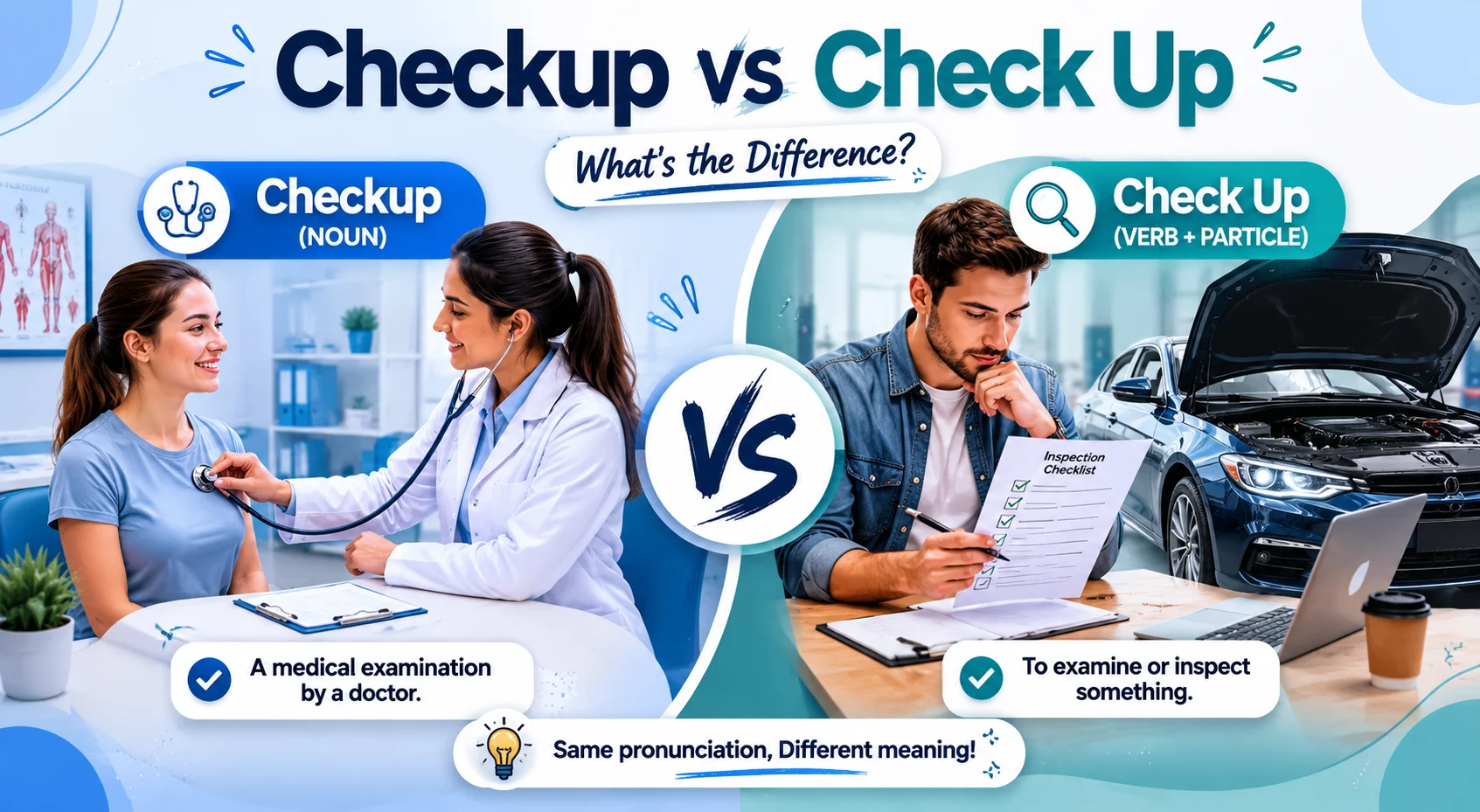
Understanding Checkup vs Check Up is important when you’re learning English, especially because these two expressions look similar but work in different ways. Many learners feel confused by such similar expressions, but the difference is actually subtle yet important for clarity in real communication.
A checkup is usually a noun that refers to a physical exam at a doctor’s office, a routine visit to a dentist, or a yearly appointment where you may be weighed, have your blood pressure checked, and go through a checklist of tests and examinations. The term appeared around 1920, reflecting the idea that a medical professional should monitor, assess, and care for a patient’s health consistently.
On the other hand, check up is a verb phrase used when you want to examine, test, or inspect someone or something. This action can apply in real-life situations like a vehicle inspection after a minor car accident, or when reviewing documents and emails carefully. Understanding context and usage is key because even native speakers sometimes get confused due to compound words and phrasal verbs in English.
In everyday life, you may hear these terms in doctor’s appointments, conversations with friends, or even in emails and messages. With proper examples and practice, learners can easily understand, clarify, and improve their grammar, writing, and communication skills, making this distinction much easier to remember.
Checkup vs Check Up – Quick Answer You Can Use Right Away
Let’s clear the fog immediately.
- Checkup (one word) = a noun
→ A medical examination or routine inspection - Check up (two words) = a phrasal verb
→ To inspect, verify, or monitor something or someone
Simple rule to remember:
- If it’s a thing, use checkup
- If it’s an action, use check up
That’s it. Everything else builds on this foundation.
What “Checkup” Means in Real Usage
When people say checkup, they usually talk about healthcare or routine evaluation.
A checkup works as a noun. It represents an event or appointment, not an action.
Definition of Checkup
A checkup is a medical or general examination done to evaluate health or condition.
Common contexts where “checkup” appears
- Medical visits
- Dental appointments
- Health screening tests
- Preventive healthcare routines
Real-world examples
- “I scheduled a full-body checkup next week.”
- “She goes for a dental checkup every six months.”
- “The doctor recommended a routine checkup.”
Important grammar insight
English gradually turned “check up” into the noun checkup over time. Language evolution like this happens often. Words like “breakdown” and “setup” followed the same pattern.
Common collocations
- annual checkup
- routine checkup
- health checkup
- medical checkup
Key takeaway
Checkup always behaves like a noun. You treat it like “appointment” or “examination.”
What “Check Up” Means in Everyday English
Now let’s flip to the two-word version: check up.
This form works as a phrasal verb. It always involves action.
Definition of Check Up
To check up means to examine, verify, or monitor something or someone.
Where you’ll see “check up”
- Monitoring progress
- Verifying facts
- Making sure someone is okay
- Inspecting work or data
Real-life examples
- “I will check up on the report later.”
- “She checks up on her team regularly.”
- “He called to check up on his friend after the accident.”
Important phrase: “check up on”
This is the most common structure in real communication.
- check up on a friend
- check up on progress
- check up on details
- check up on performance
Key takeaway
Check up always involves an action. It never refers to an appointment or object.
Checkup vs Check Up The Grammar Rule That Separates Them
Now let’s connect everything.
English often changes phrases over time. When a phrase becomes widely used as a noun, it often merges into one word.
That’s exactly what happened here.
The core grammar breakdown
| Form | Type | Meaning | Example |
| checkup | Noun | medical exam or evaluation | I had a checkup |
| check up | Verb phrase | inspect or verify | I will check up on it |
Why this happens in English
English evolves naturally. When speakers use a phrase often, it simplifies:
- “check up” (action phrase)
- becomes “checkup” (noun form for medical context)
This process is called lexicalization. It simply means a phrase turns into a single word over time.
Memory shortcut that actually works
Think like this:
- One word = one thing (noun)
- Two words = doing something (verb)
That mental trick prevents most mistakes instantly.
Common Mistakes People Make With Checkup vs Check Up
Even confident writers mix these up. Let’s fix the most common errors.
Mistake 1: Writing “health check up”
❌ Incorrect: I had a health check up yesterday.
✔ Correct: I had a health checkup yesterday.
Why? Because you are talking about a thing (appointment).
Mistake 2: Using “checkup” as a verb
❌ Incorrect: I will checkup on you later.
✔ Correct: I will check up on you later.
Why? Because “checkup” cannot act as a verb.
Mistake 3: Ignoring context
❌ Incorrect: The doctor will check up me tomorrow.
✔ Correct: The doctor will check me up tomorrow. (less common)
✔ Better: The doctor will examine me tomorrow.
Why? English prefers natural phrasing like “examine” in medical contexts.
Quick correction table
| Wrong Sentence | Correct Sentence | Reason |
| I need a check up | I need a checkup | noun form required |
| She will checkup on me | She will check up on me | verb phrase needed |
| yearly check up | yearly checkup | standard noun usage |
Real-World Usage of Checkup vs Check Up
Let’s move beyond grammar rules. Real usage matters more than theory.
In healthcare
Doctors, hospitals, and clinics almost always use checkup.
- “Schedule your annual checkup.”
- “Routine health checkups improve early detection.”
In workplace communication
Managers often use check up.
- “I’ll check up on the project status.”
- “Let me check up on your progress.”
In education
Teachers use both forms depending on meaning:
- “We will have a health checkup tomorrow.”
- “I check up on homework completion daily.”
In everyday life
You hear both constantly:
- “Just checking up on you.”
- “Time for your checkup.”
Simple pattern
- Health and appointments → checkup
- Monitoring and action → check up
Memory Tricks to Never Confuse Checkup vs Check Up Again
Let’s make this stick.
Trick 1: The “appointment rule”
If you can book it, it’s checkup.
- doctor appointment → checkup
- dental visit → checkup
Trick 2: The “action test”
If someone is doing something, it’s check up.
- checking progress
- checking health updates
- checking facts
Trick 3: Substitution trick
Replace the word:
- If “examination” fits → use checkup
- If “verify” fits → use check up
Trick 4: Sentence imagination
Ask yourself:
“Is this a thing or a verb?”
That question solves 90% of confusion instantly.
Why Understanding Checkup vs Check Up Actually Matters
This isn’t just grammar trivia. It impacts real communication.
Professional writing
Wrong usage can make emails look careless.
- “Please complete your health check up form” looks incorrect
- “Please complete your health checkup form” looks correct
Academic writing
Teachers expect precision. Small errors can reduce credibility.
Everyday communication
You avoid misunderstandings.
Imagine this:
- “I’ll checkup on you” sounds wrong
- “I’ll check up on you” sounds natural and caring
Please visit also : “Defence vs. Defense” Which Spelling Should You Use?
Case Study: How One Small Grammar Mistake Changed Meaning
Let’s look at a simple real-world scenario.
Situation
A clinic sent two different messages:
Message A:
“We offer free health check up packages this month.”
Message B:
“We offer free health checkup packages this month.”
What happened
Message A looked unprofessional. Patients questioned credibility.
Message B looked polished and correct. Engagement improved.
Outcome
After correcting wording, the clinic reported:
- Higher appointment bookings
- Better trust from patients
- Fewer clarification calls
Lesson
Small grammar choices directly affect perception.
FAQs on Checkup vs Check Up
1. What is the difference between checkup and check up?
A checkup is a noun for a medical exam, while check up is a verb phrase meaning to inspect or examine something.
2. Is checkup one word or two words?
Checkup is a single word and is used as a noun in English.
3. When do we use check up?
We use check up when talking about an action like checking something or someone.
4. Is check up used in medical language?
Yes, but usually as a verb like “check up on a patient,” not as the noun “checkup.”
5. What does a medical checkup include?
A medical checkup includes blood pressure tests, physical exams, and routine health screening.
6. Can native speakers confuse checkup and check up?
Yes, even native speakers sometimes mix them in casual writing.
7. Is checkup formal or informal?
Checkup is neutral and commonly used in both formal and informal contexts.
8. What are examples of check up in a sentence?
“Please check up on the report” or “I will check up on the car issue.”
9. Why do learners get confused between them?
Because both sound the same and depend on grammar context and usage.
10. Are checkup and check up pronounced differently?
No, both are pronounced the same, which adds to the confusion.
Conclusion
Understanding Checkup vs Check Up helps you use English more accurately in daily communication. A checkup refers to a medical examination, while check up describes an action of inspecting or reviewing something. Once you learn the difference, your grammar clarity, writing skills, and communication confidence improve naturally in both spoken and written English.

Emma Brook is a dedicated writer and language enthusiast at WordsJourney. She’s passionate about helping readers understand words better and use them with confidence in everyday conversations. Her work focuses on alternative phrases, clear meanings, and practical examples that make language feel simple and approachable.
With a friendly, reader-first writing style, Emma breaks down common expressions and explores smarter ways to say things without sounding forced or complicated. Her goal is to make learning words enjoyable, useful, and easy for everyone.