Have you ever felt cornered by a decision that seems black or white, with no middle ground? This common trap is known as the Either or Fallacy, a subtle yet pervasive error in reasoning that can mislead even the most careful thinkers. Understanding this fallacy is essential, not just in formal writing or English usage, but also in everyday contexts like business communication, project management, and even online booking or calendar scheduling.
In professional settings, the Either or Fallacy can sneak into meetings, broadcasting, and time management discussions. For instance, assuming a project must succeed entirely or fail completely oversimplifies complex scenarios. By exploring examples from grammar, formal writing, and consistency guidelines, including subtle distinctions between US and UK style preferences, this article will help you recognize and avoid these pitfalls, improving clarity in both speech and text.
By the end of this guide, you will gain practical strategies to spot Either or Fallacy in arguments, presentations, and written content. Whether you’re refining your English usage, optimizing calendar workflows, or enhancing scheduling efficiency, understanding this fallacy empowers more nuanced thinking. Read on to strengthen your reasoning, elevate your business communication, and maintain professional consistency across all written and spoken formats.
What Is the Either-Or Fallacy?
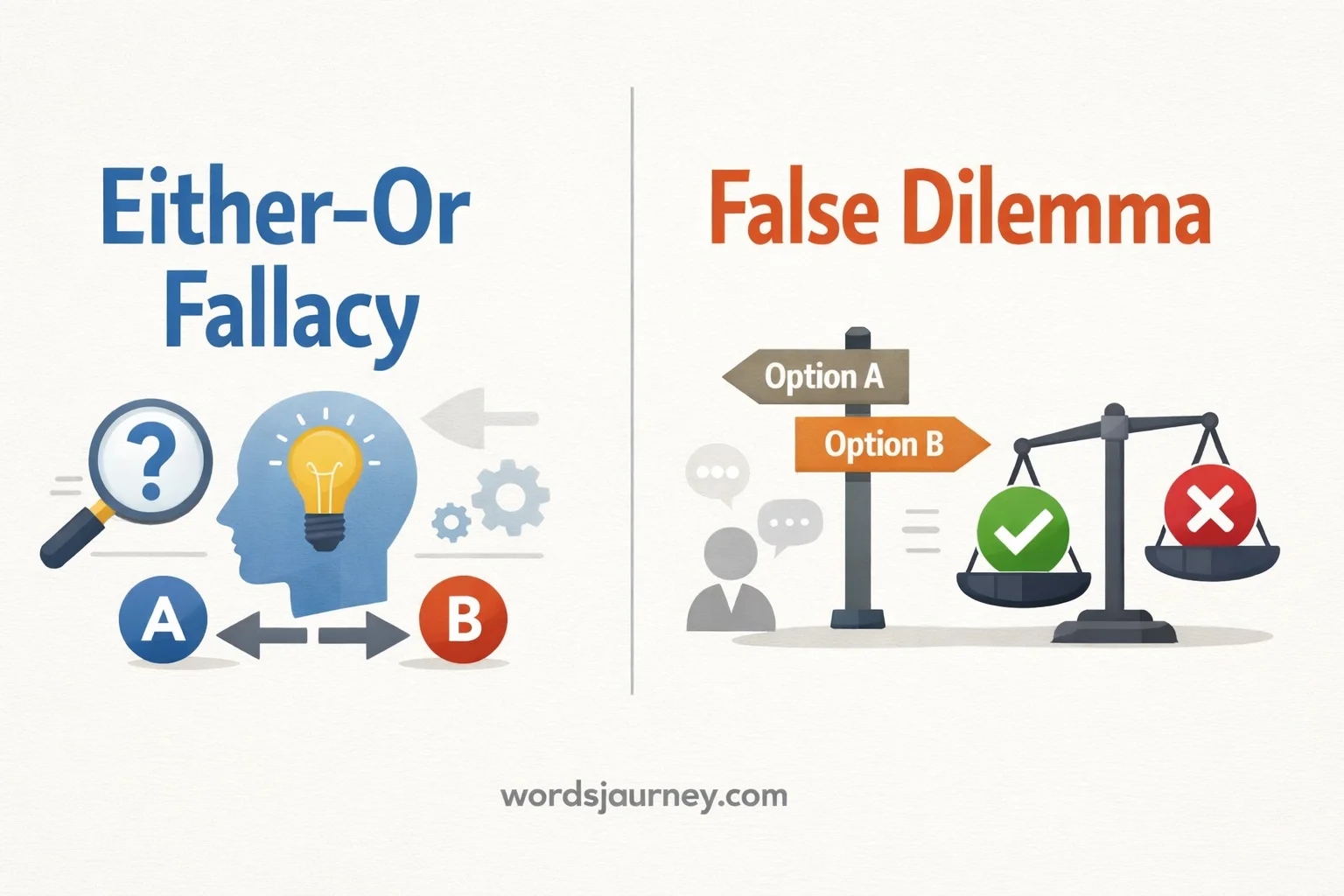
The either-or fallacy occurs when someone presents a situation as having only two alternatives, ignoring other possibilities.
Key characteristics include:
- Oversimplification: Complex issues are reduced to two extremes
- Exclusion of alternatives: Other viable options are ignored or dismissed
- Pressure to choose: Often paired with urgency or emotional appeal
It is different from legitimate binary choices. For example, flipping a coin truly has only two outcomes: heads or tails. In most real-life situations, choices aren’t that simple.
Table: Legitimate Choice vs Either-Or Fallacy
| Situation Type | Legitimate Either-Or | False Dilemma |
| Options | Truly limited | Artificially limited |
| Alternatives | None exist | Ignored or hidden |
| Logic | Sound | Misleading |
Why the Either-Or Fallacy Works on the Human Brain
Humans love shortcuts. Our brains prefer simple, quick answers rather than navigating complex options. The either-or fallacy exploits this tendency.
- Cognitive bias: People rely on mental shortcuts (heuristics) to make decisions
- Emotional triggers: Fear, loyalty, and urgency make binary choices more persuasive
- Social influence: Peer pressure or authority figures push people toward one “right” option
- Comfort in certainty: Black-and-white thinking gives an illusion of control
By understanding these psychological hooks, you can spot when your brain is being nudged toward a false binary.
Common Forms of the Either-Or Fallacy
The either-or fallacy shows up in predictable ways. Recognizing these forms is key:
- Moral extremes: “You’re either a hero or a villain.”
- Political polarization: “If you don’t vote for this, you’re against the country.”
- Marketing and sales: “Buy now or lose this deal forever.”
- Workplace decisions: “We must either cut costs or go bankrupt.”
- Personal ultimatums: “Either you support my idea completely, or you’re against me.”
Bullet Examples:
- “You’re either with us or against us.”
- “If you don’t agree with this policy, you hate progress.”
- “Buy now or miss out forever.”
Real-World Examples Across Different Fields
Politics and Public Discourse
Political campaigns frequently frame issues as all-or-nothing. Headlines like “Vote for A, or watch the nation fail” ignore nuanced solutions. Media framing amplifies this by simplifying complex problems into digestible but misleading soundbites.
Marketing and Advertising
Marketers love false dilemmas. “Limited time only” or “Only 2 choices left” creates artificial urgency. These strategies manipulate emotions rather than facts.
Education and Learning
Rigid grading systems and classroom debates can foster false binary thinking. Students may feel they’re either “good” or “bad” at a subject, ignoring the learning curve and growth opportunities.
Workplace and Leadership
Executives sometimes present decisions as only two options: cut staff or go bankrupt. In reality, hybrid solutions often exist, like restructuring, automation, or new revenue streams.
Personal Relationships
Ultimatums in relationships are classic false dilemmas: “Either you spend every weekend with me, or you don’t care about me.” Such framing escalates conflicts and limits compromise.
Either-Or Fallacy vs Related Logical Fallacies
Understanding related fallacies helps you spot nuances:
Comparison Table:
| Fallacy | Key Feature | Main Risk |
| Either-Or Fallacy | False binary choices | Ignores real options |
| Straw Man | Misrepresents views | Distorts arguments |
| Slippery Slope | Predicts extreme outcomes | Creates fear-based logic |
Unlike slippery slope, which predicts exaggerated consequences, the either-or fallacy simply limits options. Unlike straw man, it doesn’t distort arguments—it oversimplifies them.
How to Spot the Either-Or Fallacy Instantly
Certain language cues reveal false dilemmas:
- Phrases like “You either… or…” or “If not, then…”
- Dismissing potential alternatives without explanation
- Creating urgency to force a quick decision
Checklist:
- Are more options possible?
- Are alternatives ignored or dismissed?
- Is emotion being used to pressure a choice?
By asking these questions, you can quickly identify when someone is framing a situation falsely.
How to Respond When Someone Uses This Fallacy
You don’t have to accept false binaries. Here’s how to respond:
- Ask questions: “Could there be another option?”
- Reframe the situation: Introduce alternative outcomes
- Point out oversimplification: Calmly highlight missing choices
Example Response Script:
- “Is it possible there’s a third option here?”
- “What other outcomes could exist?”
This approach promotes constructive conversation without confrontation.
How to Avoid Using the Either-Or Fallacy Yourself
False dilemmas aren’t just external—they can creep into your thinking. Avoid them by:
- Slowing down decisions instead of jumping to extremes
- Listing all potential options before deciding
- Using frameworks like decision trees or mind maps
- Practicing nuanced thinking in everyday conversations
Quick Exercise: Before making a decision, write down three alternative outcomes. If you can’t, challenge whether a true binary exists.
Case Studies: When False Dilemmas Caused Real Damage
Business Failure
A tech startup believed it had only two paths: sell the company or fail. They ignored partnerships, pivot strategies, and crowdfunding, eventually shutting down.
Public Policy Mistake
During a budget debate, lawmakers framed spending as “cut or overspend.” Ignoring hybrid options delayed progress on social programs.
Relationship Breakdown
Ultimatums in a partnership created resentment, leading to avoidable conflict. Introducing compromise strategies could have preserved trust.
Also Read: Jist or Gist The Real Difference Explained
The Long-Term Impact of Either-Or Thinking
Habitual binary thinking limits growth. It fuels polarization, suppresses creativity, and encourages conflict. Conversely, embracing nuanced thinking:
- Improves problem-solving
- Strengthens relationships
- Fosters innovation
Shifting from black-and-white thinking to exploring gray areas creates better personal and professional outcomes.
Practical Tools to Think Beyond False Choices
- The “Third Option” Method: Always ask if another alternative exists
- The “Expand the Frame” Technique: Widen the perspective before deciding
- Decision Trees: Map choices and outcomes visually
- Mind-Mapping: Explore multiple pathways before finalizing decisions
These tools help avoid oversimplification and foster smarter, more informed choices.
Summary: How to Escape the Trap of False Choices
- Watch for “either-or” language
- Question missing alternatives
- Reframe decisions to explore gray areas
- Apply decision-making tools to generate options
Practical habit: Before agreeing to any choice, pause and ask yourself, “Am I seeing all the options?” This tiny habit builds stronger thinking over time.
Frequently Asked Questions (FAQs) about Either or Fallacy
1. What is the Either or Fallacy?
The Either or Fallacy is a logical error where a situation is presented as having only two possible outcomes, ignoring other alternatives. It’s also called a false dilemma or false dichotomy.
2. How does it appear in writing and communication?
This fallacy can show up in formal writing, business communication, grammar, and even project management discussions, where choices are oversimplified or exaggerated.
3. Can Either or Fallacy affect time management and scheduling?
Yes. Assuming a task must be completed perfectly or not at all can hinder calendar planning, online booking, and overall time management efficiency.
4. Is the Either or Fallacy different in US vs. UK English usage?
The concept is universal, but minor style guide differences in writing, punctuation, or formal tone may affect how examples are framed in US or UK contexts.
5. How can I avoid this fallacy in business and daily life?
Focus on identifying all possible options, consider gradations or compromises, and double-check reasoning in meetings, broadcasting, and project planning. Clear English usage and consistent grammar help convey nuanced arguments effectively.
Conclusion
The Either or Fallacy is more than just a logical misstep—it can influence decision-making, professional communication, and even scheduling efficiency. Recognizing this fallacy allows you to think critically, craft more precise formal writing, and avoid oversimplifying complex scenarios in project management, meetings, and broadcasting. By applying these insights, you can enhance clarity, consistency, and reasoning in both your written and spoken English.
Ultimately, avoiding the Either or Fallacy empowers smarter choices, better time management, and more effective business communication, creating room for thoughtful decisions rather than rushed, limited options.

Emma Brook is a dedicated writer and language enthusiast at WordsJourney. She’s passionate about helping readers understand words better and use them with confidence in everyday conversations. Her work focuses on alternative phrases, clear meanings, and practical examples that make language feel simple and approachable.
With a friendly, reader-first writing style, Emma breaks down common expressions and explores smarter ways to say things without sounding forced or complicated. Her goal is to make learning words enjoyable, useful, and easy for everyone.