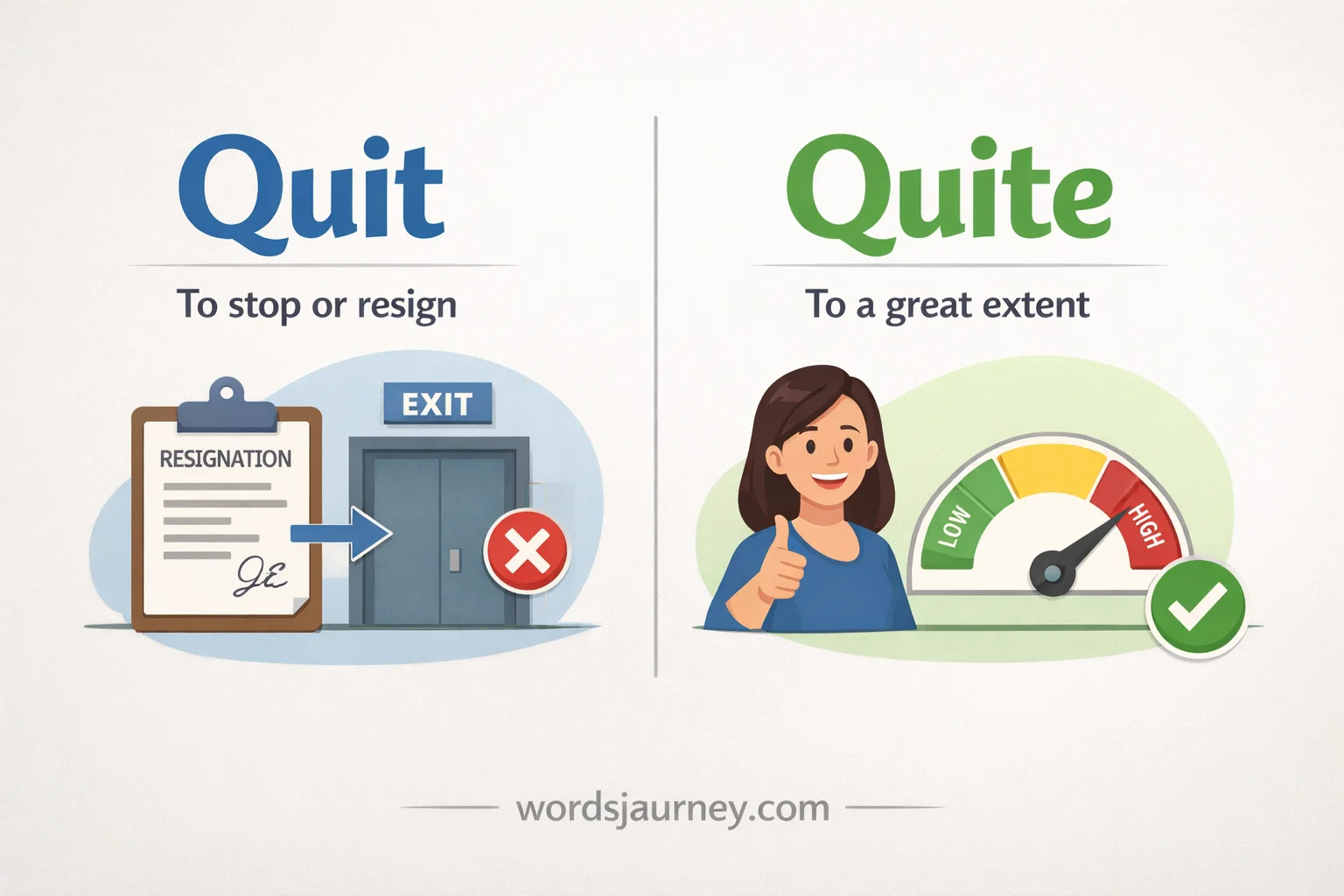
Have you ever paused mid-sentence, unsure whether quit or quite is the right choice? You’re not alone.
This tiny spelling swap causes big confusion, especially in professional contexts. Understanding “Quit or Quite” matters more than people realize because one wrong word can flip your meaning completely and quietly hurt your credibility.
In this article, you’ll learn the clear, practical difference between quit and quite, with examples rooted in real-world English usage. We’ll show how these words affect business communication, formal writing, and everyday workflows like scheduling, meetings, and project management.
Whether you’re writing emails, managing a calendar, handling online booking, or working in broadcasting, precision keeps your message sharp and consistent.
We’ll also touch on grammar rules, style guides, and light US vs. UK preferences to add clarity where people often hesitate. Expect simple explanations, memory tips, and usage patterns that promote consistency and strong time management habits.
By the end, you’ll know exactly when to use quit or quite and why getting it right makes your writing sound confident, polished, and professional.
Quick Answer: Quit vs Quite
Sometimes you just need a fast reference. Here’s a simple comparison to help you remember the difference instantly:
| Word | Part of Speech | Meaning | Common Use |
| Quit | Verb | To stop, leave, or give up | Quit a job, quit smoking |
| Quite | Adverb | To a degree, fairly, or completely | Quite good, quite sure |
Key takeaway: Quit describes an action, something you do. Quite describes the intensity or degree of something.
What Does “Quit” Mean?
Definition of Quit
“Quit” is a verb. It always refers to stopping an activity, leaving a place, or giving up something.
It can be transitive (needs an object) or intransitive (stands alone):
- Transitive: I quit smoking yesterday.
- Intransitive: She decided to quit.
Common Uses of Quit
- Quitting a habit – He quit drinking coffee.
- Leaving a job or role – She quit her job at the law firm.
- Stopping an activity – I quit trying to fix the old laptop.
Grammar Rules for Quit
- The verb “quit” is irregular: present, past, and past participle all stay the same: quit / quit / quit.
- Avoid saying “quitted”. It’s mostly incorrect in modern English.
Real-Life Examples
- I decided to quit my part-time job to focus on school.
- He quit smoking after ten years.
- They quit the game halfway through.
These examples show action, choice, and finality, all of which “quit” conveys.
What Does “Quite” Mean?
Definition of Quite
“Quite” is an adverb. It modifies adjectives, other adverbs, or sometimes verbs, to indicate degree, completeness, or emphasis.
Its meaning can shift depending on context:
- Quite good = fairly good (moderate)
- Quite amazing = completely amazing (strong emphasis)
American and British English also treat “quite” differently. In British English, it can mean somewhat or rather, while in American English it often intensifies: quite incredible = very incredible.
Different Meanings of Quite
- Fairly or somewhat – The movie was quite interesting.
- Completely or entirely – She is quite sure about her answer.
- Informal emphasis – That was quite a party!
Grammar Rules for Quite
- Usually placed before adjectives or adverbs: quite happy, quite quickly
- Can occasionally modify verbs: I quite agree with you
Real-Life Examples
- I’m quite tired after the long trip.
- This book is quite amazing; you should read it.
- He’s quite certain he locked the door.
Notice how “quite” shapes meaning subtly, giving nuance to sentences.
Also Read: Kurt or Curt How to Use Correctly
Quit vs Quite: Side-by-Side Comparison
Here’s a quick visual to reinforce the difference:
| Feature | Quit | Quite |
| Word Type | Verb | Adverb |
| Function | Action | Modifier |
| Can End a Sentence? | Yes | Rarely |
| Indicates Action? | Yes | No |
Tip: If it’s something you do, it’s quit. If it describes the intensity or extent of something, it’s quite.
Why “Quit or Quite” Is a Common Mistake
- Identical pronunciation – spoken words can’t show the difference.
- Autocorrect often doesn’t flag context errors.
- ESL confusion – learners mix these easily.
- Typing fast – the human brain sometimes picks the wrong spelling.
Even small mistakes can subtly impact credibility, especially in professional or academic writing.
How to Remember the Difference
Memory tricks make retention easier:
- Quit = Exit – both imply stopping or leaving.
- Quite = Quiet intensity – emphasizes degree, not action.
- Letter-count trick – quit is short, action-focused; quite has an extra ‘e’, just like it adds emphasis.
- Context check method – if the sentence makes sense with stop, it’s quit. If it measures intensity, it’s quite.
Common Sentences People Get Wrong (And the Fix)
- ❌ I quite my job yesterday.
✅ I quit my job yesterday. - ❌ I’m quit tired after running.
✅ I’m quite tired after running. - ❌ She quite smoking last month.
✅ She quit smoking last month.
These examples show how one letter changes everything. Always pause and consider whether it’s an action or a degree.
Also Read: Kurt or Curt How to Use Correctly
Quit or Quite in Professional Writing
In professional contexts, mistakes are more noticeable:
- Emails: “I quite my position” looks careless.
- Resumes: Using quite instead of quit undermines clarity.
- Reports & proposals: Precision matters; one wrong word can confuse readers.
Even subtle errors reduce trust and professionalism.
Regional and Style Considerations
- In American English, “quite” usually strengthens meaning.
- In British English, it may soften meaning: quite good = somewhat good.
- Overusing “quite” in casual writing can sound old-fashioned or formal.
- Knowing your audience is key to tone and clarity.
Practice Section: Choose Quit or Quite
Fill in the blanks:
- I decided to ___ my job last week.
- This cake is ___ delicious!
- He ___ finished his homework before dinner.
- I’m ___ sure I left my keys here.
Answers: 1. quit | 2. quite | 3. quit | 4. quite
Practicing like this builds automatic recognition for daily writing.
FAQs About “Quit or Quite”
1. What is the difference between “quit” and “quite”?
Quit is a verb meaning to stop doing something, while quite is an adverb used to emphasize or modify adjectives and other adverbs. For example:
- I decided to quit my job.
- She was quite surprised by the announcement.
2. Can “quite” ever replace “quit”?
No. Quite and quit serve completely different functions in English. Using them interchangeably is grammatically incorrect and can confuse readers, especially in business communication or formal writing.
3. Is “quit” used differently in US vs UK English?
Usage of quit is generally consistent across US and UK English, though Americans may say “quit smoking,” while British English sometimes prefers “give up smoking.” Quite, on the other hand, has subtle regional differences in intensity—stronger in the UK than in the US.
4. How can I remember the difference between “quit” and “quite”?
Think of quit as an action: you stop something. Think of quite as a qualifier: it describes intensity or degree. Linking the words to real-life tasks like calendar management or project deadlines can also reinforce memory through context.
5. Does using the wrong word affect professional writing?
Absolutely. Misusing quit and quite can undermine clarity in emails, scheduling notes, online booking confirmations, or broadcasting scripts. Correct usage demonstrates attention to detail and strengthens formal writing consistency.
Conclusion
Understanding the difference between quit and quite is essential for clear, professional communication. Quit drives action, signaling stopping or leaving, while quite refines meaning, emphasizing and qualifying statements. Mastering these small words enhances not only English usage but also time management, project management, and overall business communication.
By keeping regional preferences and style guides in mind, and applying these words in everyday contexts like meetings, calendars, or online scheduling, you can write confidently and accurately. Remember: clarity and precision in language reflect professionalism, and knowing when to use quit or quite is a small step with a big impact.

Emma Brook is a dedicated writer and language enthusiast at WordsJourney. She’s passionate about helping readers understand words better and use them with confidence in everyday conversations. Her work focuses on alternative phrases, clear meanings, and practical examples that make language feel simple and approachable.
With a friendly, reader-first writing style, Emma breaks down common expressions and explores smarter ways to say things without sounding forced or complicated. Her goal is to make learning words enjoyable, useful, and easy for everyone.