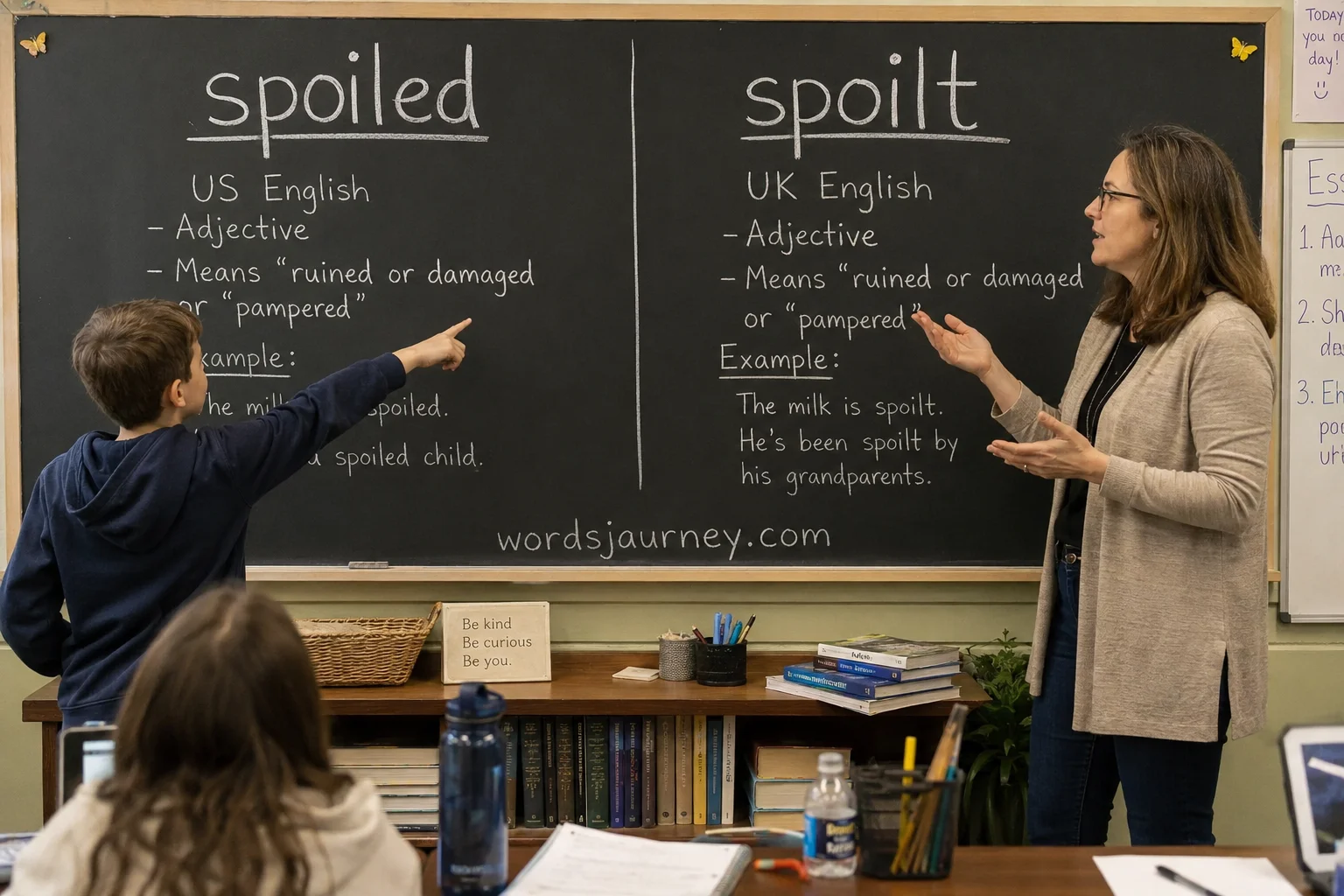
Spoilt vs Spoiled often creates confusion among learners, students, and writers, mainly because regional usage, British English, and American English influence how each form is applied in grammar and writing. In real editorial practice, even experienced editors and professional writers sometimes debate these forms during projects, especially when switching between contexts, styles, and audiences.
A simple example like a spoiled child at Christmas can easily trigger misunderstanding and correction issues, showing how both forms appear in real usage. However, there is no single universal rule, so skilled writers must rely on context, clarity, and purpose. Adapting to the right form improves confidence, grammar accuracy, and polished writing, ensuring your content feels natural, correct, and professional in every situation.
Spoilt vs Spoiled: Why This Confusion Even Exists
English doesn’t always play fair with spelling rules. It evolved from multiple languages including Old English, French, and Latin. Because of that mix, some verbs developed two accepted past forms.
The word “spoil” is one of them.
Over time:
- American English leaned toward regular verb endings like -ed
- British English kept some older irregular forms like -t endings
That’s where spoiled vs spoilt comes from.
Both are correct. The difference is regional preference, not grammar error.
Think of it like two accents saying the same word differently. The meaning stays identical. Only the style changes.
Understanding the Base Word: Spoil
Before comparing forms, you need to understand the root verb.
Meaning of “spoil”
The verb spoil means:
- To ruin something
- To damage something
- To overindulge someone (usually a child)
Simple examples
- Heat can spoil milk quickly.
- Too much attention can spoil a child.
- One mistake can spoil the entire plan.
Spoiled Explained: The American English Standard
In modern American English, the dominant form is “spoiled.”
It follows the regular verb pattern:
spoil → spoiled → spoiled
Common uses of “spoiled”
- The food spoiled overnight in the fridge.
- He spoiled the surprise by talking too much.
- The rain spoiled our picnic plans.
Why American English prefers “spoiled”
American English generally standardizes verbs into predictable patterns. That means:
- Walk → walked
- Call → called
- Spoil → spoiled
This makes learning easier and writing more consistent.
Spoilt Explained: The British English Variant
In British English, both “spoilt” and “spoiled” exist. However, “spoilt” appears more frequently in traditional writing and speech.
Examples of “spoilt”
- The heat spoilt the food before lunch.
- She is a spoilt child who always gets her way.
- The rain spoilt the football match.
Why British English keeps “spoilt”
British English retains some older verb forms that ended in -t instead of -ed. This comes from historical spelling patterns in Middle English.
You’ll still see both forms in UK publications, but “spoilt” feels slightly more traditional or stylistically British.
Spoiled vs Spoilt: Key Differences at a Glance
Let’s make this crystal clear.
| Feature | Spoiled | Spoilt |
| Region | American English | British English |
| Modern usage | More common globally | Less common but still valid |
| Style | Regular verb form | Traditional form |
| Tone | Neutral, modern | Slightly old-fashioned in some contexts |
| Acceptance | Universally accepted | Regionally preferred |
The meaning never changes. Only the spelling preference does.
Which One Should You Actually Use Today?
This is where most writers overthink it.
Here’s the practical answer:
Use “spoiled” if:
- You write for global audiences
- You target US readers
- You write SEO content
- You want consistency across platforms
Use “spoilt” if:
- You specifically target UK audiences
- You follow British editorial style guides
- You want a traditional British tone
Real-world writing tip
Most modern digital content sticks with “spoiled.”
Why? Because it performs better globally in search engines and avoids regional confusion.
Verb Forms of “Spoil” You Should Know
Understanding the full verb structure helps lock everything in place.
| Form | Word |
| Base form | spoil |
| Present participle | spoiling |
| Past tense | spoiled / spoilt |
| Past participle | spoiled / spoilt |
Examples in action
- I spoil my dog too much.
- I am spoiling my dinner appetite.
- I spoiled the cake recipe.
- The cake was spoiled by heat.
Once you see the pattern, it becomes second nature.
Spoiled vs Spoilt in Real Contexts
Grammar rules matter, but context shapes meaning in real writing.
Food context
- American: The milk spoiled after two days.
- British: The milk spoilt after two days.
Behavior context
- American: He is a spoiled teenager.
- British: He is a spoilt teenager.
Emotional tone
“Spoiled child” often carries a negative judgment. It suggests overindulgence that leads to bad behavior.
In contrast, “spoiled food” is neutral and factual.
Context decides tone more than spelling does.
Common Mistakes Writers Make
Even experienced writers slip up here.
Mistake 1: Mixing US and UK spelling
Switching between “spoiled” and “spoilt” in the same article looks inconsistent.
Mistake 2: Thinking one is wrong
Neither form is incorrect. They are regional variations.
Mistake 3: Overcorrecting British usage
Some writers force “spoiled” everywhere, even in UK-focused content. That can feel unnatural.
Mistake 4: Ignoring audience
Choosing spelling without thinking about readers weakens clarity.
Style Guide Differences You Should Know
Different editorial systems handle this differently.
| Style Guide | Preferred Form |
| AP Style (US media) | Spoiled |
| Oxford Style (UK academic) | Spoilt / spoiled both allowed |
| Cambridge | Region-dependent usage |
| Chicago Manual of Style | Spoiled (US preference) |
Case Study: How Spelling Choice Impacts Content Reach
Let’s look at a simple publishing scenario.
Scenario
A food blog writes an article about milk storage.
Version A uses “spoiled”
- Targets US + global readers
- Appears in broader search results
- Higher overall traffic potential
Version B uses “spoilt”
- Performs better in UK-only searches
- Limited global visibility
Result
Version A typically gains wider reach because of global keyword alignment.
This doesn’t mean “spoilt” is wrong. It just has a narrower audience footprint online.
Read More: Fair vs Good Difference: Why It Matters More Than You Think
Memory Tricks to Never Confuse Them Again
Here’s a simple way to lock it in.
- Spoiled = American = Extra “E” for efficiency
- Spoilt = British = Traditional “t” ending
Or think of it like this:
“America modernized it, Britain preserved it.”
Simple. Sticky. Easy to recall.
FAQs on Spoilt vs Spoiled
1. What is the difference between spoilt and spoiled?
Both words have the same meaning, but spoiled is more common in American English, while spoilt is often used in British English.
2. Is spoilt correct English?
Yes, spoilt is correct, especially in British English and some other varieties of English outside North America.
3. Is spoiled American or British?
Spoiled is mainly used in American and Canadian English, but it is also accepted in other English forms.
4. Can spoiled and spoilt be used interchangeably?
Yes, both are correct, but usage depends on region, style, and context.
5. Which form is more formal?
Both are formal, but spoiled is more widely accepted in modern global writing.
6. What does spoiled mean in grammar?
It is the past tense and past participle of spoil, meaning something has been ruined or damaged.
7. Why do British and American English differ here?
The difference comes from regional language evolution and usage traditions.
8. Is spoiled milk correct or spoilt milk?
Both are correct, but spoiled milk is more common in American English, while spoilt milk is used in British English.
9. Which one should I use in exams?
Use the form based on the English style (British or American) your exam follows.
10. Does meaning change between spoilt and spoiled?
No, the meaning stays the same, only usage and preference differ.
Conclusion
The difference between spoilt vs spoiled is not about correctness but about regional usage and writing style. Both forms are grammatically valid and widely used across English varieties. Choosing the right one depends on your audience, context, and English standard you are following. Understanding this small difference helps improve clarity, grammar accuracy, and professional writing quality, making your communication more natural and polished.

Emma Brook is a dedicated writer and language enthusiast at WordsJourney. She’s passionate about helping readers understand words better and use them with confidence in everyday conversations. Her work focuses on alternative phrases, clear meanings, and practical examples that make language feel simple and approachable.
With a friendly, reader-first writing style, Emma breaks down common expressions and explores smarter ways to say things without sounding forced or complicated. Her goal is to make learning words enjoyable, useful, and easy for everyone.