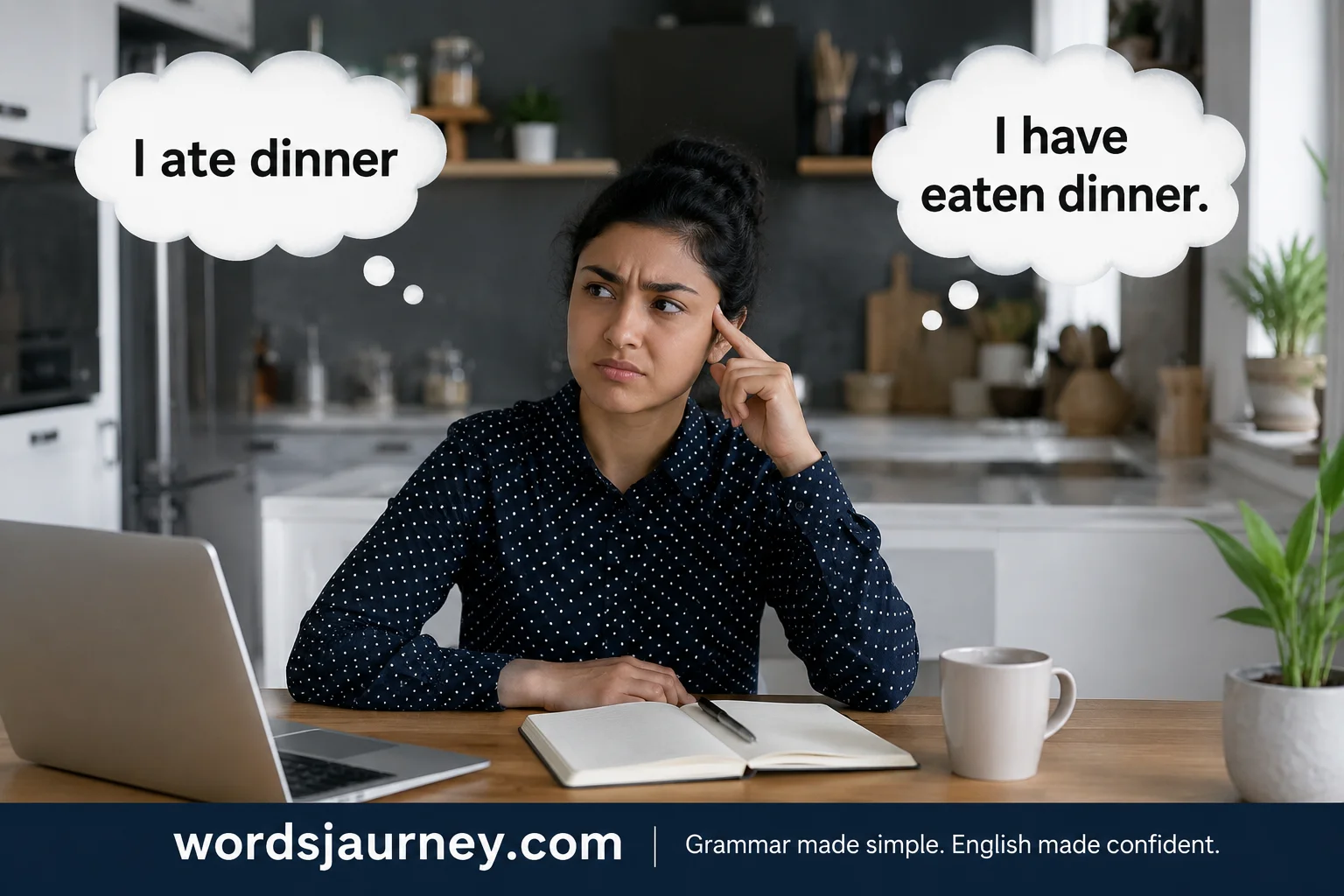
When you search When to Use “Eaten” or “Ate” (With Examples), the confusion usually starts in real life, like a picture of a dinner story with pasta, friends, and food shared at a table experience.
When you actually use English in daily talk, the difference between ate and eaten shows up naturally in simple past tense English, especially during conversation about food and experience.
Real-Life Grammar, Experience, and Clear Understanding
In everyday English, people share lunch, talk in conversation, or give detail about delicious food, but the difference between forms often creates doubt when speaking.
You might speak about an earlier day and start describing what you received, but still feel unsure. That’s normal because learners, even fluent speakers, find it tricky.
Sometimes you turn, wash dishes, or do something big after eating, and the mind still makes grammar feel small or unclear. But once you get the rule, it feels right and easy to remember.
In grammar terms, eat is the base verb, ate is simple past, and eaten is the past participle. This is where auxiliary verbs like have or has come in, forming perfect tenses that indicate a completed action at a specific time or unknown point.
For example, pizza at night, or eating activities in a week, like three times last week, show how usage changes. You might say “I ate” for a finished action, but “I have eaten” when focusing on experience, not time.
Even native speakers sometimes stumble, especially when they try to explain a grammatical situation in real conversation. But with practice, you naturally know exactly when and why to use each form, and your speech becomes clearly and correctly understood.
The key is simple: memorization is not enough. Understanding rules, grammar, language forms, negation, contraction, and context helps you use English correctly in real life.
Why You Keep Mixing Up “Ate” and “Eaten”
Here’s the core problem: both ate and eaten come from the same verb—eat. They look similar. They sound familiar. But they don’t behave the same way.
Think of them like tools:
- Ate works alone
- Eaten needs help
That’s it. But most grammar guides bury this idea under complex terminology. So you memorize rules instead of understanding patterns.
Let’s fix that.
Quick Answer: Ate vs Eaten Rule
If you remember nothing else, remember this:
- Use “ate” for the past
- Use “eaten” with helping verbs (have, has, had)
Examples
- I ate lunch ✔
- I have eaten lunch ✔
- I have ate lunch ❌
Short. Simple. Reliable.
What Does “Ate” Mean?
Ate is the simple past tense of the verb “eat.”
That means it describes something that already happened. Done. Finished. No connection to the present.
Structure
Subject + ate + object
Examples
- I ate breakfast at 8 AM
- She ate the last cookie
- They ate before leaving
Each sentence points to a completed action in the past.
Visual Timeline (Simple Past)
Past ———– Present ———– Future
(ate happens here)
Once the action ends, you use ate.
When You Should Use “Ate”
Use ate when:
- The time is clearly in the past
- The action is finished
- You don’t need a helping verb
Examples with Time Clues
- I ate dinner yesterday
- We ate at that restaurant last week
- He ate too much earlier
Notice the time markers—yesterday, last week, earlier. They anchor the action in the past.
What Does “Eaten” Mean?
Now let’s talk about eaten.
This is where most people get confused.
Eaten is the past participle of “eat.” That sounds technical. But here’s the practical truth:
“Eaten” cannot stand alone. It always needs a helping verb.
Helping Verbs You’ll See
- have
- has
- had
Structure
Subject + helping verb + eaten
Examples
- I have eaten already
- She has eaten too much
- They had eaten before we arrived
Each sentence uses a helper verb. Without it, the sentence breaks.
Why “Eaten” Needs Help
Think of eaten like a plug. It needs a socket to work.
- ❌ I eaten lunch
- ✔ I have eaten lunch
Without the helper, the sentence feels incomplete. Because it is.
Timeline View (Perfect Tenses)
Past ———– Present ———– Future
(action happened) → (connected to now)
have eaten
The key difference?
“Eaten” connects past actions to the present.
The Core Rule You Should Never Forget
Let’s lock this in.
| Tense Type | Word to Use | Example |
| Simple past | ate | I ate dinner |
| Perfect tenses | eaten | I have eaten dinner |
Memory Trick
If you see have, has, or had → use “eaten”
No helper? Use ate.
Ate vs Eaten in Real Sentences
This is where things click.
Compare These
| Incorrect ❌ | Correct ✔ | Why It Works |
| I have ate | I have eaten | Needs participle |
| She has ate | She has eaten | Helper verb used |
| I eaten lunch | I have eaten lunch | Missing helper |
| Yesterday I eaten rice | Yesterday I ate rice | Simple past needed |
Real-Life Example
Imagine a conversation:
“Did you eat?”
“Yeah, I ate earlier.”
Now compare:
“Have you eaten?”
“Yes, I’ve eaten.”
Different structure. Different purpose.
Please read: Minuet vs Minute: Meaning, Pronunciation and Usage Explained
Common Mistakes You Should Avoid
Let’s clean up the errors you’ll see everywhere.
Mixing Forms Incorrectly
- ❌ I have ate
- ✔ I have eaten
Dropping the Helping Verb
- ❌ I eaten already
- ✔ I have eaten already
Using “Eaten” for Simple Past
- ❌ I eaten dinner yesterday
- ✔ I ate dinner yesterday
Quick Fix Rule
If your sentence sounds awkward, check:
- Do you have have/has/had? → Use eaten
- No helper? → Use ate
Verb Forms of “Eat”
You’ll use this often.
| Form | Word | Example |
| Base form | eat | I eat daily |
| Past tense | ate | I ate yesterday |
| Past participle | eaten | I have eaten |
Pro Tip
Many irregular verbs follow this pattern:
- eat → ate → eaten
- go → went → gone
- see → saw → seen
Once you recognize the pattern, grammar gets easier.
When Native Speakers Use “Ate” vs “Eaten” Naturally
Here’s something most grammar guides miss:
real-world usage matters.
Casual Speech
- “I already ate.”
- “We ate before coming.”
Simple. Direct. Very common.
Slightly More Formal or Precise
- “I’ve eaten already.”
- “She has eaten too much.”
You’ll hear this more in:
- Writing
- Formal conversations
- Professional settings
Key Insight
Native speakers often prefer shorter forms in casual speech.
But both are correct when used properly.
Case Study: How One Small Mistake Changes Meaning
Let’s look at a real scenario.
Situation
You’re at a dinner invitation.
Wrong Response
“I have ate already.”
This sounds unnatural. It signals a grammar mistake.
Correct Options
- “I ate already.” (casual)
- “I’ve eaten already.” (neutral/formal)
Both work. The tone changes slightly.
Why This Matters
Small grammar mistakes can:
- Affect clarity
- Impact credibility
- Change how others perceive your fluency
Mini Practice Section
Try these.
Fill in the blanks
- I have ___ (ate/eaten) dinner
- She ___ (ate/eaten) late
- They had ___ (ate/eaten) before we arrived
- Yesterday, I ___ (ate/eaten) rice
Answers
- eaten
- ate
- eaten
- ate
Quick Recap
Let’s simplify everything again.
- Ate = simple past
- Eaten = needs helping verb
One-Line Rule
No helping verb? Use ate.
FAQs
1. What is the difference between “ate” and “eaten”?
Ate is the simple past tense and used for finished actions. Eaten is the past participle and used with have/has in perfect tenses.
2. When should I use “I ate”?
Use “I ate” when you talk about a specific time in the past, like “I ate pizza last night.”
3. When do we use “have eaten”?
Use “have eaten” when the exact time is not important, but the experience matters.
4. Is “She hasn’t ate yet” correct?
No, it is incorrect. The correct form is “She hasn’t eaten yet.”
5. Why do people confuse ate and eaten?
They come from the same verb eat, but follow different grammar rules and tenses, which causes confusion.
6. Is “eaten” always used with helping verbs?
Yes, eaten is usually used with auxiliary verbs like has, have, or had.
7. How can I remember the difference easily?
Think of it this way: ate = finished past action, eaten = experience or perfect tense form.
Conclusion
Understanding “ate” and “eaten” becomes simple once you connect them to real usage. Ate works for completed actions in the past, while eaten appears in perfect tenses with helping verbs. Instead of memorizing rules, focus on real-life sentences and daily conversation. With practice, you will naturally choose the correct form and speak more confidently in English.
Thanks for reading this article. Please stay updated for more knowledge and updatedes.

Aliya Ray is a passionate writer and language enthusiast at WordsJourney. She enjoys exploring words, phrases, and everyday expressions to help readers communicate more clearly and confidently. Her content focuses on alternative ways to say common phrases, simple explanations, and real-life examples that make language easy to understand.
Aliya believes the right words can make any message stronger. Through clear, friendly writing, she helps readers improve their vocabulary without feeling overwhelmed or confused.