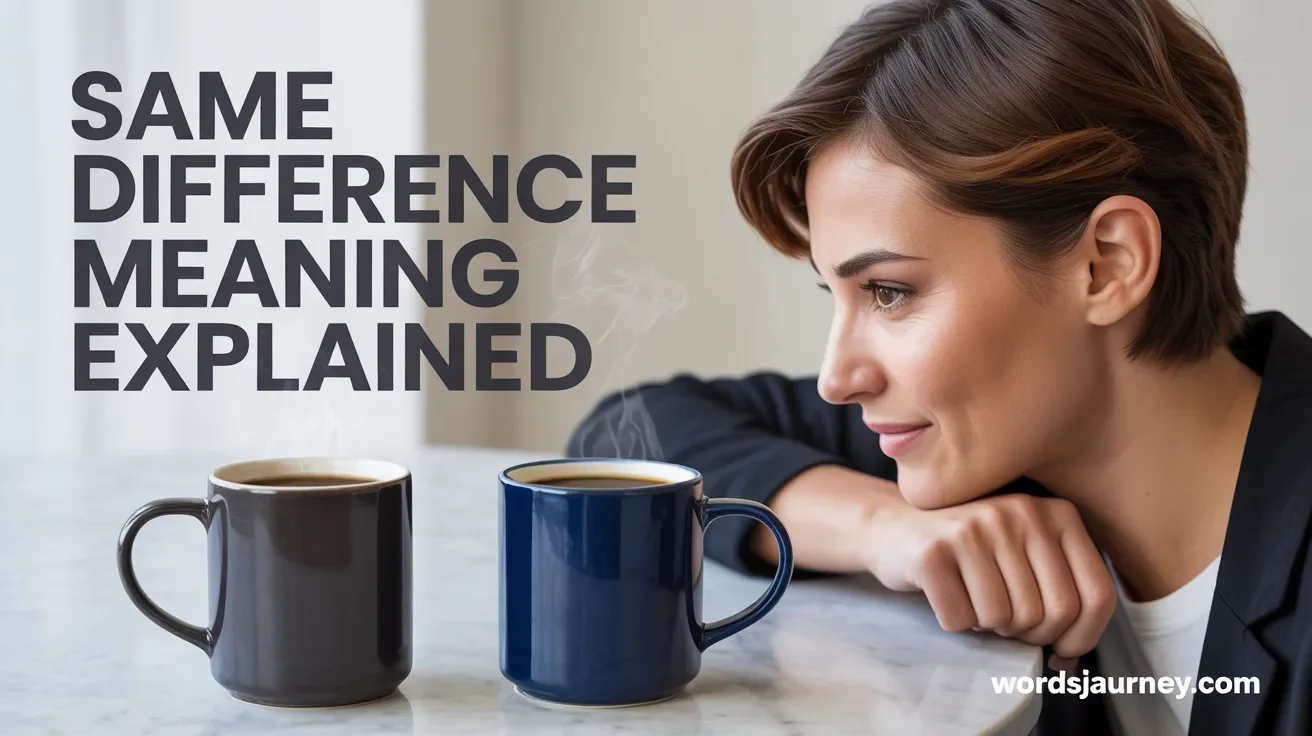
What Does Same Difference Mean? is an informal phrase used in everyday English when two things are essentially the same, even if they look slightly different at first glance. It is a way of saying that the difference between two options is so small that it does not really matter in real life conversations.
In simple use, people say “same difference” when two things appear different but function or meaning stays the same. For example, when people are arguing about a shade of blue, like sky blue or robin’s egg blue, someone might step in and say “same difference” to show that the exact name or small variation is not important.
This idiom highlights minor distinctions that are not significant, even though they are described in different ways.
In my opinion, this is why it feels both annoying and useful at the same time because it can sound like a junk phrase, but it actually reflects how people simplify communication in real conversations.
Some speakers justify it by saying it is akin to “same thing”, where the focus is not on strict logic but on practical meaning. From a linguistic point of view, it may sound like a contradiction since “same” and “difference” technically oppose each other, but in real usage it survives because language is shaped by colloquial expression, not just grammar rules.
What Does “Same Difference” Mean?
At its core, “same difference” means two things are essentially the same, even if they’re technically different.
It’s a way of saying:
“The difference doesn’t matter.”
Simple idea. Slightly confusing wording.
Clear Definition
Same Difference (idiom):
A casual expression used to say that two options, situations, or outcomes are practically identical in effect.
Quick Examples
- “It’s 10 minutes or 12 minutes—same difference.”
- “Blue shirt or black shirt—same difference.”
- “We leave today or tomorrow—same difference.”
In each case, the speaker dismisses the difference as unimportant.
Why It Sounds Contradictory
Let’s break it down:
- Same = identical
- Difference = not identical
So why combine them?
Because English loves irony. This phrase uses contradiction to emphasize a point. It grabs attention. It adds personality.
Think of it like saying:
“Different… but not in any way that matters.”
When and How to Use “Same Difference”
You don’t need a grammar textbook to use this phrase. You need context.
Common Situations Where It Fits Naturally
You’ll hear “same difference” in situations like:
Minor Comparisons
When differences exist but feel trivial.
- Price gaps
- Time variations
- Similar choices
Casual Conversations
Friends chatting. No need for precision.
Dismissive Responses
When someone doesn’t care about the distinction.
Real-Life Usage Examples
Everyday Conversations
- “We can meet at 6 or 6:15—same difference.”
- “It’s just a scratch or a dent—same difference.”
Workplace (Informal Only)
- “Email or Slack message—same difference.”
- “Two slides or three slides—same difference.”
Shopping Situations
- “$49 or $52—same difference.”
- “Brand A or Brand B—same difference.”
How to Use It Correctly
Keep it simple:
- Use it after comparing two things
- Use it when differences don’t matter
- Keep it casual and conversational
Quick Formula
Option A + Option B + “same difference”
Example:
“Taxi or Uber—same difference.”
Tone Matters: Neutral vs Sarcastic Use
Here’s where things get interesting.
“Same difference” can sound friendly or rude depending on the tone.
Neutral Tone
Used when you truly believe the difference doesn’t matter.
- “Tea or coffee—same difference.”
- “Morning or afternoon—same difference.”
This feels relaxed. No hidden meaning.
Sarcastic Tone
Used when you dismiss something slightly or express impatience.
- “Oh, 1 dollar or 10 dollars—same difference.”
- “Late by 5 minutes or 30 minutes—same difference.”
Here’s the twist. The speaker may actually think the difference does matter.
Tone Comparison Table
| Tone | Example Sentence | Real Meaning |
| Neutral | “Train or bus—same difference.” | Both are equally fine |
| Sarcastic | “Yeah, 2 hours or 5 hours—same difference.” | That difference is actually big |
| Dismissive | “It’s fine, same difference.” | Stop worrying about details |
Pro Tip
If you’re unsure, watch facial expressions and voice tone. That’s where the real meaning hides.
Real-Life Examples You’ll Actually Hear
Let’s move beyond theory. This is how real people use it.
Conversation Between Friends
A: “Let’s meet at 7.”
B: “Make it 7:10.”
A: “Yeah, same difference.”
At a Store
Customer: “This one is $20 and that one is $22.”
Friend: “Same difference. Just pick one.”
In Daily Life
- “Walk or drive—it’s close. Same difference.”
- “Call me or text me—same difference.”
Texting Example
“Pizza or burgers? Same difference 😂”
Notice the emoji. That reinforces a relaxed tone.
Case Study: How “Same Difference” Works in Real Conversations
Let’s break down a real-world scenario.
Scenario: Planning a Trip
Two friends discuss travel plans.
Friend 1: “Should we leave Friday night or Saturday morning?”
Friend 2: “Same difference. We’ll reach by noon anyway.”
What’s Happening Here
- Two options exist
- Both lead to similar outcomes
- The speaker dismisses the difference
Key Insight
The phrase helps simplify decisions.
It removes overthinking. It speeds up conversations.
Common Mistakes and Misunderstandings
Even native speakers misuse this phrase sometimes.
Let’s clear that up.
Mistake: Thinking It Means “Exactly the Same”
Wrong.
It doesn’t mean identical. It means effectively similar.
Mistake: Using It in Formal Writing
Avoid it in:
- Business reports
- Academic essays
- Professional emails
Mistake: Ignoring Tone
You might sound rude without realizing it.
Correct vs Incorrect Usage
| Incorrect Use | Why It’s Wrong | Better Alternative |
| Formal email | Too casual | “The difference is negligible.” |
| Academic paper | Lacks precision | “There is no significant variation.” |
| Sensitive discussion | Can sound dismissive | “I understand the difference, but…” |
Better Alternatives
- “No significant difference”
- “Practically the same”
- “Minimal variation”
Similar Idioms and Expressions
English offers several alternatives with similar meaning.
Each carries a slightly different flavor.
Common Alternatives
Six of One, Half a Dozen of the Other
- Meaning: Two options are equal
- Tone: Informal
It Makes No Difference
- Meaning: Outcome stays the same
- Tone: Neutral
Tomayto, Tomahto
- Meaning: Same thing, different expression
- Tone: Playful
Comparison Table
| Expression | Meaning | Tone |
| Same difference | Differences don’t matter | Casual |
| Six of one, half a dozen… | Both options equal | Informal |
| It makes no difference | No impact either way | Neutral |
| Tomayto, tomahto | Same thing, different wording | Playful |
When to Choose Which
- Use “same difference” in casual talk
- Use “no significant difference” in formal writing
- Use “six of one…” for emphasis
Origin of “Same Difference”
You won’t find a single exact origin story. Still, language experts trace it back to 20th-century American English.
How It Likely Developed
- Built from ironic phrasing
- Used for emphasis in casual speech
- Spread through everyday conversation
Why It Stuck
Because it’s:
- Short
- Memorable
- Slightly humorous
Language tends to keep what feels natural.
When NOT to Use “Same Difference”
This part matters more than you think.
Avoid It in Formal Situations
Skip it in:
- Job applications
- Business emails
- Academic work
It sounds too relaxed.
Read More: Unalienable vs. Inalienable: The Difference, why It Still Matters?
Avoid It in Sensitive Conversations
Example:
- Talking about money differences
- Discussing serious issues
It may sound dismissive or careless.
Avoid It When Precision Matters
If accuracy matters, don’t oversimplify.
Quick Guide
| Situation | Use It? |
| Casual conversation | Yes |
| Professional setting | No |
| Friendly debate | Yes |
| Serious discussion | No |
Quick Usage Cheat Sheet
Here’s a fast reference you can remember.
Use “Same Difference” When:
- Differences are minor
- You want to simplify things
- You’re speaking casually
Avoid It When:
- Writing formally
- Accuracy matters
- Tone could offend
Mini Checklist
Ask yourself:
- Does the difference matter?
- Am I speaking casually?
- Could this sound dismissive?
If all checks pass, go ahead.
Practical Examples for Better Understanding
Let’s take it one step further.
Example Set 1: Time
- “5 minutes or 7 minutes—same difference.”
- “2 hours or 3 hours—NOT the same difference.”
Example Set 2: Money
- “$10 or $12—same difference.”
- “$10 or $100—definitely not the same difference.”
Example Set 3: Choices
- “Tea or coffee—same difference.”
- “Water or soda—not always the same difference.”
Key Takeaway
Context decides everything.
Quotes That Capture the Spirit
“Sometimes, the difference exists only on paper.”
“What matters isn’t the difference, it’s the outcome.”
Why “Same Difference” Still Matters Today
Language evolves. Yet some phrases stick.
“Same difference” survives because it solves a real problem.
People overthink small choices. This phrase cuts through that noise.
It says:
“Relax. It doesn’t matter that much.”
Modern Usage Trends
- Common in texting
- Popular in casual speech
- Rare in formal writing
Why You Should Learn It
Because it helps you:
- Sound natural in English
- Understand native speakers
- Communicate more efficiently
FAQs on “Same Difference”
1. What does “same difference” mean in simple English?
It means two things are so similar that the difference between them does not matter in practical conversation.
2. Is “same difference” grammatically correct?
Yes, it is grammatically understandable, but it is considered informal and non-standard English rather than formal writing.
3. Why do people say “same difference”?
People use it to dismiss small or unimportant differences between two options during casual conversation.
4. Is “same difference” an oxymoron?
Yes, it can be seen as an oxymoronic phrase because “same” and “difference” contradict each other, but it still works as an idiom in context.
5. Is “same difference” rude to use?
Not usually, but it can sound slightly dismissive or sarcastic, depending on tone and situation.
6. Can “same difference” be used in formal writing?
No, it is better to avoid it in academic or professional writing and use clearer phrases like “no real difference.”
7. What is a better alternative to “same difference”?
You can say:
- “It doesn’t really matter”
- “They are basically the same”
- “There is no meaningful difference”
Conclusion
The phrase “same difference” is a colloquial idiom that reflects how people simplify communication in everyday speech. Even though it looks like a logical contradiction, it survives because language is not always about strict rules but about meaning in context. It is used to show that small differences are not important enough to change the outcome of a decision or opinion.

Johnson Alex is a language-focused writer and the voice behind WordsJourney. He creates practical, easy-to-understand content that helps readers improve their vocabulary and express ideas with clarity and confidence.