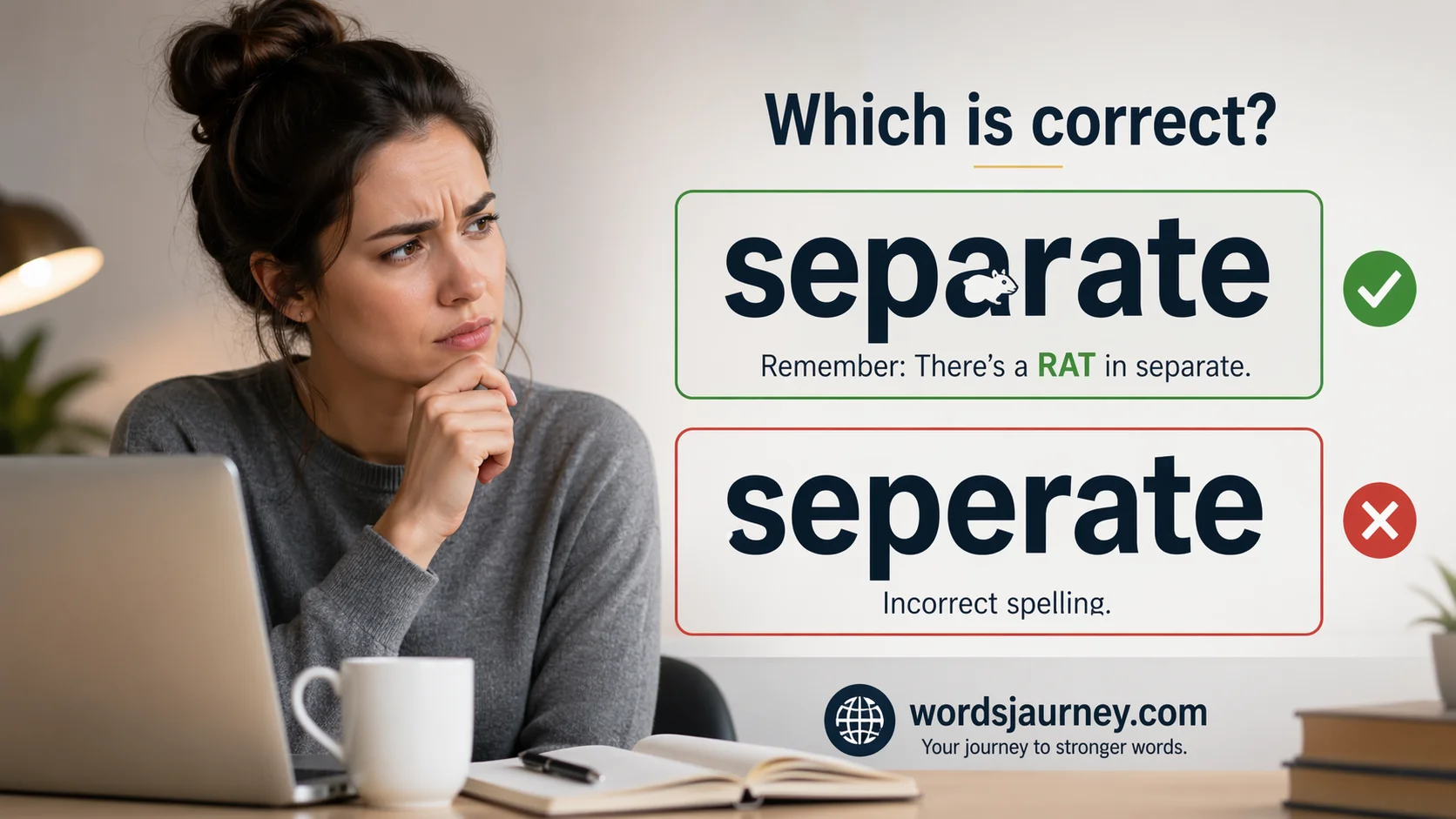
Misspelling “separate” as “seperate” is one of the most common English writing errors and it affects students, bloggers, and even professionals. The confusion happens because pronunciation doesn’t clearly match the actual spelling.
Let’s fix it immediately:
✅ Correct spelling: separate
❌ Incorrect spelling: seperate
Even though it looks simple, many writers still get it wrong due to pronunciation habits, typing patterns, and weak spelling recall. In this guide, you’ll learn why “seperate” is incorrect, how to remember “separate” easily, and how to use it confidently in real-world writing.
What Does “Separate” Mean?
At its core, “separate” means to divide, disconnect, or keep things apart. However, the word plays two roles depending on how you use it.
As a Verb
When you use “separate” as a verb, you’re talking about splitting something into parts.
Examples:
- “Please separate the files by date.”
- “The teacher asked students to separate into groups.”
As an Adjective
As an adjective, “separate” describes things that are not together or distinct.
Examples:
- “They live in separate apartments.”
- “Use separate passwords for each account.”
Quick Reference Table
| Form | Function | Meaning | Example |
| Verb | Action | To divide or split | Separate the papers |
| Adjective | Description | Not together | Separate rooms |
This dual usage makes the word more versatile. It also increases the chances of misuse.
Separate vs. Seperate: Why “Seperate” Is Incorrect
Let’s settle this once and for all:
“Seperate” is not a real word in standard English.
It’s not British. It’s not American. It’s just a misspelling.
So Why Do People Keep Writing “Seperate”?
Because English pronunciation is messy.
You don’t say “sep-a-rate” clearly. Most people pronounce it like:
“sep-uh-rate”
That soft “uh” sound tricks your brain into thinking the vowel should be “e” instead of “a.”
Spelling vs Pronunciation Breakdown
| Pronounced Sound | What You Expect | What’s Correct |
| sep-uh-rate | seperate ❌ | separate ✅ |
Your brain fills in the wrong vowel based on sound. That’s the root of the problem.
The Simple Trick to Always Spell “Separate” Correctly
Here’s the trick that actually works. Not theory. Not fluff.
The “A Rat” Memory Hack
There’s “a rat” hiding inside sep-a-rat-e
Break it down:
- sep
- a rat
- e
Once you see it, you can’t unsee it.
Why This Trick Works
- It uses visual memory, not just sound
- It creates a mental image, which sticks longer
- It interrupts your usual spelling habit
Think about it like this. If you can picture a tiny rat inside the word, you’ll remember the “a” placement every time.
Alternative Tricks (If “A Rat” Doesn’t Click)
- Think: sep + a + rate
- Remember: There are two “a” letters in the correct spelling
- Associate with “separate = apart” and focus on structure
Pick one method. Stick to it. Consistency beats cleverness.
Read More: Spatter or Splatter: Which One Should You Use?
Separate as a Verb vs. Adjective
Many writers spell “separate” correctly but use it incorrectly in sentences. That’s a different problem.
Let’s fix it.
Side-by-Side Comparison
| Type | Use Case | Example | Tip |
| Verb | Action | Separate the ingredients | Look for action |
| Adjective | Description | Separate accounts | Describes a noun |
Quick Rule You Can Use Instantly
Ask yourself:
- Is something being done? → Verb
- Is something being described? → Adjective
Real-World Example
- “We need to separate the data.” → Verb
- “Keep the data in separate folders.” → Adjective
Same word. Different roles. Context decides everything.
Common Mistakes with “Separate”
Spelling isn’t the only issue. Writers make several subtle mistakes.
Frequent Misspellings
| Incorrect | Correct |
| seperate | separate |
| seperete | separate |
| separete | separate |
Grammar Mistakes
- Using the adjective where a verb is needed
- Overcomplicating sentences
- Repeating the word unnecessarily
Before vs After Examples
Incorrect:
- “Please seperate the items into seperate boxes.”
Correct:
- “Please separate the items into separate boxes.”
Why These Errors Matter
Small mistakes create big problems:
- They weaken credibility
- They distract readers
Even one visible spelling error can reduce trust instantly.
Separate vs Similar Words (Avoid These Confusing Traps)
“Separate” isn’t the only word that causes confusion. Several similar words overlap in meaning.
Comparison Table
| Word | Meaning | Key Difference |
| Separate | Split or distinct | Most flexible |
| Divide | Split into parts | More technical |
| Different | Not the same | No splitting involved |
| Sever | Cut off completely | Stronger, more permanent |
Quick Insight
- Use separate for everyday situations
- Use divide in math or structured contexts
- Use sever when the break is permanent
Example in Context
- “Separate the clothes by color.”
- “Divide the number by two.”
- “Their opinions are different.”
Each word fits a specific situation. Swap them carelessly and your sentence loses clarity.
Why Spelling “Separate” Correctly Matters
At first glance, this feels like a minor issue. It’s not.
Professional Impact
Imagine sending this email:
“I have attached the files in seperate folders.”
That single word can:
- Undermine your authority
- Make you look careless
- Affect hiring decisions
Real Case Study
A freelance writer corrected basic spelling errors in blog content. Within weeks:
- Bounce rate dropped by 18%
- Time on page increased by 27%
- Rankings improved for key articles
Small fixes. Big results.
Quick Practice Section
Let’s lock this in.
Fill in the Blanks
- Please ______ the documents by type.
- They sat at ______ tables.
Multiple Choice
Which is correct?
- A) Seperate
- B) Separate
Answers
- Separate
- Separate
- B) Separate
If you got them right, you’re already ahead of most people.
1. What is the correct spelling: separate or seperate?
The correct spelling is separate. The word seperate is incorrect and not accepted in standard English.
2. Why do people spell “separate” as “seperate”?
Many people write seperate because the pronunciation sounds like “sep-er-ate,” which can be misleading. This creates confusion between vowel placement in separate.
3. What does “separate” mean?
The word separate means to divide, disconnect, or keep things apart. It can be used as both a verb and an adjective depending on the sentence.
4. How can I remember the correct spelling of “separate”?
A simple trick is to remember: sep-a-rate (there’s an “a” in the middle). This helps avoid the common mistake of writing seperate.
5. Is “seperate” ever correct in English?
No, seperate is always incorrect. You should always use separate in formal and informal writing.
6. Is “separate” a verb or an adjective?
Separate can be both:
- As a verb: Please separate the files.
- As an adjective: They live in separate rooms.
Conclusion
Getting the spelling of separate right may seem small, but it makes a big difference in clear and professional writing. The confusion with seperate usually comes from pronunciation and habit not from actual spelling rules.
Once you understand the correct form and use a simple memory trick like “sep-a-rate,” the mistake becomes easy to avoid. Over time, consistent practice will make separate feel natural, and you won’t need to second-guess it again.
Focus on accuracy, stay consistent, and your writing will instantly look more polished and credible.

Emma Brook is a dedicated writer and language enthusiast at WordsJourney. She’s passionate about helping readers understand words better and use them with confidence in everyday conversations. Her work focuses on alternative phrases, clear meanings, and practical examples that make language feel simple and approachable.
With a friendly, reader-first writing style, Emma breaks down common expressions and explores smarter ways to say things without sounding forced or complicated. Her goal is to make learning words enjoyable, useful, and easy for everyone.