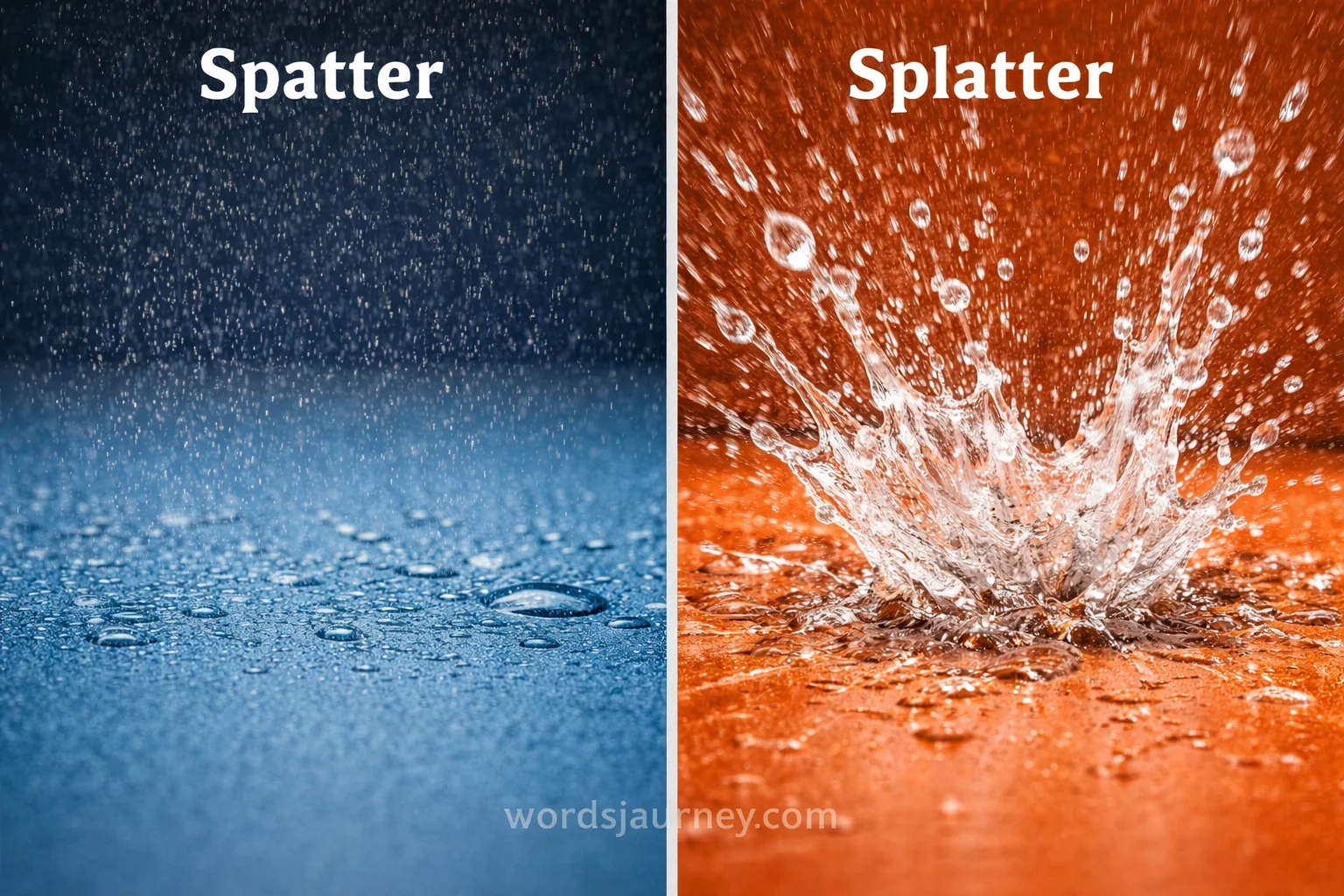
Choosing between “spatter” or “splatter” might look like a tiny grammar decision, but it has a big impact on how your writing is understood. These two commonly confused words create very different mental images for your reader. Whether you’re writing about cooking, rain, paint, or action scenes, using the right word improves both clarity and engagement.
Understanding the difference between “spatter” and “splatter” helps you write with greater clarity and accuracy. “Spatter” usually describes light, controlled droplets, while “splatter” suggests something heavier, more forceful, and messy. Choosing the right word makes your descriptions clearer, more vivid, and easier for readers to imagine.
In this guide, you’ll learn the clear difference between “spatter” and “splatter,” along with simple rules, real examples, and practical tips to use the right word every time.
Spatter or Splatter: Quick Answer You Can Use Immediately
If you’re in a hurry, here’s the simplest way to decide:
- Spatter → small, fine droplets with light force
- Splatter → larger, heavier drops with strong impact
Think of it like this:
- Spatter = subtle
- Splatter = dramatic
That’s the core difference. Everything else builds on it.
What Does “Spatter” Mean?
Spatter describes small droplets scattering lightly across a surface. The motion usually feels controlled or restrained, even when it happens quickly.
You’ll often see it in:
- Scientific writing
- Technical descriptions
- Situations where detail matters
How “Spatter” Feels in Writing
When you use spatter, you’re signaling precision. You’re telling your reader:
“This is happening in a fine, controlled, almost delicate way.”
Examples of “Spatter” in Real Sentences
- Grease spattered lightly across the stovetop.
- Raindrops spattered against the window.
- The artist carefully spattered paint to create texture.
Notice the tone. Nothing feels explosive. The movement stays contained.
Please also Read: “My Father and I” or “My Father and Me” Correct usage
What Does “Splatter” Mean?
Splatter describes larger drops hitting a surface with force, spreading messily. It feels louder, more chaotic, and more visual.
You’ll see it often in:
- Everyday conversation
- Storytelling
- Visual descriptions
How “Splatter” Feels in Writing
When you use splatter, you’re adding intensity. You’re telling your reader:
“This is messy, forceful, and hard to ignore.”
Examples of “Splatter” in Real Sentences
- Mud splattered all over the car.
- Paint splattered across the canvas in bold streaks.
- Sauce splattered everywhere when the pan overheated.
Now the scene feels louder. You can almost hear it.
Spatter vs Splatter: The Real Difference Explained Clearly
Here’s where most articles get vague. Let’s make it concrete.
Side-by-Side Comparison Table
| Feature | Spatter | Splatter |
| Droplet size | Small and fine | Large and uneven |
| Force | Light impact | Strong impact |
| Visual effect | Subtle and controlled | Messy and dramatic |
| Tone | Technical or neutral | Expressive and vivid |
| Common use | Science, cooking, precision | Storytelling, everyday language |
Simple Visual Analogy
Picture two scenarios:
- You flick water gently with your fingers → spatter
- You throw a bucket of water against a wall → splatter
That mental image alone will save you from confusion.
Real-World Examples You’ll Actually Use
Understanding theory helps. Seeing it in action locks it in.
Everyday Situations
- Cooking bacon? Oil spatters
- Driving through mud? It splatters
- Light rain? It spatters
- A dropped smoothie? It splatters
Professional Writing Examples
In product descriptions or blogs, word choice changes tone:
- “The pan prevents oil from spattering.”
- “The crash caused debris to splatter across the road.”
See the shift? One sounds controlled. The other feels intense.
Spatter or Splatter in Different Fields
Context changes everything. Let’s break it down by industry.
Forensic Science: Why “Spatter” Dominates
In forensic science, precision matters more than drama.
Experts use “blood spatter”, not splatter, because:
- It describes droplet size and pattern accurately
- It avoids emotional exaggeration
- It aligns with scientific terminology
Real Case Insight
Investigators analyze:
- Angle of impact
- Velocity of droplets
- Surface interaction
The term “splatter” would introduce ambiguity. That’s why professionals avoid it.
Art and Painting: Controlled vs Expressive
Artists use both terms intentionally.
- Spatter → controlled technique for fine texture
- Splatter → expressive, bold, energetic movement
Case Study: Abstract Art
Think of abstract painters who throw paint onto canvas.
- A careful flick → spatter
- A forceful throw → splatter
The difference changes how viewers interpret the artwork.
Cooking and Kitchen Language
Recipes tend to favor spatter, especially in safety instructions.
Why?
Because:
- It sounds less dramatic
- It focuses on prevention
- It feels practical
Examples
- “Use a lid to prevent oil from spattering.”
- “Hot sauce may splatter if overheated.”
Both appear, but tone guides the choice.
Common Mistakes Writers Make
Even experienced writers mix these up. Here’s where things go wrong.
Mistake #1: Using “Splatter” in Formal Writing
❌ The report analyzed blood splatter patterns.
✔ The report analyzed blood spatter patterns.
Fix: Use spatter for technical accuracy.
Mistake #2: Using “Spatter” for Dramatic Scenes
❌ The explosion caused debris to spatter everywhere.
✔ The explosion caused debris to splatter everywhere.
Fix: Use splatter when impact matters.
Mistake #3: Ignoring Tone
Writers often choose randomly. That weakens clarity.
Better approach:
- Ask yourself: Do I want precision or impact?
- Then pick the word that matches.
A Memory Trick You’ll Never Forget
You don’t need to memorize definitions. Use this instead:
- Spatter = Small + Soft
- Splatter = Splash + Strong
Short. Simple. Effective.
When It Doesn’t Matter Much
Language isn’t always rigid. In casual conversation, people mix these words freely.
Examples
- “The sauce splattered everywhere.”
- “The sauce spattered everywhere.”
Both sound fine to most readers.
So When Should You Care?
You should be precise when:
- Writing professionally
- Creating SEO content
- Explaining technical details
Otherwise, context often carries the meaning.
Deep Dive: Why “Splatter” Feels More Dramatic
Let’s get a bit more nuanced.
The word splatter contains:
- A heavier consonant cluster (“spl-”)
- A sharper ending (“-atter”)
That sound pattern creates a stronger sensory effect.
Linguistic Insight
Words with “spl” often relate to spreading or bursting:
- Splash
- Split
- Spill
That’s why splatter naturally feels more explosive.
Quick Decision Guide
If you ever hesitate, use this checklist:
Choose “Spatter” when:
- Droplets are small
- Movement feels light
- Context is technical
- You want a neutral tone
Choose “Splatter” when:
- Droplets are large
- Impact is strong
- Scene is messy
- You want vivid imagery
Quick Recap You Can Skim in Seconds
- Spatter = small, light, controlled
- Splatter = large, forceful, messy
- Use spatter in technical contexts
- Use splatter for vivid storytelling
- Tone decides everything
Mini Case Studies
Case Study 1: Blog Writing
Sentence A: Oil splattered across the pan.
Sentence B: Oil spattered across the pan.
👉 Sentence B sounds more natural for cooking advice.
Case Study 2: Crime Report
Sentence A: Blood splattered on the wall.
Sentence B: Blood spatter was found on the wall.
👉 Sentence B sounds more professional and precise.
Case Study 3: Fiction Scene
Sentence A: Paint spattered lightly across the canvas.
Sentence B: Paint splattered wildly across the canvas.
👉 Both work—but they create completely different moods.
FAQs: Spatter or Splatter
1. What is the difference between “spatter” and “splatter”?
“Spatter” refers to small, light droplets scattered gently, while “splatter” describes larger, heavier drops that spread forcefully and create a mess.
2. Which is correct: spatter or splatter?
Both are correct words, but they are used in different contexts depending on the intensity and size of the droplets.
3. When should I use “spatter”?
Use “spatter” when describing fine, light drops, such as light rain or small oil droplets in a pan.
4. When should I use “splatter”?
Use “splatter” when describing something messy or forceful, like sauce spilling or paint hitting a surface.
5. Are “spatter” and “splatter” interchangeable?
Not always. While similar, they create different levels of intensity and imagery, so choosing the right one matters.
6. Which word is better for descriptive writing?
It depends on the scene. Use “spatter” for subtle detail and “splatter” for dramatic, vivid descriptions.
Conclusion
Understanding the difference between “spatter or splatter” helps you write with more precision and impact. While both words describe liquid droplets, “spatter” suggests something light and controlled, whereas “splatter” conveys force, mess, and intensity.
By using the correct word, you enhance your descriptions, improve readability, and create stronger visual imagery for your audience. Keep this simple distinction in mind, and your writing will become clearer, sharper, and more engaging every time.

Johnson Alex is a language-focused writer and the voice behind WordsJourney. He creates practical, easy-to-understand content that helps readers improve their vocabulary and express ideas with clarity and confidence.