You’ve probably paused mid-sentence and second-guessed yourself. Should you say “My father and I went to the store” or “My father and me went to the store”?
Here’s the truth. Both sound right in everyday speech. That’s exactly why people get stuck.
English creates this confusion because spoken language often ignores strict grammar rules. You hear phrases like “me and my father went” all the time. It sounds natural, but grammar tells a different story.
The real problem is not intelligence. It is structured.
Once you understand how sentence roles work, the confusion disappears fast. You will never need to guess again. This guide breaks it down in a simple way so you can apply it instantly in real writing, emails, and conversations.
Let’s fix it once and for all.
My Father and I or My Father and Me The Core Grammar Rule
At the heart of this topic lies one simple rule.
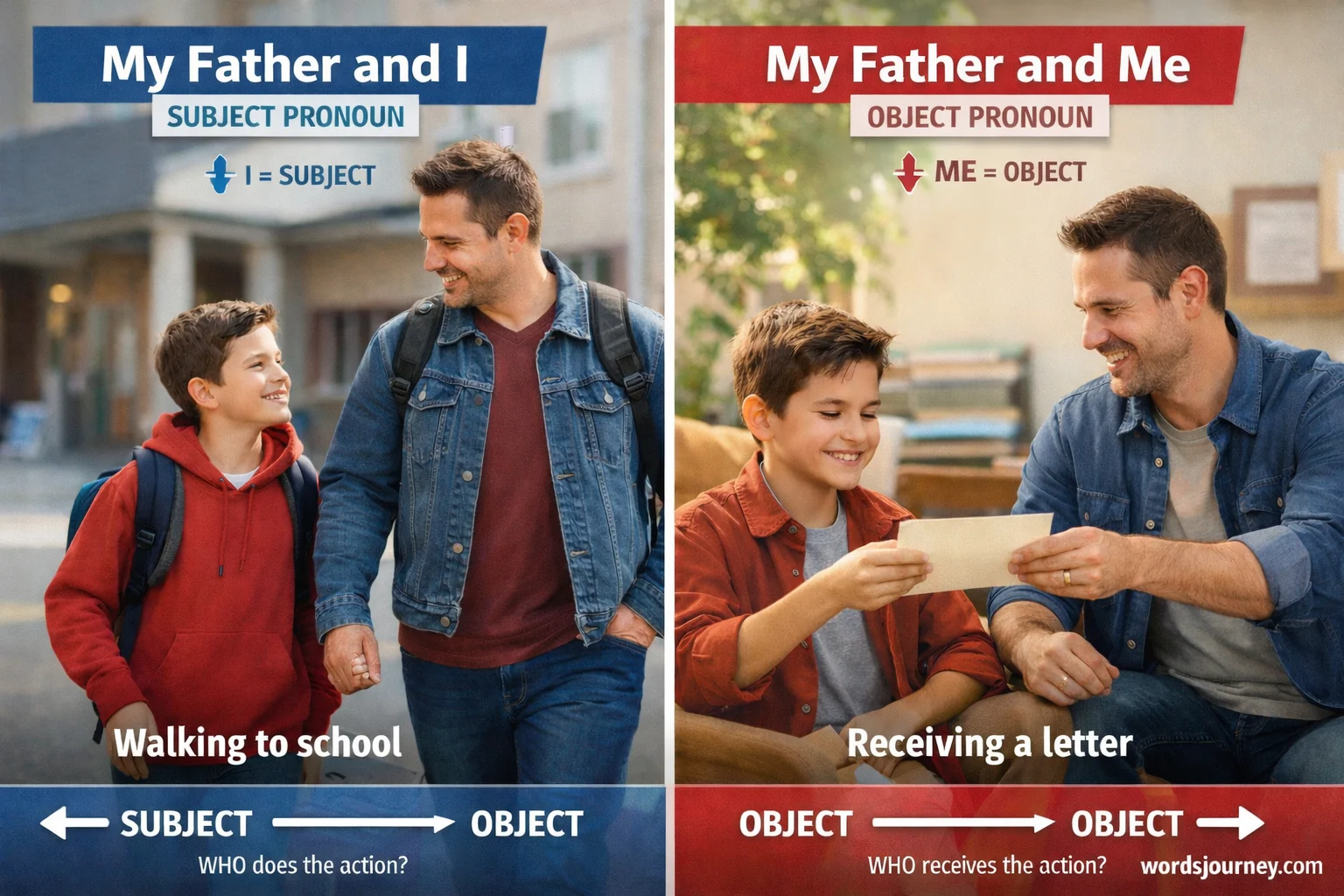
- Use “I” when you are the subject
- Use “me” when you are the object
That’s it.
Now let’s make it practical.
Think of a sentence like a movie scene.
- The subject is the one doing the action
- The object is the one receiving the action
So grammar depends on your role in the sentence, not how it sounds.
Simple breakdown:
| Role | Pronoun | Meaning |
| Subject | I | Doing the action |
| Object | Me | Receiving the action |
Now let’s apply this to real sentences involving My Father and I or My Father and Me.
When to Use “My Father and I” in Sentences
Use “My father and I” when you and your father are doing something.
This usually appears before the verb.
Examples you will actually use:
- My father and I built a small shop in our village
- My father and I attended the meeting together
- My father and I fixed the car last weekend
Notice the pattern. You are active in the action. You are not receiving it.
Quick test:
Remove “my father and” from the sentence.
- I built a small shop ✔
- I attended the meeting ✔
- I fixed the car ✔
If “I” still works alone, you are using it correctly.
That’s the subject rule in action.
When to Use “My Father and Me” Correctly
Now flip the situation.
Use “My father and me” when someone does something to you or for you.
This usually appears after the verb or after a preposition like to, for, with, between.
Examples:
- The teacher called my father and me
- The gift belongs to my father and me
- The manager spoke with my father and me
Here, you are not doing the action. You are receiving it.
Quick test:
Remove “my father and”.
- The teacher called me ✔
- The gift belongs to me ✔
- The manager spoke with me ✔
If “me” works, you are correct.
The Fastest Trick: The Removal Test
This trick saves you every time.
Just remove “my father and” and check the sentence.
Example 1:
- My father and I went to school
→ I went to school ✔
Example 2:
- She invited my father and me
→ She invited me ✔
Example 3:
- This message is for my father and me
→ This message is for me ✔
If the sentence still makes sense after removal, you picked the right pronoun.
Simple. Fast. Reliable.
Why People Still Get “My Father and I or My Father and Me” Wrong
Even native speakers mix this up. Why does this happen?
1. Spoken English influence
People say “me and my father” casually in conversation. It becomes habit.
2. The “I sounds smarter” myth
Many people think “I” sounds more formal so they overuse it.
3. Education gaps
Grammar rules often get memorized without real understanding.
4. Overcorrection
Some people avoid “me” completely because it feels wrong even when it is correct.
Real-life confusion example:
- Incorrect but common: Me and my father went shopping
- Correct: My father and I went shopping
- Incorrect: The gift is for my father and I
- Correct: The gift is for my father and me
Understanding structure fixes all of this.
Common Examples Table: My Father and I vs My Father and Me
Let’s make it even clearer with side-by-side comparison.
| Incorrect Usage | Correct Usage | Why |
| Me and my father went to school | My father and I went to school | Subject of sentence |
| The teacher praised my father and I | The teacher praised my father and me | Object of sentence |
| Between my father and I | Between my father and me | Preposition needs object |
| She invited my father and I | She invited my father and me | Object after verb |
| My father and me built a house | My father and I built a house | Subject doing action |
This table alone clears 90% of confusion.
Special Case: Prepositions Always Need “Me”
Prepositions are small words like:
- to
- for
- with
- between
- about
They always require an object.
Correct examples:
- Between my father and me
- For my father and me
- With my father and me
Incorrect examples:
- Between my father and I
- For my father and I
- With my father and I
Why?
Prepositions never take “I” because “I” cannot receive action.
Think of it like this:
- “I” walks into action
- “me” receives action
Memory Trick You’ll Never Forget
Here’s a simple mental shortcut.
- I = I do the action
- Me = action comes to me
Easy memory line:
“If I act, I use I. If I receive it, I will use it.”
Fun analogy:
Think of a cricket match.
- “I” is the batsman hitting the ball
- “Me” is the person getting hit by the ball
Different roles. Different pronouns.
Read More: Reorder or Re-order? Usage and Hyphen Rule
Real-Life Case Study: Workplace Email Mistake
Let’s look at a real-world style example.
Scenario:
An employee writes an email:
“Please send the report to my father and I.”
At first glance, it looks polite. It feels formal. But it is grammatically wrong.
Why it is wrong?
The phrase comes after “to” which is a preposition. That means object form is needed.
Correct version:
“Please send the report to my father and me.”
Impact in real life:
- Correct grammar builds credibility
- Small mistakes affect professional tone
- Hiring managers often notice these details
In business communication, grammar signals attention to detail.
Quick Practice Quiz: Test Yourself
Try these before checking answers.
Fill in the blanks:
- My father and ___ went to the market
- The manager called my father and ___
- This gift is for my father and ___
- My father and ___ repaired the roof
Answers:
- I
- me
- me
- I
If you got them right, you understand the rule.
If not, revisit the subject and object section.
Frequently Asked Questions (FAQs)
1. What is the correct usage: “My Father And I” or “My Father And Me”?
The correct choice depends on grammar function. Use “My Father And I” as the subject of a sentence. Use “My Father And Me” as the object.
2. Why do people often confuse “I” and “Me”?
Confusion happens because spoken English often blends rules. In formal writing, business communication, and academic English usage, strict subject-object rules apply.
3. Can I use both forms in professional writing?
Yes, but only when grammatically correct. In meetings, scheduling updates, and project management reports, incorrect usage can reduce clarity and consistency.
4. Is one form more formal than the other?
Neither is more formal. Correct usage depends on sentence structure, not tone. Grammar accuracy is what matters in formal writing and broadcasting scripts.
5. Do US and UK English style guides differ on this rule?
No major difference exists between US and UK standards. Both emphasize proper subject and object usage in English grammar and formal writing conventions.
Conclusion
Understanding the difference between “My Father And I” and “My Father And Me” is essential for clear and confident communication. This small grammar rule plays a big role in formal writing, business communication, scheduling notes, meetings, and online documentation where precision matters.
When used correctly, your sentences reflect strong English usage, consistency, and professionalism. Whether you are handling calendar planning, project management updates, or broadcasting scripts, correct grammar improves clarity and trust.In the end, mastering this rule is not just about grammar, it’s about improving your overall communication quality in both personal and professional contexts.

Aliya Ray is a passionate writer and language enthusiast at WordsJourney. She enjoys exploring words, phrases, and everyday expressions to help readers communicate more clearly and confidently. Her content focuses on alternative ways to say common phrases, simple explanations, and real-life examples that make language easy to understand.
Aliya believes the right words can make any message stronger. Through clear, friendly writing, she helps readers improve their vocabulary without feeling overwhelmed or confused.