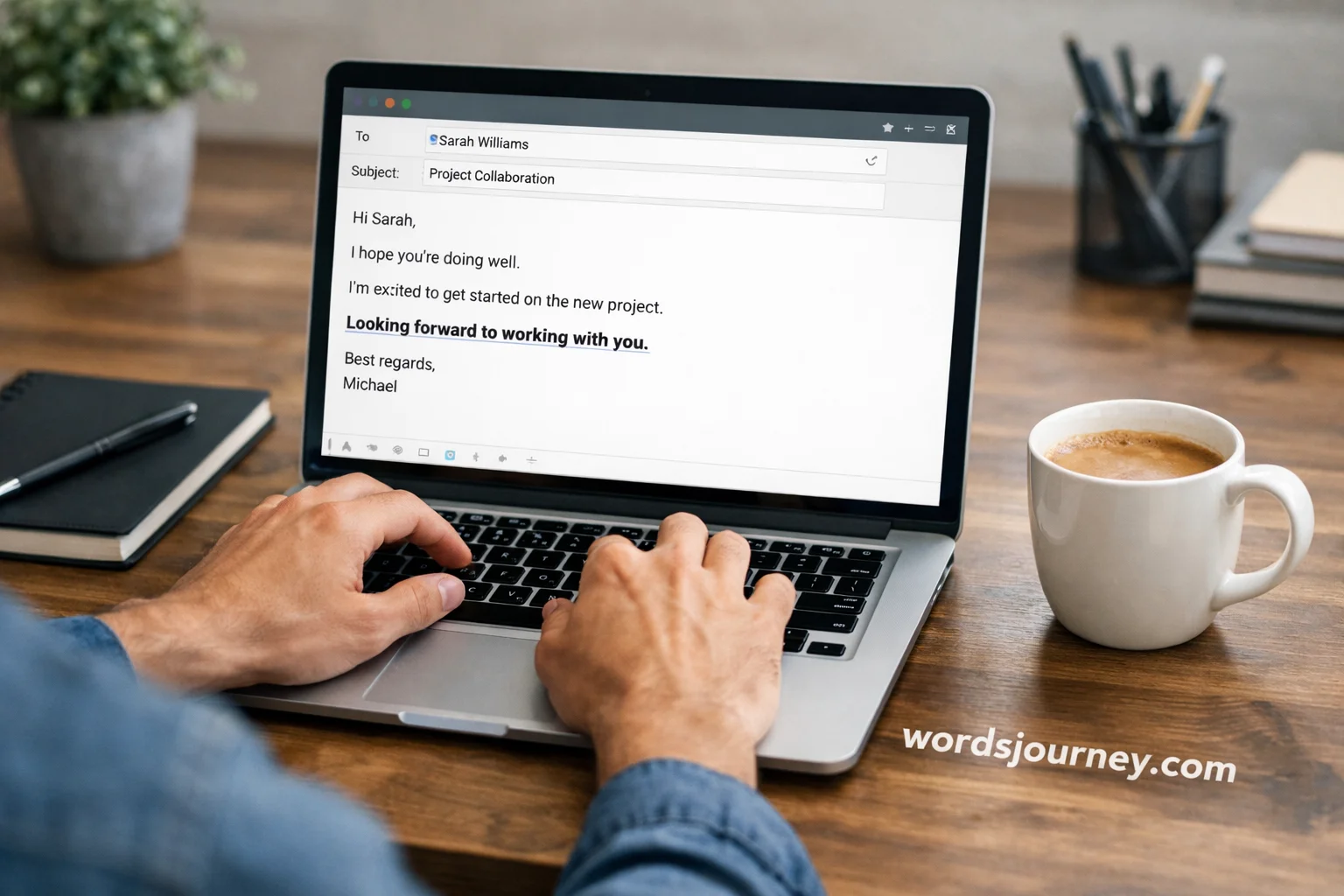
Picture this. You’ve just accepted a job offer or landed a new client. You’re about to send that final email. You pause for a second and type:
“Looking forward to working with you.”
Then doubt creeps in.
Is it actually correct? Does it sound professional? Or does it feel like something everyone says without thinking?
Let’s clear that up once and for all.
This guide goes deep. You’ll learn the grammar behind the phrase, when it works, when it doesn’t, and how to upgrade it so you stand out instead of blending in.
Is “Looking Forward to Working With You” Correct?
Short answer: Yes, it’s 100% correct.
Long answer? It’s correct grammatically, professionally, and socially. That’s why you see it everywhere—from corporate emails to freelance proposals.
However, here’s the catch.
Just because something is correct doesn’t mean it’s always effective.
This phrase works like a polite handshake. It signals warmth. It shows enthusiasm. Still, it can feel generic if you use it without intention.
Quick takeaway:
- ✔ Grammatically correct
- ✔ Widely accepted
- ✔ Professional in most contexts
- ⚠ Slightly overused
What Does “Looking Forward to Working With You” Actually Mean?
At its core, this phrase communicates positive anticipation.
You’re telling the other person:
- You expect a future interaction
- You feel optimistic about it
- You value the relationship
It’s subtle but powerful.
Instead of saying, “We will work together,” you soften the tone. You add emotion. You sound human.
Simple Example
“I’m excited about the opportunity and looking forward to working with you.”
That one line:
- Builds rapport
- Signals professionalism
- Ends the email on a warm note
Think of it like adding a smile to your message.
Grammar Breakdown: Why “Looking Forward to Working With You” Is Correct
Let’s break this down in plain English. No confusing grammar jargon.
Why “Looking Forward to” Works
The phrase “looking forward to” includes “to” as a preposition, not part of a verb.
That detail changes everything.
After a preposition, you must use a noun or a gerund (-ing verb).
Why “Working” Is Required (Not “Work”)
Here’s where people often slip.
| Phrase | Correct? | Why |
| Looking forward to working with you | ✅ | “Working” is a gerund |
| Looking forward to work with you | ❌ | Incorrect verb form |
| Looking forward to collaborate | ❌ | Missing gerund |
| Looking forward to collaborating | ✅ | Correct structure |
Rule to remember:
After “to” (as a preposition), use -ing verbs.
Is “Looking Forward to Working With You” Professional or Too Casual?
Now we get into real-world usage.
The phrase sits in a sweet spot. It’s friendly yet professional. That’s rare.
When It Sounds Professional
Use it confidently in:
- Job acceptance emails
- Client onboarding messages
- Internal team communication
- Follow-up emails
It shows you’re approachable without sounding informal.
When It Feels Weak or Generic
Sometimes, it doesn’t carry enough weight.
Avoid relying on it when:
- Writing high-stakes proposals
- Pitching premium services
- Communicating in formal legal settings
In those cases, it can sound like filler.
Real Insight
Recruiters and hiring managers see this phrase daily. It doesn’t hurt you. It just doesn’t help you stand out.
“Looking Forward to Working With You” vs Similar Phrases
Not all phrases carry the same tone. Small changes shift the entire message.
Comparison Table
| Phrase | Tone | Best Use Case |
| Looking forward to working with you | Friendly + professional | Everyday emails |
| I look forward to working with you | More formal | Business letters |
| Excited to work with you | Casual and energetic | Startups, creatives |
| Eager to collaborate | Modern and confident | Team-based roles |
| Anticipate working with you | Formal and reserved | Corporate settings |
Key Difference
“I look forward to…” feels more polished.
“Looking forward to…” feels more conversational.
Choose based on your audience.
Better Alternatives to “Looking Forward to Working With You”
Want to sound fresh? Swap the phrase based on context.
For Job Acceptance Emails
Instead of repeating the same line, try:
- “I’m excited to contribute to the team.”
- “I’m eager to get started and make an impact.”
- “I appreciate the opportunity and can’t wait to begin.”
These sound more intentional.
For Client Communication
Clients care about results. Show that.
- “I’m excited to partner with you on this project.”
- “Looking forward to delivering strong results together.”
- “I’m ready to help bring your vision to life.”
Notice the shift. It’s not just excitement—it’s value-driven language.
For Formal Business Situations
Go a bit more refined.
- “I anticipate a productive collaboration.”
- “I look forward to our professional engagement.”
- “I welcome the opportunity to work together.”
These sound polished without feeling stiff.
Read More: Its Self or Itself: The Complete Guide to the Correct Form
Real Email Examples You Can Use Immediately
Let’s make this practical.
Job Acceptance Email Example
Hi [Name],
Thank you for the opportunity. I’m excited to join the team and contribute to upcoming projects.
I look forward to working with you and the rest of the team.
Best regards,
[Your Name]
Client Onboarding Example
Hi [Client Name],
I appreciate your trust in this project. I’ve reviewed the details and everything looks great.
I’m excited to partner with you and deliver results that exceed expectations.
Let’s get started.
Best,
[Your Name]
Internal Team Message Example
Hi Team,
I’m glad to be part of this initiative. The goals look ambitious and exciting.
Looking forward to working with you all and building something impactful together.
Cheers,
[Your Name]
Common Mistakes to Avoid
Even simple phrases can go wrong.
Avoid These Errors
- ❌ “Looking forward to work with you”
- ❌ “Looking forward working with you”
- ❌ Overusing the phrase in every email
- ❌ Copy-pasting without personalization
Why These Mistakes Matter
They make your writing:
- Look careless
- Sound robotic
- Reduce credibility
One small mistake can change the entire tone.
When You Should Avoid This Phrase Completely
Sometimes, skipping the phrase makes you sound stronger.
Avoid It When:
- You need to show authority
- You’re writing cold outreach emails
- The tone must be highly formal
- You want to sound unique and memorable
Better Strategy
Be specific instead of generic.
Instead of:
“Looking forward to working with you.”
Say:
“I’m ready to help you increase conversions by 30% this quarter.”
That hits harder. It shows confidence and direction.
Pro Tip: Make It Sound More Human
Here’s how you upgrade the phrase instantly.
Basic Version
- Looking forward to working with you.
Upgraded Version
- I’m genuinely excited to start working together and see what we can build.
Why This Works
- Adds personality
- Feels authentic
- Builds connection
People don’t remember polite phrases.
They remember how you made them feel.
Case Study: Same Message, Different Impact
Let’s compare two real-world styles.
Version 1 (Generic)
“I look forward to working with you.”
Version 2 (Enhanced)
“I’m excited to collaborate and create results that truly move the needle for your business.”
Result
| Factor | Version 1 | Version 2 |
| Emotional impact | Low | High |
| Memorability | Weak | Strong |
| Professional tone | Neutral | Confident |
| Engagement | Average | High |
Small tweaks create big differences.
Expert Insight: Why This Phrase Became So Popular
Email culture shaped this phrase.
Professionals needed a safe, polite closing line. This one checked all boxes:
- Neutral tone
- Positive emotion
- Low risk of sounding rude
Over time, it became a default.
Quote
“Professional language often becomes repetitive because people optimize for safety over originality.”
That’s exactly what happened here.
FAQs About “Looking Forward to Working With You”
1. Is “Looking forward to working with you” grammatically correct?
Yes, it is grammatically correct and widely used in business communication. It works well in emails, meetings, and professional introductions.
2. Is it formal or informal in English usage?
It is considered semi-formal to formal, depending on context. In strict formal writing, some prefer more structured alternatives.
3. Can I use it in US and UK English styles?
Yes, both US vs. UK style guides accept it. However, UK English may sometimes favor slightly more reserved phrasing in official documents.
4. When should I avoid using this phrase?
Avoid it in very rigid legal, academic, or highly formal documents. In such cases, more precise English grammar and formal expressions are preferred.
5. What are better alternatives for formal writing?
You can use:
- “I look forward to our collaboration.”
- “I look forward to working together.”
- “I anticipate our partnership with interest.”
6. Is it suitable for emails, scheduling, and meetings?
Yes, it fits perfectly in emails, scheduling updates, calendar coordination, meetings, and project management communication where tone matters.
Conclusion
The phrase “Is It Correct to Say “Looking Forward to Working With You?”” is not only correct but also widely accepted in modern business communication. It helps create a positive tone in emails, scheduling messages, and professional collaboration contexts. Its simplicity makes it effective for daily English usage, especially in digital workflows like online booking, meetings, and project management systems. However, choosing the right expression depends on context, audience, and tone. While it works well in most professional scenarios, understanding formal writing standards, regional preferences, and language consistency ensures stronger communication. By applying the right phrasing at the right time, you can improve clarity, professionalism, and overall impact in every interaction.

Johnson Alex is a language-focused writer and the voice behind WordsJourney. He creates practical, easy-to-understand content that helps readers improve their vocabulary and express ideas with clarity and confidence.