Ever wondered why people casually say “gimme” in everyday conversations or texts? Understanding What Does “Gimme” Mean is essential for mastering modern English usage and improving natural communication. This expression often appears in informal speech, online chats, and even fast-paced business communication, where tone and clarity can easily shift meaning. It reflects how language evolves while still connecting to core grammar principles and real-world usage.
In today’s digital world, words like “gimme” show up beyond casual talk and influence scheduling, time management, and even workplace messaging. You may see it in quick meetings notes, project management updates, or relaxed online booking confirmations. It also appears in broadcasting scripts or informal calendar reminders where speed matters more than formality. Yet, understanding when to avoid it is key for maintaining formal writing standards and consistency in professional communication.
This article breaks down the meaning, usage, and context of “gimme” in a simple way. You’ll learn how it fits into modern English, when it works in casual speech, and when it should be avoided in professional settings. By the end, you’ll clearly understand how this small expression impacts tone, clarity, and effective communication across both personal and professional contexts.
What Does Gimme Mean in English Grammar and Everyday Speech?
From a grammar point of view, “gimme” is a phonetic contraction. It comes from spoken English, not formal writing.
The word forms like this:
- “Give me” → “Giv me” → “Gimme”
Native speakers reduce sounds naturally when speaking fast. English does this often. Think of:
- “want to” → “wanna”
- “going to” → “gonna”
- “give me” → “gimme”
So “gimme” is not random slang. It is a natural speech shortcut.
Linguists call this process elision, which means speakers drop or merge sounds to make speech smoother. It happens in nearly every language, not just English.
A simple way to understand it:
People don’t speak like textbooks. They speak like energy-saving machines.
Where Does “Gimme” Come From? The Real Origin
The origin of “gimme” is not tied to one person or event. It evolved naturally over time in spoken English.
Here is what actually happened:
- “Give me” existed in Old and Middle English
- Speakers began shortening it in fast conversation
- By the 19th and 20th centuries, “gimme” became common in informal American English
- Pop culture and sports helped spread it globally
One major driver of its popularity was American sports culture, especially baseball and golf. Athletes and fans used quick speech during fast-paced moments, so shorter words became normal.
You also see “gimme” frequently in:
- Film dialogue
- Street conversations
- Music lyrics
- Social media captions
It stayed informal the entire time. That matters because “gimme” never entered formal grammar rules. It lives fully in spoken and casual English.
What Does Gimme Mean in Different Contexts? Full Breakdown
The meaning of “gimme” shifts depending on situation and tone. The word itself stays the same, but interpretation changes.
Here is a clear breakdown:
| Context | Meaning | Tone | Example |
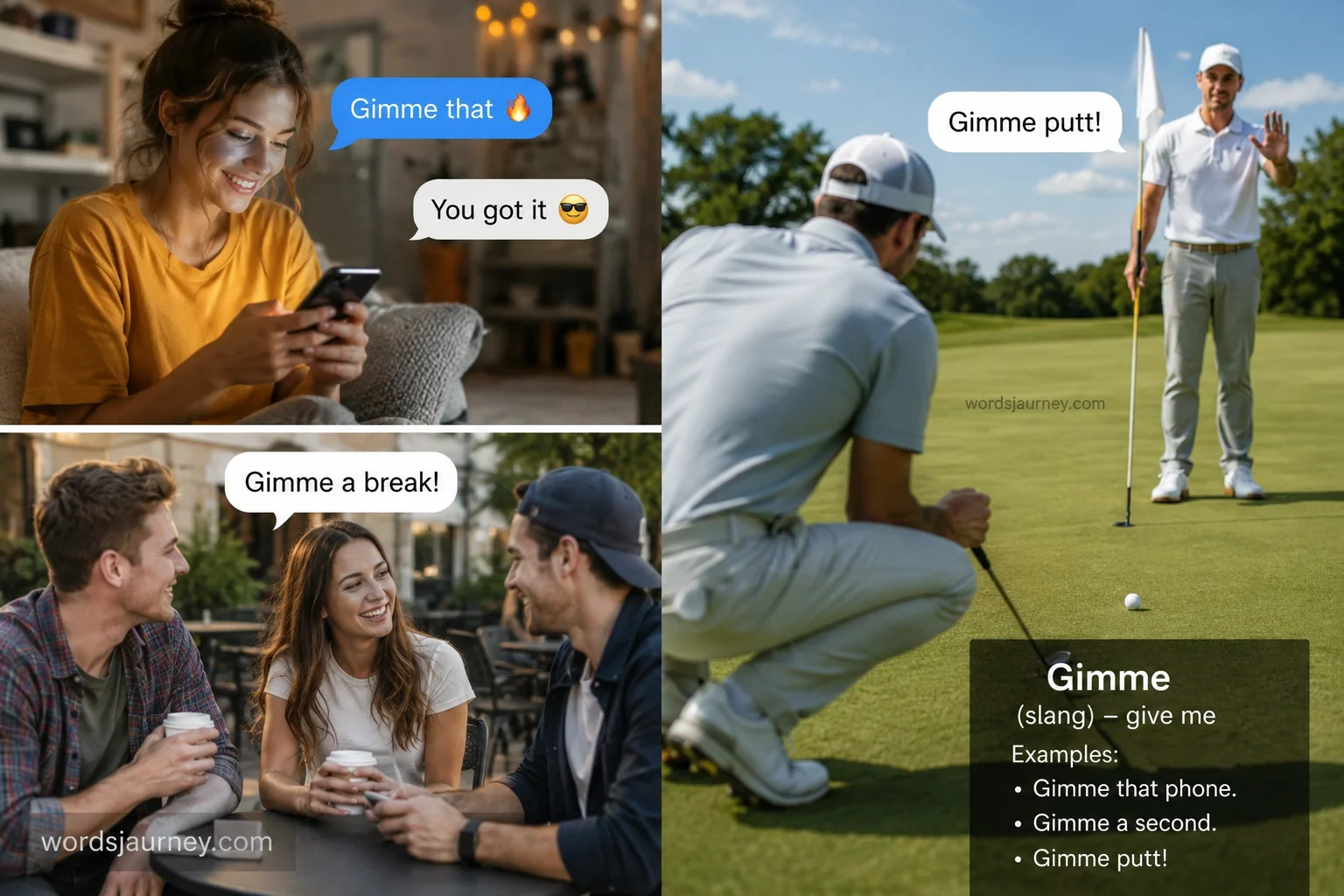
| Everyday speech | Quick request | Casual | “Gimme that pen.” |
| Texting | Short request | Friendly | “Gimme the details.” |
| Sports | Demand or excitement | Energetic | “Gimme the ball!” |
| Golf | Automatic short putt | Technical | “That’s a gimme.” |
| Emotional speech | Strong desire | Intense | “Gimme a break!” |
Now let’s explore each one in detail.
What Does Gimme Mean in Everyday Conversation?
In normal speech, “gimme” works as a fast request. People use it when they already expect cooperation.
Examples:
- “Gimme a second.”
- “Gimme your charger.”
- “Gimme that book real quick.”
It often sounds friendly among close people. However, tone controls everything.
Compare these:
- Polite: “Can you give me the remote?”
- Casual: “Gimme the remote.”
Both mean the same thing. One feels formal. The other feels relaxed.
Here is a simple analogy:
“Gimme” is like tossing a ball instead of carefully handing it over.
You still get the same result, just faster and less formal.
What Does Gimme Mean in Texting and Social Media?
Online communication changed how people use “gimme.” It became even more common in texting because speed matters.
People use it to:
- Ask for information quickly
- Sound casual with friends
- Match meme culture tone
Examples:
- “Gimme the link”
- “Gimme your playlist”
- “Gimme the tea” (slang for gossip)
On social media, “gimme” often adds personality. It makes messages feel direct and expressive.
A key reason it works online:
Short words feel more natural in fast digital conversations.
What Does Gimme Mean in Sports and Games?
Sports introduced one of the most interesting uses of “gimme.”
In golf, a “gimme putt” means a very short putt that players agree is already made. It usually happens in casual games, not professional tournaments.
Example:
- “That’s a gimme. Pick it up.”
This usage shows trust between players. They assume the shot is too easy to miss.
Outside golf, athletes also use “gimme” to express urgency:
- “Gimme the ball!”
- “Gimme the pass!”
In this case, it becomes emotional and fast-paced.
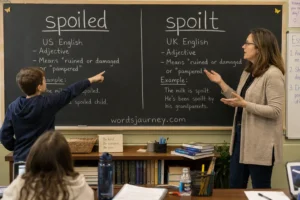
Read More: Spoilt vs Spoiled: What’s the Difference and Why It Matters?
How “Gimme” Changes Tone and Meaning
Tone is everything with “gimme.” The same word can sound:
- Friendly
- Demanding
- Playful
- Impatient
Let’s compare:
- Friendly: “Gimme a minute, I’m coming.”
- Neutral: “Gimme that.”
- Aggressive: “Gimme it now.”
Notice how meaning shifts without changing the word.
This happens because English relies heavily on intonation and context.
Think of “gimme” like facial expression in language. The word stays the same, but emotion changes everything.
Common Mistakes People Make With “Gimme”
Many English learners misuse “gimme” without realizing tone problems.
Here are common mistakes:
Using it in formal writing
- Emails
- Academic essays
- Job applications
Wrong: “Gimme the report by Monday.”
Correct: “Please send the report by Monday.”
Overusing it in serious situations
If someone is upset or emotional, “gimme” can sound disrespectful.
Misreading tone
Some learners think “gimme” always sounds rude. That is not true. Friends use it casually all the time.
Synonyms and Alternatives to “Gimme”
You do not always need “gimme.” English gives you many options depending on tone.
| Word | Tone |
| Give me | Neutral |
| Can I have | Polite |
| Pass me | Casual |
| Let me get | Friendly |
| I need | Direct |
Example:
- “Gimme water”
- “Can I have some water?”
Both work. The second just sounds more polite.
When You Should NOT Use “Gimme”
“Gimme” does not fit every situation.
Avoid it in:
- Business emails
- Academic writing
- Customer service conversations
- Formal interviews
Why?
Because it reduces professionalism.
Instead, use clear polite phrases:
- “Please provide…”
- “Could you send…”
- “May I have…”
Think of it like clothing:
“Gimme” is a T-shirt. Formal speech is a suit.
Both are useful. You just wear them in different places.
Real-Life Case Studies: How “Gimme” Works in Context
Case Study 1: Friendly Conversation
Ali is talking to his friend.
- Ali: “Gimme your phone, I want to check something.”
- Friend: “Sure.”
Here, the tone feels relaxed. No problem.
Case Study 2: Workplace Mistake
A new employee emails their manager:
- “Gimme the project file.”
Result:
The manager feels the tone is too casual. It may create a negative impression.
Better version:
- “Could you please share the project file?”
Case Study 3: Sports Environment
Two friends playing golf:
- Player 1: “That’s a gimme putt.”
- Player 2 picks up the ball.
Here, the word builds trust and keeps the game flowing.
Quick Reference Table: What Does Gimme Mean in Different Situations
| Situation | Meaning of “Gimme” | Best Usage |
| Friends talking | Casual request | Very common |
| Text messages | Short request | Common |
| Sports | Urgent or agreed action | Very common |
| Golf | Automatic short shot | Technical |
| Business | Too informal | Avoid |
Ever wondered why people casually say “gimme” in everyday conversations or texts? Understanding What Does “Gimme” Mean is essential for mastering modern English usage and improving natural communication. This expression often appears in informal speech, online chats, and even fast-paced business communication, where tone and clarity can easily shift meaning. It reflects how language evolves while still connecting to core grammar principles and real-world usage.
In today’s digital world, words like “gimme” show up beyond casual talk and influence scheduling, time management, and even workplace messaging. You may see it in quick meetings notes, project management updates, or relaxed online booking confirmations. It also appears in broadcasting scripts or informal calendar reminders where speed matters more than formality. Yet, understanding when to avoid it is key for maintaining formal writing standards and consistency in professional communication.
This article breaks down the meaning, usage, and context of “gimme” in a simple way. You’ll learn how it fits into modern English, when it works in casual speech, and when it should be avoided in professional settings. By the end, you’ll clearly understand how this small expression impacts tone, clarity, and effective communication across both personal and professional contexts.
10 faqs and conclusion
FAQs on “What Does ‘Gimme’ Mean”
1. What does “gimme” mean in English?
“Gimme” is an informal way of saying “give me.” It is commonly used in casual speech and texting.
2. Is “gimme” a correct English word?
Yes, but only in informal English usage. It is not suitable for formal writing or professional documents.
3. Where is “gimme” commonly used?
It often appears in online chats, casual conversations, broadcasting, and quick workplace messages.
4. Is “gimme” considered slang?
Yes, “gimme” is widely considered informal slang, used to make speech faster and more relaxed.
5. Can I use “gimme” in business communication?
It depends on context. It is fine in informal team chats, but not in formal business communication or emails.
6. What is the formal alternative to “gimme”?
The formal version is “give me.” It is preferred in grammar-conscious writing and professional settings.
7. Does “gimme” affect tone in communication?
Yes, it creates a casual and friendly tone but reduces formality and professionalism.
8. Is “gimme” used in digital communication?
Yes, it is very common in online booking systems, messaging apps, and quick project management updates.
9. Why do people use “gimme” instead of “give me”?
People use it for speed, convenience, and a more natural conversational style in informal situations.
10. Should learners of English use “gimme”?
Learners should understand it for English usage comprehension but prioritize formal alternatives in writing.
Conclusion
Understanding What Does “Gimme” Mean helps you navigate both casual and professional communication more effectively. It is a shortened, informal version of “give me” that reflects how modern English usage adapts to speed and convenience in digital conversations.
While it works well in relaxed environments like chats, meetings, or informal project management discussions, it is not suitable for formal writing, official business communication, or structured calendar updates. Choosing the right form depends on context, audience, and purpose. In short, mastering when to use or avoid “gimme” improves your grammar accuracy, enhances consistency, and strengthens overall communication skills in both personal and professional settings.

Aliya Ray is a passionate writer and language enthusiast at WordsJourney. She enjoys exploring words, phrases, and everyday expressions to help readers communicate more clearly and confidently. Her content focuses on alternative ways to say common phrases, simple explanations, and real-life examples that make language easy to understand.
Aliya believes the right words can make any message stronger. Through clear, friendly writing, she helps readers improve their vocabulary without feeling overwhelmed or confused.