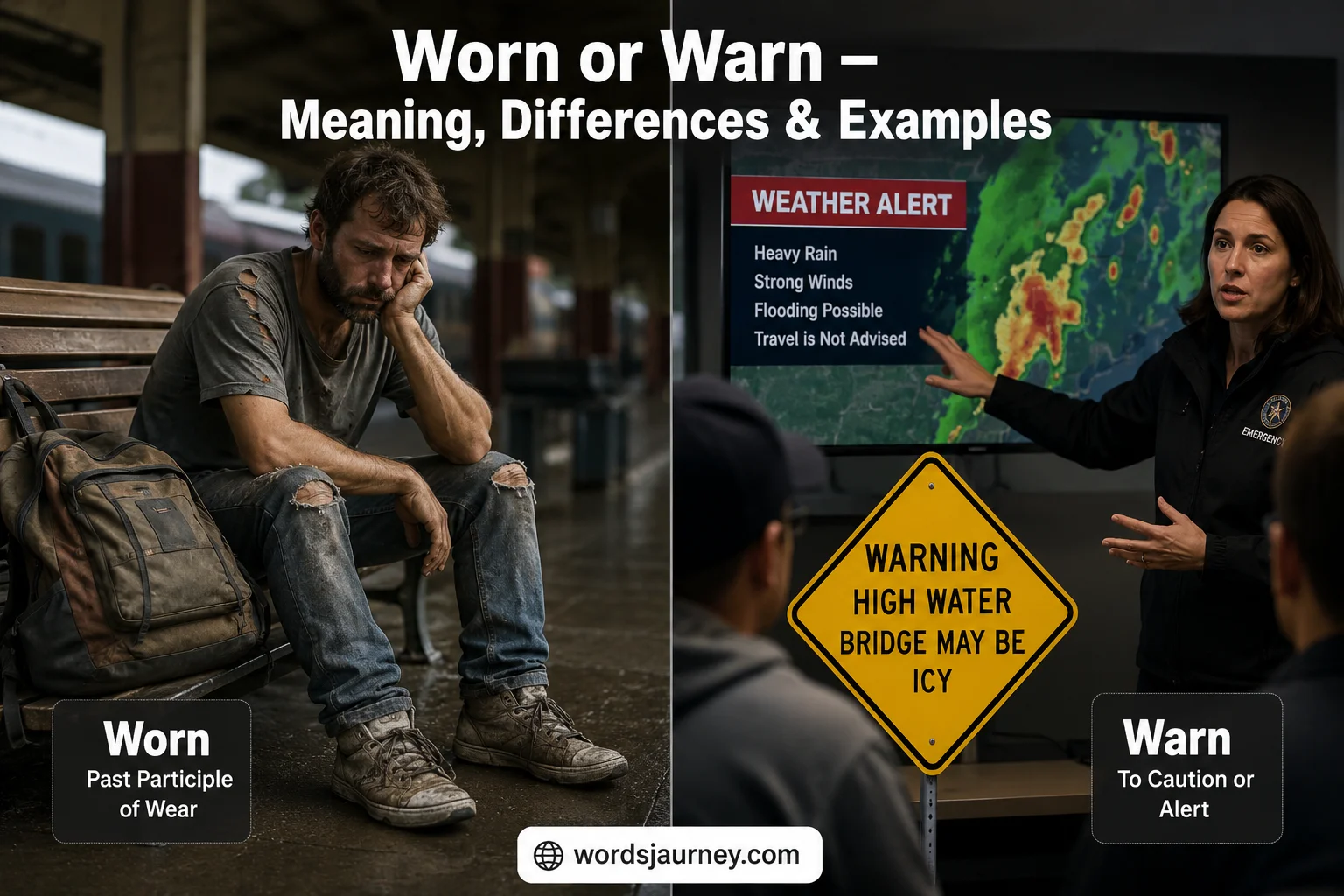
Ever confused between Worn or Warn while writing an important message or email? This common mix-up often affects English usage, grammar, and even formal writing in real-world communication. Whether you are handling business communication, ensuring consistency, or improving clarity, understanding this difference is essential for accuracy and professionalism.
This confusion frequently appears in scheduling, time management, and online booking systems where clear wording matters most. It can also impact meetings, calendar updates, project management, and even broadcasting content where precise language is critical. In fast-paced digital environments, a small grammar error can change meaning and reduce clarity.
In this article, you will clearly learn the difference between these terms with practical examples and usage tips. We will break down grammar rules, improve writing accuracy, and strengthen professional communication skills. By the end, you will confidently avoid mistakes and use language more effectively in everyday and business contexts.
What Is the Difference Between Worn and Warn?
The difference between worn and warn comes down to meaning and grammar.
- Worn relates to wear, damage, usage, or exhaustion.
- Warn means to alert someone about danger or possible problems.
Although they sound very similar, they are used in completely different situations.
Quick Comparison Table
| Word | Part of Speech | Meaning | Example |
| Worn | Adjective/Past Participle | Damaged, used, exhausted | My shoes are worn out. |
| Warn | Verb | To caution or alert someone | They warn drivers daily. |
Why People Confuse Worn and Warn
Several factors create confusion:
- Both words sound alike
- English pronunciation can be inconsistent
- Similar spelling patterns
- Fast speech hides tiny sound differences
- Learners confuse “wore,” “worn,” and “warn”
Here’s the easiest way to remember them:
Worn = related to wear
Warn = related to warning
Meaning of Worn
The word worn comes from the verb wear. It usually describes something old, damaged, overused, or physically exhausted.
Definition of Worn
Worn can mean:
- Damaged from repeated use
- No longer new
- Extremely tired
- Past participle of “wear”
Examples of Worn in Sentences
- The sofa looked worn after years of use.
- His backpack was old and worn.
- I feel completely worn out today.
- She had worn the same jacket before.
How Worn Works in Grammar
Grammar is important because worn is not usually used alone in simple past tense sentences.
Verb Forms of Wear
| Verb Form | Example |
| Base Verb | Wear |
| Past Tense | Wore |
| Past Participle | Worn |
Correct Examples
- I have worn these shoes before.
- She had worn the necklace earlier.
Incorrect Example
- I worn these shoes yesterday.
Correct Version
- I wore these shoes yesterday.
The word worn normally appears with helping verbs like:
- has
- have
- had
- was
- were
Worn as an Adjective
Besides being a verb form, worn also functions as an adjective.
Examples
| Phrase | Meaning |
| Worn carpet | Old carpet |
| Worn shoes | Damaged shoes |
| Worn expression | Tired facial look |
| Worn furniture | Aged furniture |
Example Sentences
- The old cabin had worn wooden floors.
- His face carried a worn expression after work.
- The tires looked badly worn.
Common Phrases With Worn
English speakers frequently use these expressions.
Worn Out
Means exhausted or heavily damaged.
Examples
- I’m worn out after the trip.
- Those boots are completely worn out.
Worn Down
Means weakened over time.
Examples
- Stress had worn him down.
- Water slowly wore down the rocks.
Well-Worn
Means familiar or commonly used.
Examples
- That’s a well-worn excuse.
- We followed a well-worn hiking path.
Time-Worn
Means old because of age or long tradition.
Examples
- The building looked time-worn.
- It’s a time-worn custom.
Meaning of Warn
The word warn means to alert someone about danger, risk, or possible consequences.
Unlike “worn,” this word focuses on communication and caution.
Definition of Warn
Warn means:
- To advise someone carefully
- To notify about danger
- To caution against something harmful
- To signal possible trouble
Examples of Warn in Sentences
- Police warned drivers about icy roads.
- Doctors warn against smoking.
- She warned him not to touch the wire.
- Officials warned residents before the storm.
Read More: “Practice vs Practise” The Complete Guide to Correct Usage
How Warn Works in Grammar
Warn is a regular verb, unlike “wear.”
Verb Forms of Warn
| Verb Form | Example |
| Base Verb | Warn |
| Past Tense | Warned |
| Past Participle | Warned |
Examples
- They warn tourists every summer.
- She warned me yesterday.
- We have warned them repeatedly.
Common Sentence Structures With Warn
English uses several common patterns with “warn.”
Warn Someone About Something
- Teachers warned students about cheating.
- Officials warned citizens about flooding.
Warn Someone Against Something
- Doctors warn against unhealthy eating.
- Experts warn against online scams.
Warn Someone To Do Something
- My father warned me to drive carefully.
- Police warned travelers to stay indoors.
Worn vs Warn Side-by-Side Comparison
Comparing them directly makes the difference easier to remember.
| Feature | Worn | Warn |
| Meaning | Used, damaged, exhausted | Alert or caution |
| Word Type | Adjective/Past participle | Verb |
| Related Word | Wear | Warning |
| Example | The couch is worn. | They warn visitors. |
Pronunciation Difference Between Worn and Warn
In many American accents, the words sound nearly identical.
Pronunciation Table
| Word | IPA Pronunciation |
| Worn | /wɔːrn/ |
| Warn | /wɔːrn/ |
Because they sound the same, context becomes extremely important.
Examples
- The tires are worn.
- They warn drivers daily.
Even though the pronunciation matches, the surrounding words clarify the meaning instantly.
Easy Tricks to Remember Worn vs Warn
Simple memory tricks help avoid mistakes quickly.
Memory Trick for Worn
Think about:
- Torn clothing
- Old shoes
- Exhaustion
The word worn relates to things becoming weak, old, or damaged.
Visual Image
Imagine ripped sneakers after years of walking.
Memory Trick for Warn
Think about:
- Warning signs
- Watch out
- Danger alerts
Visual Image
Imagine a bright yellow caution sign.
Common Mistakes People Make
Many learners repeat the same errors.
Using Warn Instead of Worn
Incorrect
- My jacket is warn out.
Correct
- My jacket is worn out.
Using Worn Instead of Warn
Incorrect
- They worn us about the storm.
Correct
- They warned us about the storm.
Confusing Wore and Worn
Incorrect
- She has wore the dress before.
Correct
- She has worn the dress before.
Wore vs Worn vs Warn
This group causes major confusion for English learners.
Quick Grammar Breakdown
| Word | Function | Example |
| Wear | Base verb | I wear glasses. |
| Wore | Past tense | She wore black yesterday. |
| Worn | Past participle | He has worn that coat before. |
| Warn | Verb | They warn visitors daily. |
| Warned | Past tense | She warned me earlier. |
Real-Life Examples of Worn
Real examples make grammar easier to understand.
Everyday Examples
- The couch looked worn after years of use.
- His backpack was old and worn.
- I feel worn out today.
Travel Examples
- The hiking boots became worn after the trip.
- The signs looked weather-worn.
Emotional Examples
- She had a worn expression after work.
- Long hours left him mentally worn.
Real-Life Examples of Warn
Safety Examples
- Firefighters warned residents to evacuate.
- Doctors warn patients about unhealthy habits.
Workplace Examples
- Managers warned employees about phishing scams.
- The company warned workers of budget cuts.
Parenting Examples
- Parents warn children about strangers.
- She warned her son not to run near the pool.
Why Worn and Warn Are So Confusing
English contains many confusing homophones.
What Are Homophones?
Homophones are words that:
- Sound alike
- Have different meanings
- Often have different spellings
Examples of Homophones
| Word Pair | Meaning Difference |
| Their vs There | Possession vs location |
| Sale vs Sail | Shopping vs boating |
| Allowed vs Aloud | Permission vs spoken sound |
| Worn vs Warn | Damage vs caution |
Why English Learners Struggle With Homophones
Several reasons make homophones difficult.
Silent Letters
English pronunciation often ignores spelling rules.
Accent Differences
Regional accents change pronunciation slightly.
Fast Conversation
Quick speech hides tiny sound differences.
Similar Spellings
One small letter change creates a completely new meaning.
Synonyms of Worn
Using synonyms improves writing quality and vocabulary.
| Synonym | Best Usage |
| Damaged | Physical condition |
| Faded | Appearance |
| Ragged | Torn clothing |
| Exhausted | Tiredness |
| Weathered | Outdoor aging |
Example Sentence
- The weathered cabin stood deep in the forest.
Synonyms of Warn
| Synonym | Best Usage |
| Alert | Emergency situations |
| Caution | Careful advice |
| Notify | Formal communication |
| Advise | Guidance |
| Signal | Indicate danger |
Example Sentence
- Officials alerted residents before the hurricane arrived.
Mini Case Study: One Letter Changes Everything
Imagine sending this workplace email:
“The machines are warn out.”
The sentence immediately looks incorrect because “warn” does not fit the context.
Correct Version
“The machines are worn out.”
Now consider this sentence:
“Management worn employees about safety issues.”
Again, the meaning breaks completely.
Correct Version
“Management warned employees about safety issues.”
A single letter changes the entire meaning and professionalism of the sentence.
Worn in Literature and Descriptive Writing
Writers often use “worn” to create strong imagery.
Common Literary Examples
- Worn leather boots
- Worn photographs
- Worn smiles
- Worn wooden floors
These descriptions instantly create emotion and realism.
Symbolism of Worn
Authors commonly use “worn” to symbolize:
- hardship
- aging
- emotional fatigue
- long history
A “worn diary” sounds more vivid than simply saying “an old diary.”
Warn in News Headlines
News organizations constantly use “warn” because journalism often focuses on danger and public safety.
Common Headline Examples
- Experts warn of rising temperatures
- Officials warn drivers about fog
- Scientists warn against misinformation
The word creates urgency and grabs attention quickly.
Practice Quiz: Worn or Warn?
Choose the correct word.
Questions
- The carpet looked badly ___.
- Officials ___ residents about flooding.
- My shoes are completely ___ out.
- Doctors often ___ against smoking.
- She had ___ the same jacket before.
Answer Key
| Question | Correct Answer |
| 1 | worn |
| 2 | warned |
| 3 | worn |
| 4 | warn |
| 5 | worn |
Quick Grammar Tips to Remember Forever
Use Worn When Talking About:
- clothing
- damage
- exhaustion
- repeated use
Use Warn When Talking About:
- danger
- advice
- risk
- caution
Frequently Asked Questions About Worn vs Warn
1. What is the difference between Worn or Warn?
Worn is the past form of “wear,” while Warn means to alert someone about danger or risk. They are completely different in meaning and usage.
2. Is worn related to clothing only?
No, worn is used for clothing, objects, or even emotional states like tiredness or stress.
3. When should I use warn in sentences?
Use warn when giving caution, advice, or alerting someone about possible danger or mistake.
4. Can worn or warn be used in business communication?
Yes, but in different contexts. Warn is used for alerts, while worn describes usage, condition, or exhaustion in reports.
5. Why do people confuse worn and warn?
They sound similar in speech, but their meanings differ in English usage and grammar rules, leading to common mistakes.
6. Is warned the correct past tense?
Yes, warned is the correct past form of warn and is widely used in formal writing and communication.
7. What does worn out mean?
Worn out means something is overused or completely exhausted, often used in physical or emotional contexts.
8. Can misuse of worn or warn affect professionalism?
Yes, incorrect usage can impact formal writing, business communication, and clarity in project management or reports.
9. How can I avoid confusion between worn or warn?
Practice sentence examples and focus on grammar, context, and real-life usage in meetings and emails.
10. Are worn and warn commonly mistaken in digital communication?
Yes, especially in online booking, scheduling, and calendar updates, where quick typing leads to errors.
Conclusion
Understanding the difference between worn and warn is essential for clear and professional communication. While worn describes condition or usage, warn focuses on alerting or cautioning someone about risk or action.
Mastering this distinction improves English usage, strengthens grammar accuracy, and enhances overall formal writing skills. It also ensures better clarity in business communication, meetings, project management, and online scheduling systems. By applying the correct usage in daily writing, you improve both consistency and professionalism. Small grammar improvements like this can make a big difference in how your message is understood in both personal and professional contexts.

Aliya Ray is a passionate writer and language enthusiast at WordsJourney. She enjoys exploring words, phrases, and everyday expressions to help readers communicate more clearly and confidently. Her content focuses on alternative ways to say common phrases, simple explanations, and real-life examples that make language easy to understand.
Aliya believes the right words can make any message stronger. Through clear, friendly writing, she helps readers improve their vocabulary without feeling overwhelmed or confused.