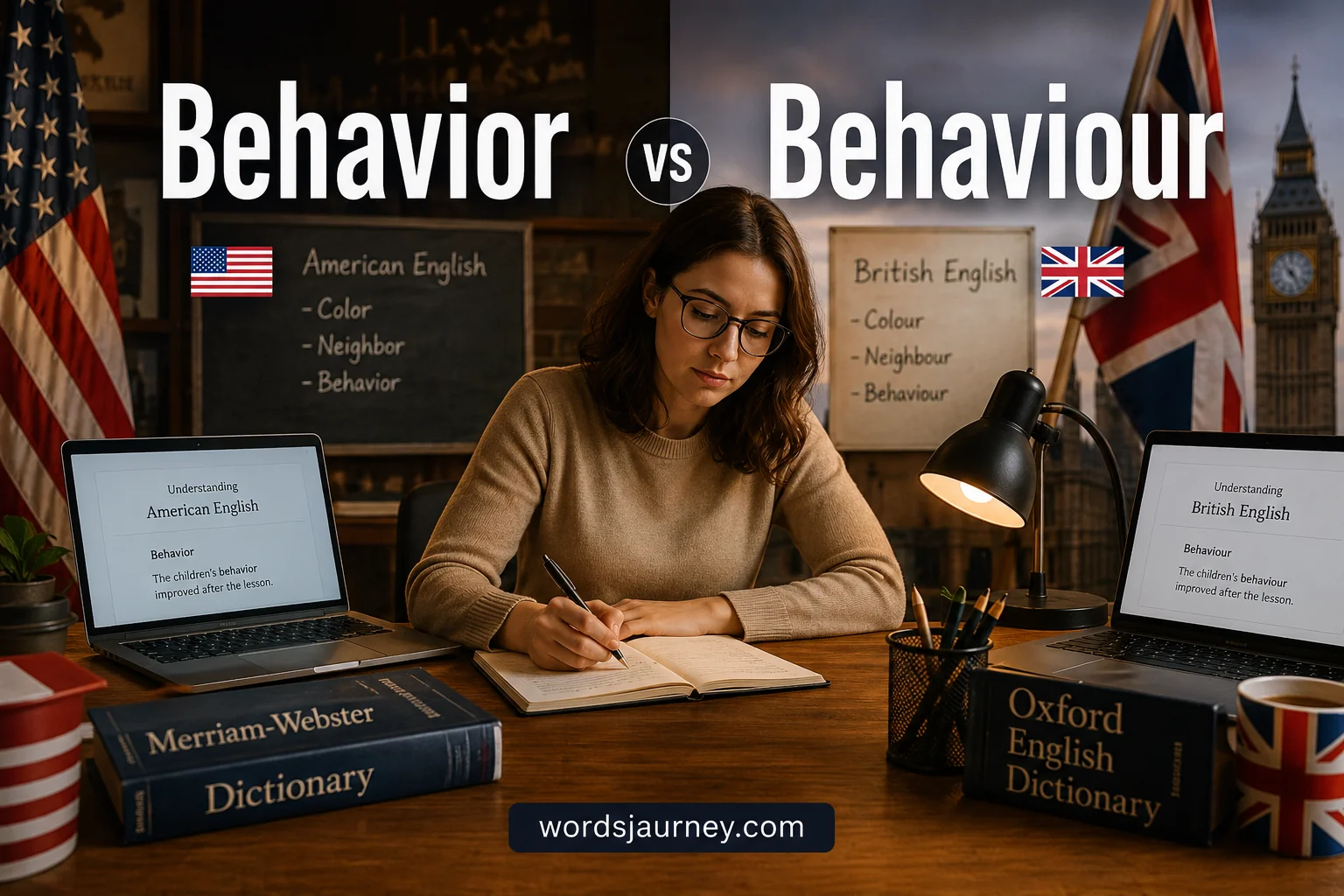
Behavior or Behaviour confusion happens because people often compare American English and British English spelling in real writing situations today.
It’s important to know your audience because it will guide your choice. If you’re writing for a British audience or using standards, include behaviour. If your audience follows American English, use behavior. Both are correct, but their use depends on the form you are following. Many people feel confused when they see the words behavior and behaviour. These two spellings look very similar, sound exactly the same, and have the same meaning. Because of this, learners often wonder which one is correct and should be used in writing. This confusion appears in school assignments, exams, emails, and professional documents.
The difference is not about meaning but about spelling variation between American English and British English. The distinction also extends to derivatives like behaviors, behaviours, behavioral, behavioural, and behaviorally. In real use, the main difference lies in how each version of English uses the word. American English drops “u” and spells it as behavior, while British English keeps it in behaviour.
Behavior vs Behaviour: The Quick Answer
If you want the short version, here it is:
| Spelling | Used In | Correct? |
| Behavior | United States | Yes |
| Behaviour | United Kingdom, Canada, Australia | Yes |
Both words mean the same thing:
The way a person, animal, or thing acts.
So if someone tells you one version is “wrong,” they’re oversimplifying the issue.
Language changes across regions all the time. English simply happens to have many spelling variations because it evolved differently in different countries.
What Does “Behavior” or “Behaviour” Mean?
The word refers to the way someone acts or conducts themselves. It can describe people, animals, organizations, or even scientific systems.
Simple Definition
Behavior / Behaviour means:
- Actions
- Conduct
- Responses
- Reactions
- Mannerisms
You’ll hear the word used in everyday life constantly.
Examples
- The child’s behavior improved at school.
- Consumer behaviour influences marketing trends.
- Animal behavior fascinates scientists.
- Professional behavior matters in the workplace.
The word appears across many industries including:
| Industry | Example Usage |
| Psychology | Human behavior studies |
| Education | Student behavior reports |
| Marketing | Consumer behavior analysis |
| Science | Chemical behavior under heat |
| Business | Workplace behavior policies |
That flexibility makes it one of the most widely used English nouns.
Why Are There Two Spellings?
Now things get interesting.
The split between behavior and behaviour began centuries ago when American English started developing separately from British English.
The Role of Noah Webster
American lexicographer Noah Webster played a huge role in changing American spelling conventions.
Webster believed English spelling should become simpler and more logical. During the early 1800s, he promoted shorter spellings in his dictionaries.
That’s why American English dropped the “u” in many words.
British English Kept Traditional Spellings
British English maintained older French-influenced spellings such as:
| American English | British English |
| Color | Colour |
| Honor | Honour |
| Favor | Favour |
| Behavior | Behaviour |
| Labor | Labour |
Americans simplified many words. Britain largely kept traditional forms.
Neither system is more correct historically. They simply evolved differently.
Is “Behaviour” Wrong in America?
No. Americans will still understand the British spelling instantly.
However, it can look unusual in US-based writing.
Imagine visiting an American business website and seeing sentences like:
- “Customer behaviour matters to us.”
- “Positive workplace behaviour improves productivity.”
Most Americans would understand those sentences immediately. Still, the spelling might feel slightly foreign.
Read More: “Apologise” or “Apologize” Which Spelling Is Correct?
When British Spelling Appears in America
You’ll often see British spelling in:
- International companies
- Academic research
- Global publications
- Imported books
- Canadian content
- UK media outlets
For example, universities sometimes preserve British spelling when quoting international scholars.
The important thing is consistency.
Mixing spellings randomly creates confusion.
Is “Behavior” Wrong in British English?
Again, no.
British readers understand American spelling perfectly well because American media dominates global entertainment and online culture.
Movies, streaming platforms, YouTube, gaming, and social media constantly expose British audiences to American English.
That’s why words like:
- behavior
- color
- organize
- traveled
look familiar almost everywhere today.
Still, formal British publications usually prefer traditional UK spelling.
British Style Guides Still Prefer “Behaviour”
Most UK-based organizations use British spelling standards.
Examples include:
- Newspapers
- Universities
- Government documents
- Academic journals
- Publishing houses
So while “behavior” won’t confuse British readers, “behaviour” remains the expected standard in most formal UK writing.
Which Spelling Should You Use?
This depends entirely on your audience.
That’s the golden rule.
Use “Behavior” If Your Audience Is:
- American
- US-based businesses
- American students
- US publications
- American customers
Use “Behaviour” If Your Audience Is:
- British
- Australian
- Canadian
- Irish
- New Zealand readers
For International Audiences
Things become more flexible here.
Many international brands choose American spelling because US English dominates online content. Others stay with British English because it feels more formal globally.
Neither choice is inherently better.
What matters is consistency.
Common Mistakes Writers Make
Writers often create accidental inconsistency.
That hurts readability and professionalism.
Mixing Both Spellings
Bad example:
“Good behaviour improves workplace behavior.”
That sentence feels sloppy because it switches language systems halfway through.
Better Example
American English:
“Good behavior improves workplace culture.”
British English:
“Good behaviour improves workplace culture.”
Consistency makes writing look polished.
Behavior vs Behaviour in Academic Writing
Academic institutions usually follow strict style guides.
That means spelling consistency becomes extremely important.
American Academic Standards
Most US universities follow:
- APA Style
- MLA Style
- Chicago Manual of Style
These typically prefer American spelling.
So American students should usually write:
- behavior
- color
- analyze
- organize
British Academic Standards
UK universities generally prefer:
- behaviour
- colour
- analyse
- organise
Professors may deduct marks for inconsistent spelling systems.
That’s why students should always check institutional guidelines first.
Pronunciation: Do They Sound Different?
No.
Both spellings sound identical.
Pronunciation
Behavior / Behaviour
bih-HAY-vyer
The pronunciation does not change between American and British English.
That surprises many learners because the spelling difference looks significant.
Still, native speakers pronounce both words almost the same way.
Real-World Examples of Behavior and Behaviour
The word appears almost everywhere in daily life.
In Psychology
Behavioral psychology studies how humans react to stimuli, habits, rewards, and environments.
Famous psychologists like B. F. Skinner built entire theories around human behavior patterns.
Common Psychology Terms
| American | British |
| Behavioral science | Behavioural science |
| Behavioral therapy | Behavioural therapy |
| Behavioral patterns | Behavioural patterns |
In Schools
Teachers constantly discuss student behavior.
Schools may track:
- Attendance
- Classroom conduct
- Discipline records
- Participation
- Social interaction
Good behavior often leads to rewards while repeated misconduct may trigger disciplinary action.
In Marketing
Consumer behavior shapes modern advertising.
Companies analyze:
- Buying habits
- Online activity
- Emotional triggers
- Brand loyalty
- Purchasing decisions
Businesses spend billions understanding customer behavior because it directly affects revenue.
Behavioral vs Behavioural: Another Common Confusion
The spelling difference also affects related words.
Comparison Table
| American English | British English |
| Behavioral | Behavioural |
| Misbehavior | Misbehaviour |
| Behaviors | Behaviours |
The same regional rule applies throughout.
British vs American English: Why These Differences Continue
English evolved across continents for hundreds of years.
Once America separated politically from Britain, language naturally evolved separately too.
Reasons Spelling Differences Survived
Geography
Countries developed independently for centuries.
Dictionaries
Different dictionaries standardized different spellings.
Education Systems
Schools taught separate language conventions.
Printing Industries
Publishers reinforced regional preferences.
Media Influence
Television, books, and journalism spread local spelling norms.
Language behaves like culture. It changes over time.
Other British and American Spelling Differences
Behavior vs behaviour is only one example.
Here are other famous spelling differences.
| American English | British English |
| Center | Centre |
| Theater | Theatre |
| Defense | Defence |
| Traveling | Travelling |
| Canceled | Cancelled |
| Gray | Grey |
These differences confuse learners constantly.
Still, they rarely create serious communication problems.
Should You Use Both Spellings in One Article?
Usually, no.
Choose one system and stick with it.
Exception: Comparison Articles
This article intentionally uses both spellings because the topic itself compares them.
Outside comparison topics, consistency matters more.
Case Study: How Spelling Affects Brand Perception
Imagine two companies targeting American customers.
Company A
Uses:
- behaviour
- colour
- favour
Company B
Uses:
- behavior
- color
- favor
American readers will usually perceive Company B as more local and natural.
Now flip the audience to the UK and the opposite becomes true.
That’s why localization matters in marketing.
Small language details influence trust more than people realize.
How Major Companies Handle Spelling Differences
Global brands often localize spelling based on region.
For example:
| Region | Preferred Style |
| US Website | Behavior |
| UK Website | Behaviour |
| Australian Content | Behaviour |
Large international companies sometimes create separate regional websites specifically for this reason.
Why Consistency Builds Trust
Readers notice inconsistency quickly.
Even if they don’t consciously recognize it, mixed spelling creates subtle friction.
Consistent spelling signals:
- Professionalism
- Attention to detail
- Editorial quality
- Brand reliability
Think of language like interior design. One mismatched piece might not ruin the room but people still notice it.
Fun Fact: Canadian English Uses Both Systems
Canadian English sits somewhere between British and American English.
Canadians often use:
- behaviour
- colour
- labour
Yet they also adopt many American conventions in business and technology.
That hybrid style makes Canadian English uniquely flexible.
Quick Memory Trick
If the word contains:
- “our” → usually British English
- “or” → usually American English
Examples:
| British | American |
| Colour | Color |
| Honour | Honor |
| Behaviour | Behavior |
Simple. Easy to remember.
Expert Quote on English Variations
“English is not a single uniform language. It adapts to culture, geography, and history.”
That flexibility explains why spelling variations continue today.
Language changes because people use it differently across regions and generations.
FAQs on Behavior or Behaviour
1. What is the difference between behavior and behaviour?
There is no difference in meaning. The only difference is spelling based on American and British English.
2. Which spelling is correct?
Both are correct. “Behavior” is American English, while “behaviour” is British English.
3. Why are there two spellings?
English evolved differently in regions, so American and British English developed separate spelling rules.
4. Is behavior used only in the USA?
Yes, mainly in American English. It is standard in the United States.
5. Where is behaviour used?
“Behaviour” is used in British English, including the UK, Australia, and other Commonwealth countries.
6. Do behavior and behaviour have different meanings?
No. Both words mean the same thing related to actions or conduct.
7. Which spelling should I use in exams?
Use the spelling based on the English style your exam follows (American or British).
8. Does spelling change in other forms of the word?
Yes. Examples include behaviors/behaviours, behavioral/behavioural, behaviorally/behaviourally.
9. Can I mix both spellings in one document?
It is not recommended. You should stay consistent with one spelling style.
10. How do I know which one to use?
Check your audience. Use American spelling for US readers and British spelling for UK and others.
Conclusion
The words behavior and behaviour mean exactly the same thing, but their usage depends on English variation. American English prefers behavior, while British English uses behaviour. The key is consistency. Once you choose a style, stick with it across your writing.

Emma Brook is a dedicated writer and language enthusiast at WordsJourney. She’s passionate about helping readers understand words better and use them with confidence in everyday conversations. Her work focuses on alternative phrases, clear meanings, and practical examples that make language feel simple and approachable.
With a friendly, reader-first writing style, Emma breaks down common expressions and explores smarter ways to say things without sounding forced or complicated. Her goal is to make learning words enjoyable, useful, and easy for everyone.