Envelope vs Envelop is a common confusion in everyday writing and speaking because both words are similar and share the idea of surrounding something, yet they work differently in meaning and usage. One is used for a physical object like a paper container, and the other is used as a verb that means to enclose or cover something completely.
In real usage, you might see a letter placed inside an envelope, while in another context a scene can surround or enclose an object, showing how meaning shifts based on grammar and context.
In practical examples, we see flat paper container, sealable flap, and document usage when talking about an envelope used for a letter. On the other hand, the verb form connects with action and limits, such as system capability, top speed, highest pressure, and greatest output, where engineers or pilots may push the plane capabilities beyond normal limits, similar to the phrase pushed envelope.
These ideas help explain how both words connect from simple objects to complex systems involving pilot, capability, and controlled boundaries.
Spelling, Grammar and Pronunciation History
The difference between Envelope and Envelop also comes from spelling, grammar, and pronunciation changes over time. Many learners get confused because these are heteronyms, meaning words that can look related but behave differently in speech and grammar.
The noun and verb forms follow different stress patterns, which affects pronunciation in natural English usage.
Historically, Old French envoluper influenced early English usage, and records from Geoffrey Chaucer’s The Pardoner’s Tale (1386) show early forms like envoliped. Later, Modern French enveloppe shaped the noun form that became standard in English by the early 1700s. According to the Oxford English Dictionary, usage evolved through centuries, including citations before 1715 in historical writings.
Today, pronunciation varies as EN-vuh-lope or AWN-vuh-lope for the noun, while the verb remains en-VEH-lup, showing clear differences in stressed syllable, vowel sound, and pronunciation pattern in modern standard English.
Envelope vs Envelop Quick Meaning Breakdown
Let’s clear the fog immediately.
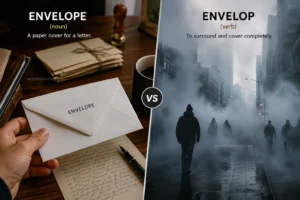
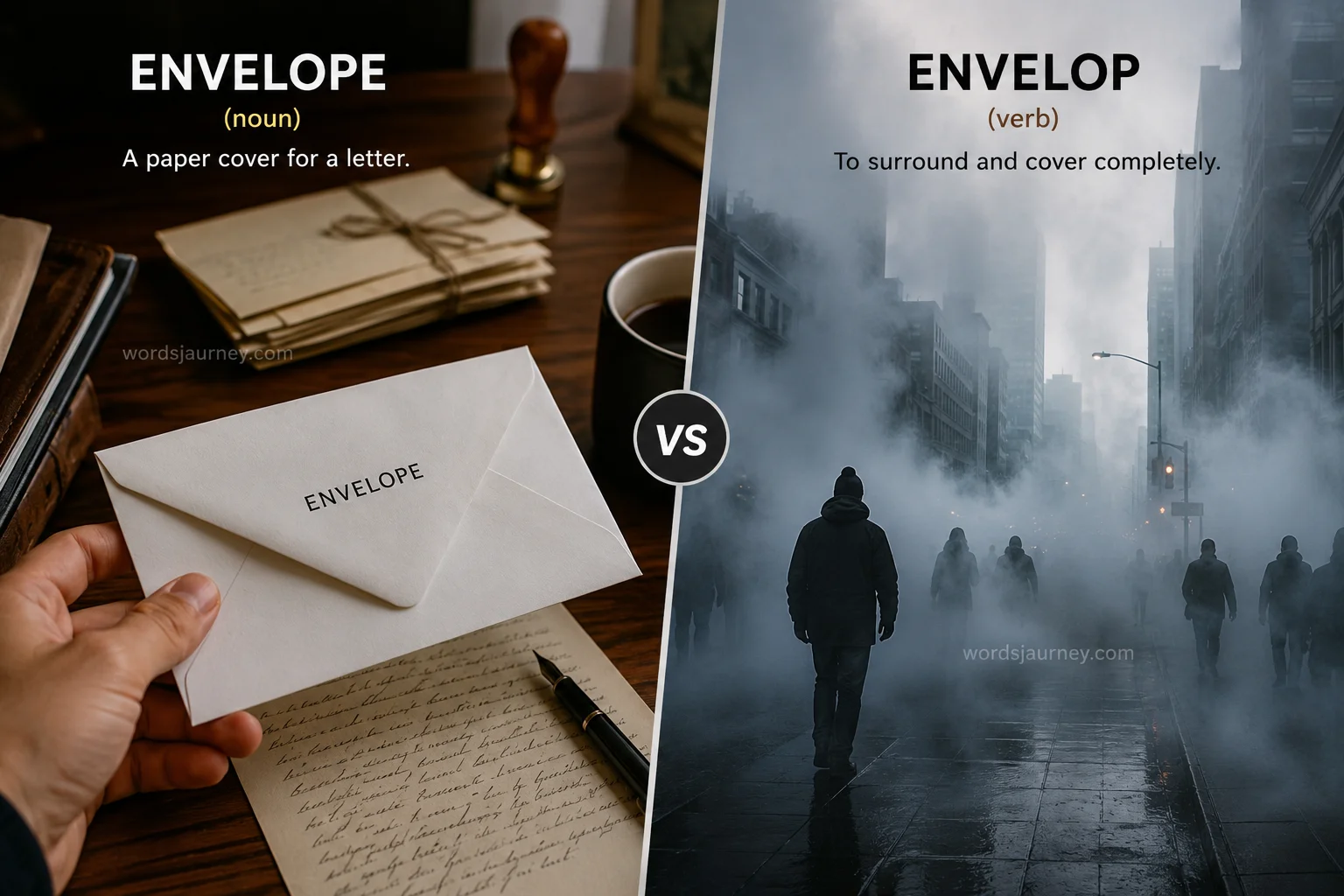
- Envelope = a noun. It is a paper cover used for letters or documents
- Envelop = a verb. It means to surround or cover something completely
Here is a simple rule you can rely on:
- If you can hold it, it is an envelope
- If it is doing the action, it is enveloping
That one idea fixes most confusion.
What Is an Envelope?
Envelope Definition in Simple Terms
An envelope is a flat paper container used to hold letters, cards, or documents. It protects contents and keeps them private until opened.
Think of it as a paper pocket for communication.
Real-World Uses of Envelope
You interact with envelopes more often than you think.
- Sending letters through postal services
- Mailing invoices or contracts
- Wedding invitations
- Bank statements
- Official documents
Even in a digital world, envelopes still matter in physical communication.
Types of Envelopes You See in Daily Life
Different tasks use different envelopes. Here are common types:
| Type of Envelope | Purpose | Example Use |
| Business envelope | Formal communication | Office letters |
| Window envelope | Displays address through a cutout | Bills and statements |
| Security envelope | Hides printed content | Bank letters |
| Invitation envelope | Decorative use | Weddings and events |
| Air mail envelope | International mail | Overseas shipping |
Each type solves a specific communication need.
Key Characteristics of an Envelope
An envelope usually has:
- Paper material
- Sealed flap
- Flat rectangular shape
- Space for address and postage
It does not perform actions. It simply holds things.
Common Sentence Examples
- I placed the letter inside the envelope
- She sealed the envelope before mailing it
- The envelope looked expensive and formal
Notice how it always acts as an object.
Read More: Backyard or Back Yard? Modern English Rules
What Does Envelop Mean?
Envelop Definition in Simple Terms
Envelop is a verb. It means to surround, cover, or wrap something completely.
It describes an action, not an object.
Everyday Uses of Envelop
You will see “envelop” mostly in descriptive or emotional writing.
- Fog envelops a city
- Darkness envelops a room
- Silence envelops a crowd
- Smoke envelops the building
It creates strong visual imagery.
Emotional and Figurative Use of Envelop
Writers use “envelop” to express feelings or abstract ideas.
- Fear enveloped him during the storm
- Calmness enveloped the village at sunrise
- Sadness enveloped the conversation
It often carries emotional weight.
Physical vs Abstract Usage
| Usage Type | Example | Meaning |
| Physical | Fog envelops the forest | Covers physically |
| Emotional | Anxiety enveloped her | Mental state |
| Environmental | Snow envelops the mountain | Natural covering |
This flexibility makes it powerful in storytelling.
Sentence Examples for Clarity
- The mist enveloped the valley
- Warm light enveloped the room
- Silence enveloped the audience after the speech
Each sentence shows action, not object.
Envelope vs Envelop Side-by-Side Comparison
This table removes all remaining confusion.
| Feature | Envelope | Envelop |
| Word type | Noun | Verb |
| Core meaning | Paper container | To surround or cover |
| Function | Object | Action |
| Tangible | Yes | No |
| Usage context | Communication, mailing | Descriptive writing |
| Example | Put letter in envelope | Fog envelops city |
Why People Confuse Envelope and Envelop
This confusion is more logical than it looks.
Similar spelling and sound
Both words look almost identical. That creates automatic confusion when typing or speaking.
Shared linguistic origin
Both words come from French roots connected to wrapping or covering. That shared origin creates overlap in meaning.
Autocorrect and fast typing
Many mistakes come from:
- Autocorrect assumptions
- Speed typing
- Lack of proofreading
Limited exposure to “envelop”
Most people use “envelope” often. “Envelop” appears less frequently in daily conversation. That imbalance makes it harder to remember.
Easy Memory Tricks to Never Mix Them Again
Here are practical memory shortcuts that actually work.
Trick 1: Object vs Action Rule
- Envelope = object you can hold
- Envelop = action that happens
Trick 2: Letter clue method
Think of “envelope” containing a letter. The word itself contains “lope” like “wrap and slope of paper.”
Trick 3: Action test
Ask yourself:
- Is something doing the covering? → use envelop
- Is something being held? → use envelope
Trick 4: Visual imagination trick
Picture this:
- Envelope = paper pouch on a desk
- Envelop = fog spreading across a mountain
That contrast sticks in memory fast.
Common Mistakes with Envelope and Envelop
Even experienced writers slip up.
Mistake 1: Using “envelope” as a verb
❌ The fog envelope the city
✔ The fog envelops the city
Mistake 2: Using “envelop” as a noun
❌ Put the letter in the envelop
✔ Put the letter in the envelope
Mistake 3: Mixing both in formal writing
- Business emails often contain spelling confusion
- Academic writing mistakes reduce clarity
- Automated tools sometimes fail to correct context
Word Origin and Linguistic Background
Understanding origin makes memory stronger.
Both words trace back to French roots related to wrapping:
- Old French “envoloper” meant to wrap or cover
- English later separated usage into noun and verb forms
That split created today’s distinction.
This is common in English. One root word often evolves into multiple meanings depending on function.
When to Use Envelope vs Envelop in Real Writing
Let’s make this practical.
Use “Envelope” when talking about:
- Mailing letters
- Physical stationery
- Documents and packaging
- Office communication
Example:
- I need an envelope for this contract
Use “Envelop” when describing:
- Weather conditions
- Emotional states
- Environmental changes
- Abstract or poetic writing
Example:
- A heavy silence enveloped the hall
Mini Case Study: Real Writing Error Analysis
Let’s look at a realistic scenario.
Scenario
A student writes:
The darkness envelope the room as the storm approached.
Problem
- “Envelope” is incorrectly used as a verb
- The sentence describes action, so verb form is required
Correct version
The darkness enveloped the room as the storm approached.
Why it matters
Small errors like this can:
- Reduce academic scores
- Confuse readers
- Lower writing clarity
Fixing them improves professionalism instantly.
Practice Section: Test Your Understanding
Try these quick corrections.
Fill in the blanks
- The letter went inside the ______
- Fog began to ______ the city
- She sealed the ______ carefully
- Silence ______ the audience
Answers
- envelope
- envelop
- envelope
- enveloped
FAQs on Envelope vs Envelop
1. What is the difference between Envelope and Envelop?
Envelope is a noun for a paper container, while envelop is a verb meaning to surround or cover something completely.
2. Is envelope a noun or verb?
Envelope is mainly a noun used for a flat paper container with a sealable flap.
3. What does envelop mean?
Envelop means to surround, cover, or enclose something fully.
4. Why do people confuse envelope and envelop?
They look and sound similar, but they have different grammar roles and meanings.
5. How do you use an envelope in a sentence?
You can say, “Put the letter in the envelope.”
6. How do you use envelop in a sentence?
You can say, “Fog can envelop the city at night.”
7. Is the pronunciation different for envelope and envelop?
Yes, envelope is stressed on the first syllable, while envelop is stressed on the second.
8. Are envelope and envelop related in origin?
Yes, both come from French roots and evolved into English over time.
9. What is a common example of envelop in real life?
A storm can envelop a whole area, meaning it surrounds it completely.
10. Is envelope used in technical meaning?
Yes, it can also mean system limits like speed, pressure, or capability boundaries.
Conclusion
The difference between Envelope and Envelop is simple once you understand their roles in English. Envelope refers to a physical object used for letters and documents, while envelop describes an action of surrounding or enclosing something. Their confusion mainly comes from similar spelling and shared idea of covering.
Understanding their correct use improves writing, speaking, and grammar accuracy. With practice, you can easily avoid mistakes and use both words confidently in everyday and professional communication.

Emma Brook is a dedicated writer and language enthusiast at WordsJourney. She’s passionate about helping readers understand words better and use them with confidence in everyday conversations. Her work focuses on alternative phrases, clear meanings, and practical examples that make language feel simple and approachable.
With a friendly, reader-first writing style, Emma breaks down common expressions and explores smarter ways to say things without sounding forced or complicated. Her goal is to make learning words enjoyable, useful, and easy for everyone.