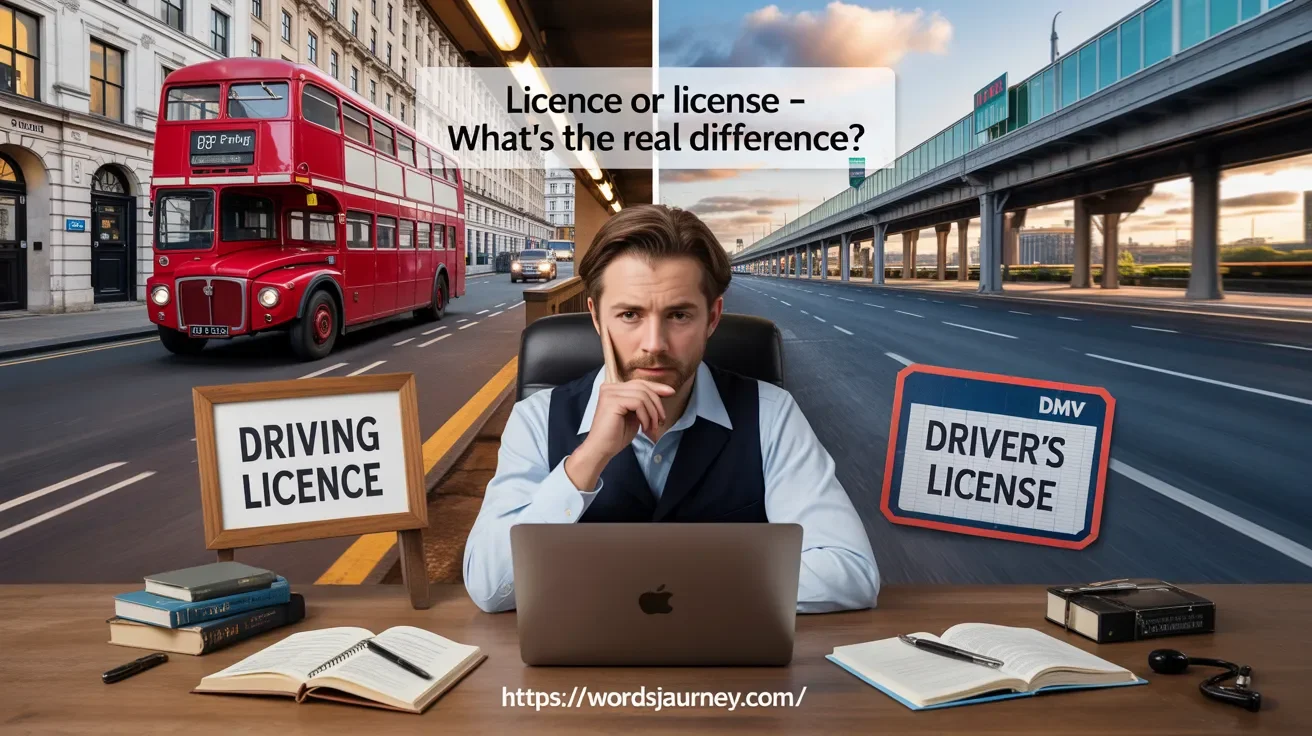
Understanding Licence or License is important if you write in British or American English. The confusion happens because both words look and sound the same, but their meaning changes based on regional English rules. In British English, a licence is used as a noun meaning an official permit given by an authority to own, use, or do something.
For example, a driver’s licence allows a person to legally drive a vehicle. On the other hand, the verb form is license, which means to give official permission. For instance, a government may license a business to operate legally.
In American English, the system is simpler because license is used for both noun and verb, making it more straightforward in writing and communication. This difference often appears in legal documents, education, and professional writing, where accuracy matters.
The key to remembering the difference is understanding UK vs US English conventions. In the UK, the spelling changes depending on part of speech, while in the US, one spelling works for both. This is why writers often get confused when switching between styles. In real-world communication, using the correct form improves clarity, professionalism, and global understanding.
Whether you are writing about a legal permit, driving license, or business approval, knowing when to use licence or license helps avoid mistakes. In short, both words are correct, but their usage depends entirely on regional English standards and writing context.
Licence or License: The Main Difference
The difference between licence and license depends on two things:
- The type of English you use
- Whether the word acts as a noun or verb
Here’s the easiest way to understand it.
| English Version | Noun | Verb |
| British English | Licence | License |
| American English | License | License |
That’s the entire rule in one table.
Still, there’s more nuance beneath the surface. Let’s unpack it properly.
How British English Uses “Licence”
In British English, licence is a noun. It refers to permission, authority, or an official document.
For example:
- You need a driving licence before operating a car.
- The restaurant received a liquor licence.
- Her software licence expired last month.
Think of licence as a thing you possess.
Common British Noun Uses
Here are the most common contexts:
| Type | Example |
| Driving | Driving licence |
| Business | Trading licence |
| Media | TV licence |
| Technology | Software licence |
| Legal | Marriage licence |
| Recreation | Fishing licence |
In the UK, using “license” as a noun often looks incorrect unless the context follows American English standards.
How British English Uses “License”
In British English, license functions as a verb.
That means it describes the act of granting permission.
Examples:
- The council will license the new taxi company.
- Authorities refused to license the product.
- The government plans to license additional broadcasters.
Notice the action-based meaning. Someone is actively permitting something.
A Fast Memory Trick
Many people remember the rule this way:
- C in licence = certificate
- S in license = action
It’s not a perfect grammar formula but it helps under pressure.
How American English Uses “License”
American English simplifies the rule completely.
The spelling license works for both noun and verb forms.
Examples:
- She renewed her driver’s license.
- The agency will license the company.
Americans rarely use “licence.” In fact, it usually appears as a spelling mistake in US publications.
This difference explains why global companies often struggle with consistency. A British website may say “software licence” while an American product page says “software license.”
Neither is automatically wrong. The audience determines the correct spelling.
Licence vs License Comparison Table
Here’s a clearer side-by-side comparison.
| Feature | Licence | License |
| Used In | British English | American English |
| Part of Speech | Noun | Noun and verb |
| Meaning | Permission document | Permission or granting permission |
| Common Regions | UK, Australia, New Zealand | United States |
| Example | Driving licence | Driver’s license |
| Verb Form | Not used | Used |
This table alone solves most confusion.
What Does “Licence” Mean?
The noun licence refers to official authorization.
It gives someone legal permission to perform an activity, own something, or operate within regulated rules.
Without a licence, many activities become illegal.
Common Meanings of Licence
A licence can mean:
- Legal permission
- Official approval
- Government certification
- Commercial authorization
- Regulatory clearance
In practical life, licences control everything from driving to broadcasting.
Types of Licences You Encounter Daily
Most people use several licences without even noticing.
Driving Licence
This proves you can legally operate a vehicle.
In the UK, the phrase is always “driving licence.”
In the US, it becomes “driver’s license.”
Software Licence
Software companies grant permission through licensing agreements.
For example:
- Adobe software licences
- Microsoft enterprise licences
- Antivirus licences
These agreements define:
- User rights
- Installation limits
- Commercial restrictions
- Subscription periods
Business Licence
Local governments issue business licences to regulate commerce.
Restaurants, contractors, salons, and online businesses may all require licensing depending on the country and industry.
Broadcasting Licence
Television and radio broadcasters often need government authorization before transmitting content.
The UK TV licence remains one of the most famous examples worldwide.
Example Sentences Using “Licence”
Here are natural British English examples.
| Correct Sentence | Usage Type |
| Her driving licence expires next year. | Noun |
| The business licence arrived yesterday. | Noun |
| You need a fishing licence in this area. | Noun |
| Their software licence covers 50 employees. | Noun |
Notice every example treats the word as an object or document.
What Does “License” Mean?
The word license carries two roles in American English.
It can mean:
- An official permit
- The act of granting permission
That dual function makes American grammar simpler.
License as a Noun
When used as a noun, “license” means permission or certification.
Examples:
- His driver’s license was suspended.
- The restaurant renewed its liquor license.
- Your software license expires soon.
This matches the British noun meaning except for the spelling.
License as a Verb
As a verb, “license” means authorizing someone legally.
Examples:
- The state will license new operators.
- Authorities licensed the medical facility.
- The company licenses its technology globally.
This usage appears heavily in legal and corporate writing.
Why British English Uses Two Spellings
English spelling evolved through centuries of linguistic chaos. That sounds dramatic because it is.
The word traces back to:
- Latin: licentia
- Old French: licence
- Middle English developments
Over time, British English developed noun-and-verb spelling distinctions.
That pattern appears in several word pairs.
| Noun | Verb |
| Advice | Advise |
| Practice | Practise |
| Device | Devise |
| Prophecy | Prophesy |
| Licence | License |
British English likes visual separation between things and actions.
American English simplified many spellings during language reforms in the 18th and 19th centuries. Noah Webster played a major role in standardizing shorter American spellings.
That’s why Americans use:
- Color instead of colour
- Organize instead of organise
- License instead of licence
Language evolves like a river. It rarely flows in straight lines.
Licence vs License Around the World
Different countries follow different spelling traditions.
United Kingdom
The UK uses:
- Licence as noun
- License as verb
Government agencies follow this rule consistently.
For example:
- Driving licence
- TV licence
- Firearms licence
United States
The US uses license for everything.
Examples include:
- Driver’s license
- Business license
- Licensed professional
“Licence” looks foreign to most American readers.
Canada
Canada sits somewhere in the middle.
Canadian English blends British and American influences.
In official writing, many Canadian institutions still prefer:
- Licence (noun)
- License (verb)
However, American spelling appears frequently in business and technology sectors.
Read More: “Favourite” or “Favorite” Which Spelling Is Correct?
Australia and New Zealand
Australia and New Zealand generally follow British conventions.
That means:
- Licence = noun
- License = verb
Government websites in both countries maintain this distinction.
Common Licence vs License Mistakes
People mix these spellings constantly. Even professional writers slip up when switching between audiences.
Using “Licence” in American Writing
This instantly stands out to American readers.
Incorrect US example:
- I renewed my driver’s licence yesterday.
Correct US version:
- I renewed my driver’s license yesterday.
Mixing British Noun and Verb Forms
This happens often in UK content.
Incorrect:
- The council issued a taxi license.
Correct:
- The council issued a taxi licence.
But:
- The council will license additional taxis.
See the difference? One refers to the document while the other describes the action.
Licence or License in Professional Writing
Spelling consistency matters more in professional settings than casual conversation.
A single incorrect word can undermine credibility.
Academic Writing
Universities expect regional consistency.
If you write in British English:
- Use licence for nouns
- Use license for verbs
If you write in American English:
- Use license throughout
Switching styles mid-paper creates unnecessary confusion.
Legal Documents
Legal writing depends heavily on precise language.
A licensing agreement, for example, may define:
- User permissions
- Intellectual property rights
- Liability clauses
- Distribution rights
Small spelling inconsistencies can create editing headaches during contract review.
Business and Marketing Content
Global businesses must decide which audience they target.
Example
A UK cybersecurity company may write:
- “Enterprise software licence solutions”
Meanwhile, a US competitor writes:
- “Enterprise software license solutions”
Neither is wrong. Audience targeting matters most.
Software and Technology Usage
Technology creates one of the biggest spelling battlegrounds online.
You’ll regularly see:
| British English | American English |
| Software licence | Software license |
| Licensing agreement | Licensing agreement |
| Licensed product | Licensed product |
Interestingly, “licensing” stays the same in both systems because it derives from the verb form.
That detail surprises many writers.
Real-World Case Study: Global Software Brands
Large software companies adapt spelling regionally.
Example Pattern
| Region | Common Wording |
| United Kingdom | Software licence |
| United States | Software license |
| Australia | User licence |
| Canada | Mixed usage |
This localization improves:
- User trust
- Search visibility
- Brand professionalism
- Conversion rates
Small language details influence perception more than people realize.
Easy Examples to Understand the Difference
Sometimes examples teach faster than explanations.
British English Examples
| Sentence | Correct? |
| She renewed her driving licence. | Yes |
| The council will license new drivers. | Yes |
| His software licence expired. | Yes |
| They licensed the technology last year. | Yes |
American English Examples
| Sentence | Correct? |
| She renewed her driver’s license. | Yes |
| The state licensed the facility. | Yes |
| Your software license is active. | Yes |
| The company licenses music content. | Yes |
Incorrect Examples Explained
| Incorrect | Correct |
| UK: Driving license | Driving licence |
| US: Driving licence | Driver’s license |
| UK: The agency will licence operators | The agency will license operators |
These tiny adjustments make your writing instantly cleaner.
Quick Grammar Rules You Can Memorize
Sometimes you just need the fastest possible answer.
British English Rule
- Licence = noun
- License = verb
American English Rule
- License = noun and verb
One-Line Cheat Sheet
British English splits the spellings. American English doesn’t.
That single sentence solves the confusion for most readers.
Licence vs License in Popular Style Guides
Professional style guides help standardize usage.
Oxford Style
Oxford English follows:
- Licence = noun
- License = verb
Cambridge Style
Cambridge dictionaries use the same British distinction.
AP Style
Associated Press style in the US uses “license” for both forms.
This dominates American journalism.
Chicago Manual of Style
Chicago style also follows standard American usage.
That means “license” across the board.
Government Language Standards
Government agencies usually follow regional spelling conventions strictly.
Examples:
| Country | Preferred Form |
| UK | Licence |
| US | License |
| Australia | Licence |
| New Zealand | Licence |
Official language consistency matters heavily in public communication.
Why People Still Get Confused
English isn’t always logical.
That’s the honest answer.
Many people encounter both spelling systems online every day through:
- Social media
- Streaming services
- International websites
- Remote work
- Global software products
As a result, spelling conventions blur together.
A British freelancer might write for American clients while an American business sells products in the UK.
Language globalization creates overlap constantly.
A Simple Analogy That Actually Helps
Think about it this way.
In British English:
- A licence is the ticket
- To license is handing out the ticket
The noun represents the object.
The verb represents the action.
That mental picture sticks surprisingly well.
Frequently Asked Questions (FAQs)
1. What is the difference between licence and license?
The difference is based on region. In British English, licence is a noun and license is a verb, while in American English license is used for both.
2. Is licence correct in American English?
No. In American English, the correct spelling for both noun and verb is license.
3. When should I use license as a verb?
Use license as a verb when talking about giving official permission, such as a government licensing a business.
4. What is a driver’s licence?
A driver’s licence is an official document that allows a person to legally drive a vehicle in countries using British English spelling.
5. Why do UK and US spellings differ?
They differ due to historical English language evolution and regional writing standards.
6. Can both spellings be considered correct?
Yes, both are correct, but their usage depends on whether you follow British or American English conventions.
7. What does license mean in legal terms?
It refers to official permission granted by an authority to do something, such as operating a business or driving.
8. Is licence always a noun in British English?
Yes, in British English, licence is always used as a noun.
9. How can I remember the difference easily?
Think of it this way: in British English, nouns end in -ce and verbs use -se.
10. Where is license used for both noun and verb?
It is used in American English, where spelling is simplified for both grammatical forms.
Conclusion
The difference between licence or license depends entirely on regional English usage, especially between the UK and the US. While British English separates the noun (licence) and verb (license), American English uses license for both. Understanding this small but important distinction helps improve writing accuracy, grammar clarity, and professional communication. Whether you are writing for academic, legal, or business purposes, using the correct form ensures your message is clear and globally understandable.

Aliya Ray is a passionate writer and language enthusiast at WordsJourney. She enjoys exploring words, phrases, and everyday expressions to help readers communicate more clearly and confidently. Her content focuses on alternative ways to say common phrases, simple explanations, and real-life examples that make language easy to understand.
Aliya believes the right words can make any message stronger. Through clear, friendly writing, she helps readers improve their vocabulary without feeling overwhelmed or confused.