Ever paused while writing and asked yourself whether it should be “Roofs vs Rooves”? This small but tricky spelling choice often catches even confident writers off guard. The English language has a habit of bending its own rules, and the plural of roof is a perfect example of that confusion.
This debate exists because English has evolved through centuries of regional usage differences, irregular plural forms, and shifting grammar standards. Today, “roofs” dominates modern American and international English, while “rooves” survives in older British texts and historical references. Knowing this distinction strengthens your grasp of proper spelling conventions, language evolution, and clear written communication.
In this guide, you’ll discover why both forms appeared, which one is accepted in modern writing, and how to confidently choose the correct version in real-world use. By the end, you’ll have a clear understanding of this grammar variation and never second-guess it again.
Roofs vs Rooves: The Short and Clear Answer
Here’s the truth without any fluff:
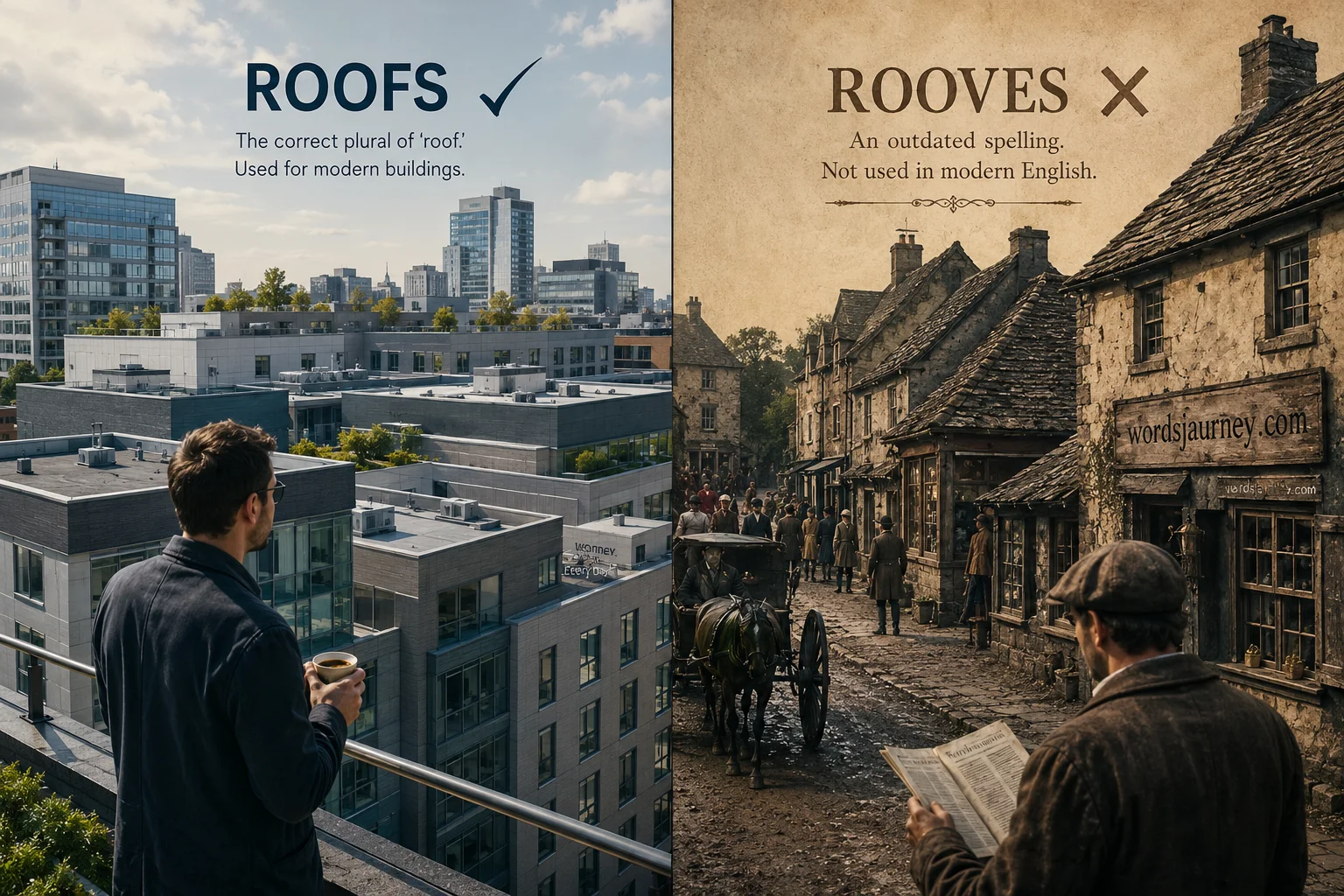
- Roofs is the correct modern plural form of roof
- Rooves is outdated and considered nonstandard today
Most dictionaries, grammar guides, and style manuals now recommend roofs only.
Simple rule you can trust:
Always use roofs in modern writing unless you’re quoting historical text.
That’s it. Clean and simple.
What Does “Roof” Mean in English?
Before comparing roofs vs rooves, you need a clear definition of the base word.
A roof is the top covering of a structure. It protects buildings from weather like rain, heat, wind, and snow.
Common examples of roofs in real life:
- House roofs
- Apartment building roofs
- Carport roofs
- Stadium roofs
- Shed roofs
A roof does one main job. It creates protection above enclosed space.
Why plural matters:
When you talk about more than one structure, you naturally need a plural form. That’s where confusion starts.
Roofs vs Rooves: Why This Confusion Exists
English spelling did not stay stable over time. It evolved through centuries of change.
Older English used irregular plural forms more often. Over time, English simplified many of them.
So both forms appeared in history:
- Rooves came from older English patterns
- Roofs became the standardized modern form
Key idea:
English prefers simplicity today, not older irregular patterns.
That’s why “roofs” won.
Roofs Explained: The Modern Standard Usage
The word roofs follows modern English grammar rules.
Most words ending in -f or -fe form plurals by adding -s.
Examples:
- roof → roofs
- chief → chiefs
- belief → beliefs
Sentences using roofs:
- The storm damaged several roofs across the city.
- Many modern homes now use flat roofs.
- Workers repaired the roofs before the rainy season.
Why this form works best:
- It follows modern spelling rules
- It appears in all major dictionaries
- It fits academic and professional writing
Fact: Nearly all modern English publications use “roofs” exclusively.
Rooves Explained: The Old and Rare Form
The plural rooves comes from older English usage. It once appeared in some dialects and historical writing.
But language changed over time. The form slowly disappeared from standard English.
Where you might still see “rooves”:
- Old literature from the 1500s–1800s
- Regional dialect writing
- Nonstandard or informal usage
- Historical documents
Important note:
Modern grammar authorities consider rooves outdated.
Example of older usage:
“The rooves of the village houses stood covered in snow.”
Today, this sentence would be written as:
“The roofs of the village houses stood covered in snow.”
Why “Roofs” Replaced “Rooves”
Language evolves when speakers choose easier patterns.
English gradually simplified plural rules to improve consistency.
Main reasons for the shift:
- Standardization of spelling rules
- Influence of dictionaries and education systems
- Preference for simpler plural forms
- Reduction of irregular word endings
Think of it like this:
English cleaned up its grammar closet. It removed confusing old patterns and kept simpler ones.
Read More: “Specter vs Spectre” Difference and Real-World Examples
Grammar Rule Behind Roofs vs Rooves
Most nouns ending in -f or -fe follow a predictable pattern today.
Modern rule:
- Add -s to form plurals
Examples:
- roof → roofs
- chef → chefs
- cliff → cliffs
But English still keeps a few exceptions:
Some words change f → ves
Examples:
- leaf → leaves
- knife → knives
- wolf → wolves
- wife → wives
Roofs vs Rooves: Comparison Table
Here’s a simple breakdown to lock it in:
| Singular | Modern Plural | Status |
| roof | roofs | Correct |
| roof | rooves | Outdated |
| leaf | leaves | Correct exception |
| knife | knives | Correct exception |
Key takeaway:
“Roofs” belongs to modern English. “Rooves” belongs to history books.
When Should You Use “Roofs”?
You should always choose roofs in modern communication.
Use “roofs” in:
- Academic writing
- Business documents
- Blog posts
- Emails
- SEO content
- News articles
Example sentence:
- The engineers inspected all building roofs after the storm.
Simple rule:
If your goal is clarity and correctness, use “roofs” every time.
Why Some People Still Write “Rooves”
Even today, some writers still use “rooves.” That usually happens for three reasons.
1. Habit from older learning
Some people learned outdated grammar rules.
2. Influence from older texts
They read historical writing and mimic it unconsciously.
3. Sound-based spelling guess
“Rooves” looks like it should exist because of similar words like “knives.”
Reality check:
Modern English does not support “rooves” as standard usage.
Common Mistakes with Roofs vs Rooves
Writers often slip up in predictable ways.
Mistake patterns:
- Mixing both forms in one article
- Using “rooves” in formal writing
- Overthinking -f plural rules
- Relying on outdated grammar memory
Example mistake:
- Incorrect: The rooves of the houses need repair
- Correct: The roofs of the houses need repair
Style Guide Consensus on Roofs vs Rooves
Major language authorities agree on one thing.
What style guides say:
- Modern dictionaries list roofs as correct
- “Rooves” appears as archaic or nonstandard
- Educational systems teach “roofs” only
Summary:
If you follow any professional writing standard, “roofs” is the only safe choice.
Memory Tricks to Remember the Correct Form
You can lock this rule in your memory easily.
Trick 1:
“One roof, many roofs—no V needed.”
Trick 2:
Think of English simplifying over time, not complicating.
Trick 3:
If unsure, remove the extra letters. Choose simplicity.
Real-World Usage of Roofs in Writing
Let’s see how professionals actually use it.
Construction industry example:
- Contractors inspect building roofs after installation.
Journalism example:
- Heavy rain damaged hundreds of roofs across the city.
Academic writing example:
- Urban heat studies analyze reflective roofing materials on roofs.
Case Study: Language Simplification in English
English has a long history of simplifying plural forms.
Observed pattern:
- Older English used more irregular plurals
- Modern English reduced irregular endings
- Standard forms became dominant in education and publishing
Example shift:
- Older form: rooves
- Modern form: roofs
Similar changes:
- shew → show
- musick → music
- colour → color (American standardization)
Insight: Language evolves toward clarity and ease of use.
Quick Grammar Rules You Can Apply Immediately
Here’s a fast checklist for plurals ending in -f:
Always use -s when:
- The word is modern and standard
- Dictionaries show a simple plural form
Use -ves only when:
- The word is a known exception (leaf, knife, wolf)
Otherwise:
Default to “-s” and you will be correct most of the time.
FAQs on Roofs vs Rooves
1. What is the correct plural of roof?
The correct modern plural is “roofs”. It is widely accepted in both American and British English today.
2. Is “rooves” still correct?
“Rooves” is considered outdated. It appears in older British texts but is rarely used in modern writing.
3. Why do two forms exist for roof?
Both forms come from historical English changes. Over time, standardization of grammar favored “roofs.”
4. Do Americans ever use “rooves”?
No, American English consistently uses “roofs” in all formal and informal contexts.
5. Is “roofs” grammatically correct?
Yes, “roofs” follows modern pluralization rules and is grammatically correct in all standard English usage.
6. Where might I still see “rooves”?
You may find it in old literature, historical documents, or dialectal writing from earlier centuries.
Conclusion
The debate of roofs vs rooves may look minor, but it highlights how English evolves over time. While both forms have historical roots, modern usage clearly favors “roofs” as the standard plural. This makes your writing more consistent, professional, and widely understood.If you aim for clarity in academic work, blogging, or business communication, sticking with “roofs” is the safest choice. Understanding these small grammar shifts not only improves accuracy but also strengthens your overall command of English language conventions.

Emma Brook is a dedicated writer and language enthusiast at WordsJourney. She’s passionate about helping readers understand words better and use them with confidence in everyday conversations. Her work focuses on alternative phrases, clear meanings, and practical examples that make language feel simple and approachable.
With a friendly, reader-first writing style, Emma breaks down common expressions and explores smarter ways to say things without sounding forced or complicated. Her goal is to make learning words enjoyable, useful, and easy for everyone.