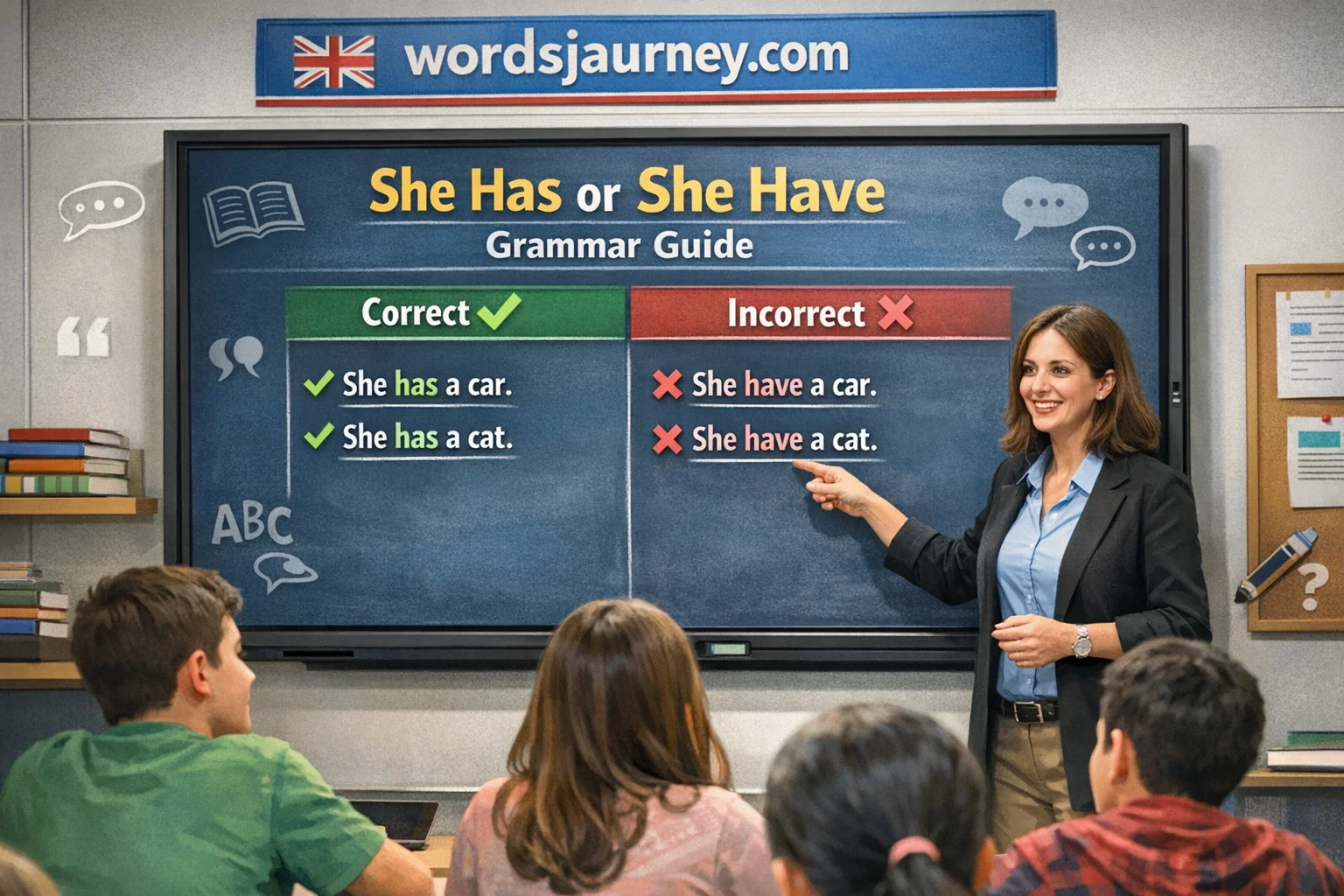
Choosing between “she has” or “she have” may seem like a small detail, but it’s one of the most common grammar mistakes in English. Many learners and even fluent speakers pause mid-sentence, unsure which form is correct. The confusion comes from a basic yet essential rule: subject-verb agreement, where the verb must match the subject.
In standard English, “she has” is correct because “she” is a third-person singular subject, while “she have” is incorrect in most contexts. Still, this rule can feel tricky, especially when you’re thinking fast or translating from another language.
This guide breaks down “She Has” or “She Have” The Correct Usage Explained with Simple Rules, Real Examples, and Clear Grammar Fixes” in a way that’s easy to understand and remember. You’ll learn the exact rule, see clear examples, discover quick memory tips, and practice with real-life sentences so you can use the correct form confidently every time.
Why People Confuse “She Has” or “She Have” in Everyday English
The confusion comes from how English feels versus how English actually works.
When people speak casually, they often hear patterns like:
- I have
- You have
- They have
So the brain tries to apply “have” everywhere. That leads to mistakes like:
- ❌ She have a car
- ❌ She have finished work
Another reason is speed. In fast speech, grammar rules take a back seat. People prioritize meaning over correctness.
Here are the most common causes of confusion:
- Overgeneralizing the word have
- Mixing spoken habits with written grammar
- Forgetting subject-verb agreement rules
- Translating directly from native languages
- Hearing incorrect usage in informal speech
Here is a simple truth:
English does not use the same verb form for every subject. The subject controls the verb.
Once you understand that, everything becomes easier.
The Simple Rule for “She Has” or “She Have” Must Remember
Let’s strip it down to the core rule.
Basic Grammar Rule
- She = third-person singular subject
- Third-person singular subjects always use “has” in the present tense
So the correct form is:
✔ She has
And the incorrect form is:
❌ She have
“She Has” or “She Have” Quick Reference Table:
This table will save you from 90% of mistakes:
| Subject | Correct Verb | Example |
| I | have | I have a pen |
| You | have | You have time |
| He | has | He has a bike |
| She | has | She has a laptop |
| It | has | It has value |
| We | have | We have plans |
| They | have | They have tickets |
Notice something important?
Only he, she, and it use has. Everything else uses have.
That is the heart of the rule.
Correct Usage of “She Has” in Real-Life English
Now let’s see how she has worked in real communication. This is where grammar becomes practical.
Everyday English Examples
- She has a busy schedule today.
- She has two younger brothers.
- She has already eaten lunch.
Workplace Examples
- She has submitted the report on time.
- She has attended the meeting.
- She has completed her project ahead of deadline.
Academic Examples
- She has demonstrated strong research skills.
- She has improved her writing over time.
- She has studied the topic in depth.
Key Insight
In all these cases, “she” stays singular. So the verb must also stay singular. That is why it has never changed.
Why “She Have” Is Incorrect in Standard English
Let’s be clear. “She have” is not standard English grammar.
Here is why it is wrong:
- “She” is singular
- “Have” is used for plural subjects or I/you/we/they
- Mixing them breaks subject-verb agreement rules
Grammar Breakdown Example
❌ She have a phone
- Subject: She (singular)
- Verb: have (plural form)
- Problem: mismatch
✔ She has a phone
- Subject: She (singular)
- Verb: has (singular form)
- Correct agreement
Think of it like fitting puzzle pieces. If the shapes do not match, the sentence feels wrong.
Native speakers instantly notice this mismatch even if they cannot explain the rule.
Why “Have” Appears Confusing in Questions and Negative Sentences
Now things get trickier. English changes form in questions and negatives.
This is where many learners lose confidence.
“She Has” or “She Have” in Questions
You do NOT say:
❌ Does she has a car?
You MUST say:
✔ Does she have a car?
Why this happens
The word “does” already carries the tense. So the main verb returns to its base form have.
Simple rule
When using does, always use have, never has.
Examples:
- Does she have time?
- Does she have experience?
- Does she have a plan?
“She Has” or “She Have” in Negative Sentences
The same rule applies.
❌ She does not has a car
✔ She does not have a car
Why? Because “does” controls the verb.
Quick pattern
- She does not + have
- He does not + have
- It does not + have
This is one of the most important grammar patterns in English.
Common Mistakes with She Has or She Have
Let’s fix real errors you might see or even make yourself.
Mistake List
- ❌ She have a meeting
- ❌ She have finished work
- ❌ Does she has a phone?
- ❌ She don’t have time
Correct Versions
- ✔ She has a meeting
- ✔ She has finished work
- ✔ Does she have a phone?
- ✔ She does not have time
Why these errors happen
- Mixing auxiliary verbs incorrectly
- Relying on spoken English habits
- Ignoring subject-verb agreement
Read More: “My Father and I” or “My Father and Me” Correct usage
Easy Memory Tricks for She Has or She Have
Let’s make this stick in your mind forever.
Memory Trick 1: The “S Rule”
If the subject ends in S (he, she, it), the verb often changes.
- She → has
- He → has
- It → has
Memory Trick 2: The “Drop the S” Trick
When “does” appears, drop the -s:
- She has → She does have (conceptually)
- But correct form becomes → She does have / does not have
Memory Trick 3: Speak Slowly Rule
When unsure, slow down and check:
- Who is the subject?
- Is it singular or plural?
- Then choose verb
Real-Life Situations Where You Hear This Mistake
This mistake is more common than you think. You will hear it in:
- Casual conversations
- Fast speaking environments
- Social media captions
- Non-native English classrooms
Example Conversation
Incorrect:
- “She have a new phone, right?”
Correct:
- “She has a new phone, right?”
Even if people understand you, correct grammar improves clarity and credibility.
Practice Section: Test Your Understanding of She Has or She Have
Try these before checking answers.
Fill in the blanks
- She ___ a beautiful dress.
- Does she ___ a passport?
- She ___ finished her homework.
- She does not ___ enough time.
- She ___ a strong opinion about it.
Answers
- has
- have
- has
- have
- has
If you got most correct, you are on the right track.
Case Study: How One Simple Grammar Fix Improves Communication
Let’s take a real-world learning example.
A student writing emails to clients often wrote:
- ❌ She have completed the task
After correction:
- ✔ She has completed the task
Result
- Emails became clearer
- Clients understood messages faster
- Professional tone improved instantly
Small grammar fixes often create big communication gains.
Expert Insight on “She Has” or “She Have”
Linguists often describe subject-verb agreement as the backbone of English grammar.
According to modern grammar studies:
- Over 70% of beginner English errors involve verb agreement
- “has/have” confusion is one of the top five mistakes globally
This shows how important this rule is for clear communication.
FAQs: She Has or She Have
1. Which is correct: “she has” or “she have”?
The correct form is “she has.” In standard English, “she” is a third-person singular subject, so it always takes “has,” not “have.”
2. Why do people say “she have”?
This usually happens due to confusion with plural subjects (like “they have”) or when speakers translate directly from their native language. It’s also sometimes heard in informal or non-standard dialects.
3. Can “she have” ever be correct?
Yes, but only in very specific cases, such as after modal verbs. For example:
- “She may have finished her work.”
- “She could have called you.” Here, “have” is correct because it follows a modal verb.
4. What is the basic rule to remember?
Use “has” with singular subjects (he, she, it) and “have” with plural subjects (I, you, we, they).
5. Is “she’s” the same as “she has”?
Sometimes, yes. “She’s” can mean “she has” (e.g., “She’s finished her homework”) or “she is” depending on the sentence.
Conclusion
Understanding the difference between “she has” or “she have” comes down to one simple rule: match the verb with the subject. Since “she” is singular, “she has” is the correct choice in standard English.
Although it may seem like a small detail, using the correct form makes your English sound clear, natural, and professional. With the simple rules, real examples, and tips you’ve learned here, you can now avoid this common mistake with confidence. Keep practicing, stay consistent, and soon choosing between “she has” or “she have” will feel completely natural.

Aliya Ray is a passionate writer and language enthusiast at WordsJourney. She enjoys exploring words, phrases, and everyday expressions to help readers communicate more clearly and confidently. Her content focuses on alternative ways to say common phrases, simple explanations, and real-life examples that make language easy to understand.
Aliya believes the right words can make any message stronger. Through clear, friendly writing, she helps readers improve their vocabulary without feeling overwhelmed or confused.