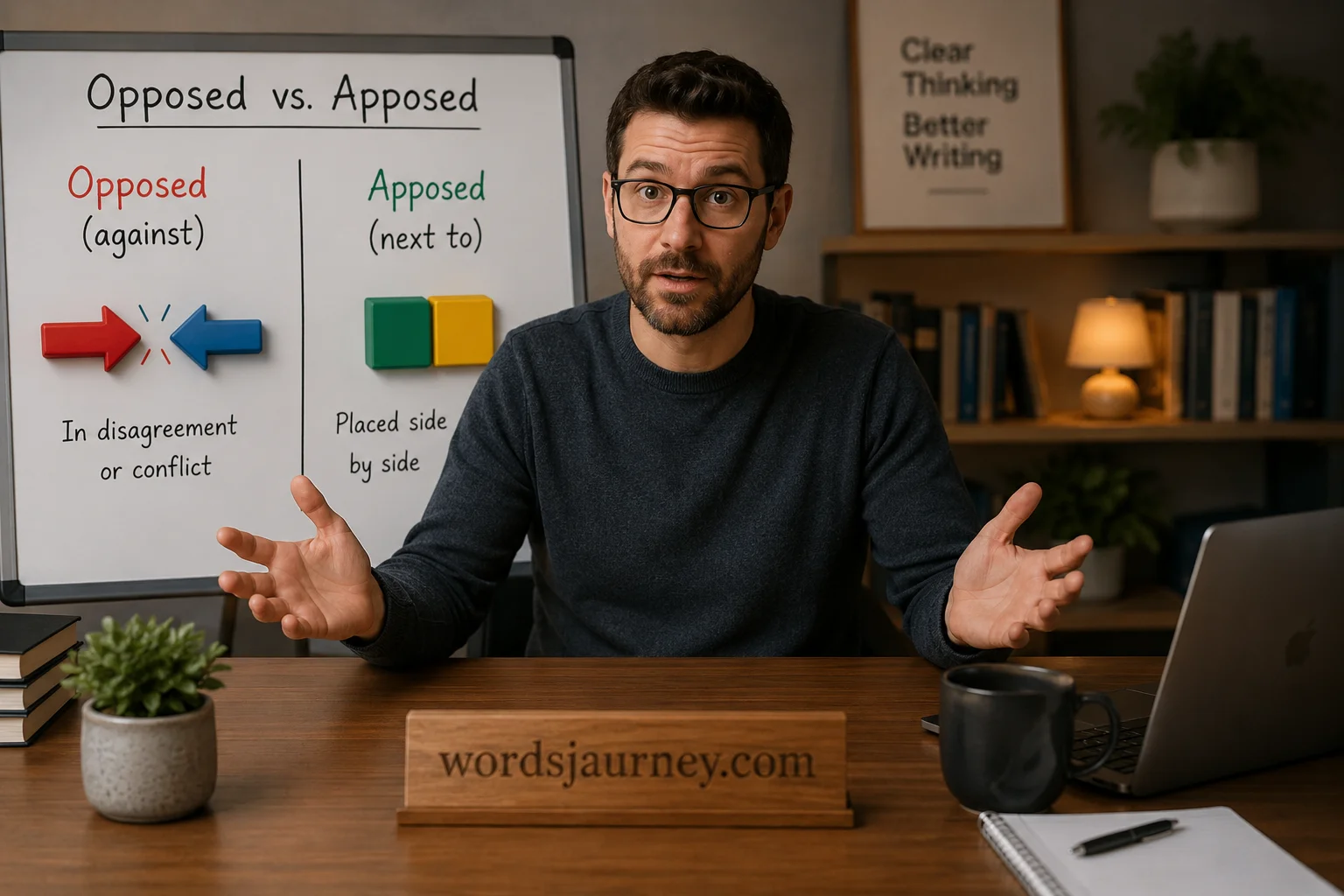
Apposed vs Opposed shows how small spelling changes confuse English language writing when words sound similar but mean different things clearly.
In English language, these words often sound like distant cousins or siblings yet meanings differ. You’re not alone when mixing them. These words behave differently in writing and change meaning in anatomy spelling disagreement confusion vs stand use.
As an editor, I see writers pause because apposed vs opposed looks close but works differently in academic and everyday writing. One shows placement next to each other while the other shows resistance. Understanding this builds confidence in clear writing.
Apposed vs Opposed: Quick Answer First
Before going deep, here’s the fast breakdown:
- Opposed = against something or in disagreement
- Apposed = placed next to something or in grammatical/technical alignment
That’s it. Two words. Two totally different meanings.
Now let’s break them down so you never confuse them again.
Opposed Meaning in English (Clear Definition and Usage)
The word opposed comes from Latin roots meaning “to stand against.” In modern English, it describes resistance, disagreement, or conflict.
Simple Definition of Opposed
To be opposed means:
- You disagree with something
- You resist something
- You stand against an idea, action, or decision
How “Opposed” Works in Real Life
You’ll see this word everywhere because it’s common in daily communication.
Everyday situations
- “I am opposed to waking up early on weekends.”
- “She is opposed to the new dress code.”
- “They are opposed to changing the schedule.”
Professional and formal use
- “The committee opposed the proposed budget cuts.”
- “Experts opposed the policy due to safety concerns.”
- “The lawyer opposed the motion in court.”
Political use
- “The senator opposed the bill during the session.”
- “Citizens opposed the tax increase.”
Opposed as a Verb vs Adjective
This word works in two main forms:
As a verb
- “The manager opposed the decision.”
As an adjective
- “They are opposed to the decision.”
Both are correct. The structure changes, but the meaning stays tied to disagreement.
Read More: Appal vs. Appall: Meaning and Differences
Common Phrases with Opposed
- Opposed to change
- Strongly opposed
- Firmly opposed
- Publicly opposed
- Historically opposed
Synonyms of Opposed
| Word | Meaning | Usage Context |
| Against | Direct opposition | Casual speech |
| Resistant | Not accepting | Formal contexts |
| Hostile | Emotionally negative | Strong disagreement |
| Contrary | Opposite idea | Logical discussions |
| Objecting | Formal disagreement | Legal or debate settings |
Apposed Meaning in English (Rare but Real Word)
Now let’s talk about the less familiar word: apposed.
Most people never use it in daily conversation. That’s why confusion happens.
Simple Definition of Apposed
The word apposed means:
- Placed next to something
- Positioned side by side
- Aligned in close contact (especially in technical language)
Unlike “opposed,” this word has nothing to do with disagreement.
Instead, it describes physical or structural placement.
Where “Apposed” Is Commonly Used
You’ll usually find “apposed” in:
- Grammar and linguistics
- Anatomy and biology
- Medical descriptions
- Technical writing
Apposed in Grammar (Apposition Explained Simply)
In grammar, apposition happens when one noun explains another noun right next to it.
Example of Apposition
- “My friend, John, arrived early.”
Here:
- “My friend” and “John” refer to the same person
- They sit next to each other in structure
So we say they are apposed.
Apposed in Biology and Medicine
In science, “apposed” describes structures placed closely together.
Medical examples
- “The wound edges were apposed neatly after surgery.”
- “The membranes remained apposed during healing.”
Biology examples
- “The cells were apposed along the tissue boundary.”
- “The leaves are apposed on the stem.”
This is technical language, not everyday English.
Apposed Examples in Sentences
Here are clear examples to understand usage:
- “The apposed tissue layers began to fuse.”
- “In grammar, apposed nouns explain each other.”
- “The surgeon ensured the skin edges were properly apposed.”
Why You Don’t Hear “Apposed” Often
Let’s be honest. You almost never hear it in casual speech.
Why?
- It belongs to technical fields
- It is replaced by simpler phrases
- Most writers prefer “placed next to” or “aligned”
So while it is real, it stays in specialized writing.
Apposed vs Opposed: Core Differences Explained
Now let’s compare them directly.
Side-by-Side Comparison Table
| Feature | Apposed | Opposed |
| Meaning | Placed next to something | Against or in disagreement |
| Usage | Technical, scientific, grammatical | Everyday English |
| Emotional tone | Neutral | Conflict-based |
| Commonness | Rare | Very common |
| Context | Medicine, linguistics | Opinions, politics, daily speech |
| Example | “Apposed tissue layers” | “I opposed the idea” |
Simple Way to Remember the Difference
Think of it like this:
- Opposed = opposition (fight, disagreement)
- Apposed = arrangement (side-by-side placement)
That small mental link makes everything easier.
Why People Confuse Apposed vs Opposed
Even strong writers mix these up. Let’s break down why.
1. Similar spelling
Only one letter changes:
- Apposed
- Opposed
That single “a” makes a huge difference in meaning.
2. Similar pronunciation
Both words sound nearly identical when spoken quickly.
So writing becomes the real challenge.
3. Keyboard and autocorrect mistakes
Typing fast often leads to:
- “apposed” instead of “opposed”
- autocorrect missing context
4. Lack of exposure to “apposed”
Most people only see:
- opposed in school
- opposed in media
So “apposed” feels unfamiliar.
5. Context confusion
Writers assume it means “against” because it looks similar.
But that assumption is incorrect.
How to Remember Apposed vs Opposed Easily
Let’s make this stick in your memory.
Memory Trick 1: Opposed = Opposition
- Opposed → Oppose → Opposition
- All involve disagreement
👉 Think: “I oppose your idea.”
Memory Trick 2: Apposed = Apposition
- Apposed → Apposition → placement side-by-side
👉 Think: “Things sitting next to each other.”
Memory Trick 3: Visual shortcut
- Opposed → two people pushing away
- Apposed → two objects touching side-by-side
Common Mistakes with Apposed vs Opposed
Let’s fix the real errors people make.
Mistake 1: Using apposed instead of opposed
Incorrect:
- “I am apposed to this plan.”
Correct:
- “I am opposed to this plan.”
Mistake 2: Using opposed when meaning placement
Incorrect:
- “The cells were opposed in structure.”
Correct:
- “The cells were apposed in structure.”
Mistake 3: Overusing apposed in casual writing
This word does not belong in:
- emails
- blogs
- social media
- general communication
Is Apposed a Real Word or Just a Mistake?
Yes, apposed is a real English word, but it is rare.
It appears mainly in:
- scientific journals
- anatomy textbooks
- grammar explanations
However, in everyday English, it almost never appears.
When You SHOULD use “Apposed”
Use it only when:
- Writing about anatomy or biology
- Discussing grammar rules
- Writing technical or academic content
When You SHOULD NOT use it
Avoid it in:
- daily conversations
- business emails
- blogs
- casual writing
Instead, use simpler alternatives like:
- “next to”
- “side-by-side”
- “aligned”
Grammar Rules You Should Know
Understanding structure helps avoid mistakes.
Opposed to vs Opposed against
- Correct: “opposed to”
- Incorrect: “opposed against” (usually redundant)
Example:
- “She is opposed to the decision.”
Verb vs adjective usage of opposed
As a verb:
- “He opposed the motion.”
As an adjective:
- “He is opposed to the motion.”
Apposed in grammar (apposition rule)
- Two nouns placed side by side
- One explains the other
Example:
- “The teacher, Mr. Khan, explained the lesson.”
Real-World Style Examples
Let’s make this practical.
Opposed in real-world context
- “Employees opposed the new policy due to workload concerns.”
- “Scientists opposed the theory after reviewing new data.”
- “Voters opposed the amendment in large numbers.”
Apposed in technical context
- “The apposed surfaces of the tissue began healing.”
- “In grammar, apposed nouns provide clarification.”
- “The surgeon apposed the wound edges carefully.”
Quick FAQ: Apposed vs Opposed
1. What does Apposed mean?
It means placed side by side or adjacent, often used in anatomy and technical writing.
2. What does Opposed mean?
It means to resist, disagree with, or stand against something.
3. Why do people confuse Apposed and Opposed?
They confuse them because both words look and sound similar in English language.
4. Where is Apposed commonly used?
It is mainly used in biology, anatomy, and technical descriptions.
5. Where is Opposed commonly used?
It is used in daily conversation, writing, and expressing disagreement or resistance.
6. Does a single letter really change the meaning?
Yes, a single letter can completely change meaning in writing and context.
7. How can I remember the difference easily?
Think: Apposed = together (side by side) and Opposed = against (opposite ideas).
Conclusion
Understanding Apposed vs Opposed helps you avoid common writing mistakes in English language. One word shows position or placement, while the other shows resistance or disagreement. When you clearly remember this difference, your writing becomes more precise, confident, and easy to understand in everyday and professional use.

Emma Brook is a dedicated writer and language enthusiast at WordsJourney. She’s passionate about helping readers understand words better and use them with confidence in everyday conversations. Her work focuses on alternative phrases, clear meanings, and practical examples that make language feel simple and approachable.
With a friendly, reader-first writing style, Emma breaks down common expressions and explores smarter ways to say things without sounding forced or complicated. Her goal is to make learning words enjoyable, useful, and easy for everyone.