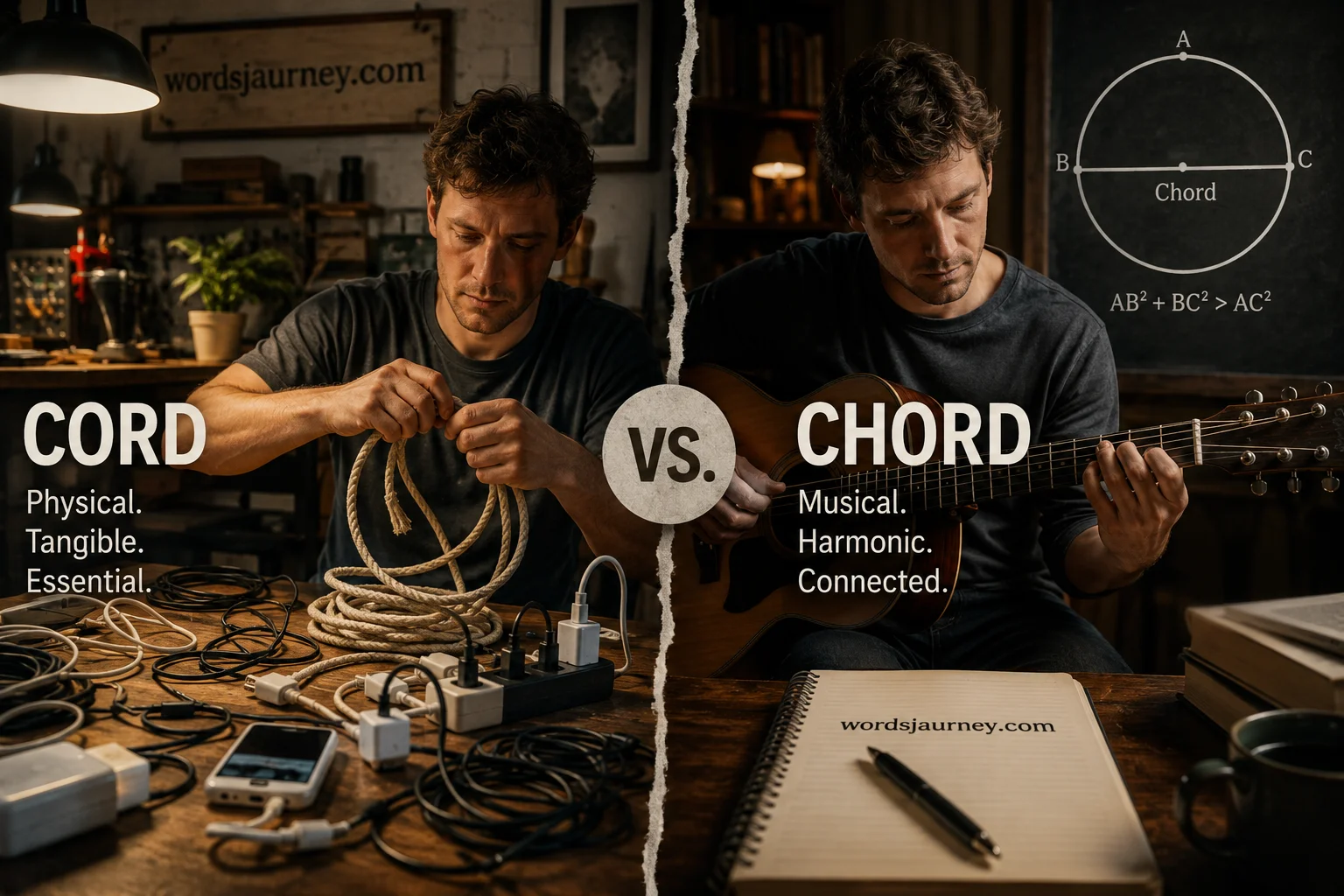
Cord vs Chord shows how English, language, and words can feel the same in sound, yet differ in meaning. It’s a confusing quirk where identical dictations still change sense.
The first paragraph highlights how communication skills and understanding grow when we clear confusion. Words may appear similar in form, but their true meaning always diverges in context.
Musical and Real-Life Usage of Words
In music, a chord creates harmony using notes and a melody, while a cord refers to a rope or string used in real life. Both look similar but serve completely different purposes.
This difference helps enhance grasp of language and avoids mix-up in learning moments. When you keep meanings straight, your skills improve and confusion becomes easier to avoid.
Cord vs Chord: Why This Confusing Pair Matters in English
English is full of “sound-alike” words. But cord vs chord causes extra trouble because both are common in daily life and education.
Here’s the real issue:
- You hear the word, not the spelling
- Your brain assumes both are the same
- You guess the spelling and often get it wrong
That mistake can change meaning completely.
For example:
- “guitar cord” sounds right when spoken, but it’s wrong in writing
- “extension chord” is also incorrect and confusing
A single letter changes everything.
What Is a Cord? Meaning of Cord in Cord vs Chord Confusion
Let’s start with cord.
A cord is a long, flexible material used to connect, tie, or transmit something. It is physical and practical.
You see cords everywhere in daily life.
Cord Meaning in Simple Words
A cord is basically:
- A rope-like object
- A flexible connector
- Something used for holding, powering, or binding
Think of it as a physical link between two points.
Electrical Cord Explained
One of the most common uses is in electronics.
An electrical cord carries power from a source to a device.
Examples include:
- Phone charging cords
- Laptop power cords
- Extension cords for multiple appliances
Without cords, most modern devices simply wouldn’t work.
👉 Fun fact: A damaged cord is one of the most common causes of device charging failure worldwide.
Cord as a Measurement Unit
Here’s something many people don’t know.
A cord is also a unit of volume used for firewood.
- 1 cord = 128 cubic feet of stacked wood
- Usually measured as 4 ft × 4 ft × 8 ft stack
This usage is common in forestry and agriculture.
Everyday Examples of Cord
You interact with cords more than you realize:
- Shoe laces (thin cords)
- Curtain ties
- Earphone wires
- Rope used for packaging
Case Study: Real-World Cord Mistake
A retail store once labeled “charging chord” on product packaging. Customers reported confusion, and sales descriptions were flagged online.
Why?
Because search engines and users expect cord, not chord.
A single spelling error affected visibility and trust.
What Is a Chord? Meaning of Chord in Cord vs Chord Comparison
Now let’s switch gears completely.
A chord has nothing to do with ropes or cables.
It belongs to music, math, and science.
Chord Meaning in Music
In music, a chord is:
A group of three or more notes played together to create harmony.
It forms the backbone of songs.
Types of Musical Chords
Here are the most common ones:
- Major chords → happy, bright sound
- Minor chords → sad, emotional tone
- Seventh chords → jazzy, rich feel
Example of a Chord in Action
On a guitar:
- C major chord = C + E + G
- G major chord = G + B + D
These combinations create harmony, not single notes.
👉 Without chords, music would sound empty and flat.
Read More: “Tear vs Tare” Meaning and Differences
Chord in Geometry Explained
In math, a chord is:
A line segment that connects two points on a circle.
It does NOT pass through the center (unless it becomes a diameter).
Chord vs Diameter
| Feature | Chord | Diameter |
| Passes through center | No | Yes |
| Length | Variable | Maximum possible |
| Position | Anywhere in circle | Fixed through center |
Real Example in Geometry
If you draw a circle on paper:
- Any straight line connecting two edges = chord
- Longest possible chord = diameter
Chord in Science and Biology
In biology, “chord” appears in terms like notochord, a structure in embryo development.
It plays a role in early spinal formation in vertebrates.
Case Study: Music Learning Confusion
A beginner guitar student once searched “how to play cords on guitar.”
The results showed electrical cables instead of music lessons.
The mistake delayed learning because search intent failed due to spelling confusion.
Cord vs Chord: Key Differences You Must Remember
Now let’s break it down clearly.
Meaning Difference
- Cord → physical object (rope, cable, binding material)
- Chord → music notes or geometry line
Field of Use
- Cord → everyday life, electronics, packaging
- Chord → music theory, mathematics, science
Spelling Trick That Actually Works
Try this:
- Cord = C for Cable
- Chord = H for Harmony
That tiny trick helps lock it in your memory.
Pronunciation Reality Check
Both words sound identical:
/kɔːrd/
That’s why spelling mistakes happen so often.
Your ear won’t help you here. Only context will.
Cord vs Chord Comparison Table
| Feature | Cord | Chord |
| Definition | Rope or cable | Music notes or geometry line |
| Category | Physical object | Abstract concept |
| Usage | Charging, tying, connecting | Music, math, science |
| Example | phone cord | guitar chord |
| Common mistake | “guitar cord” | “extension chord” |
| Key idea | Tangible | Theoretical |
Common Cord vs Chord Mistakes People Make
Even fluent English speakers slip up.
Here are the biggest errors:
- Writing “guitar cord” instead of “guitar chord”
- Saying “circle cord” instead of “circle chord”
- Mixing both in technical writing
- Auto-correct not catching mistakes
Why These Mistakes Happen
Three main reasons:
- Same pronunciation
- Weak spelling memory
- Lack of context awareness
Your brain hears sound, not spelling. That’s the root issue.
Real-World Sentences Using Cord vs Chord
Let’s lock the difference in with real usage.
Cord in Sentences
- The charger cord broke after two years of use.
- She wrapped the package with a strong cord.
- The extension cord reached across the room.
Chord in Sentences
- He played a perfect G major chord on the guitar.
- The chord of the circle touches two points on its edge.
- The song starts with a soft minor chord.
Memory Tricks to Master Cord vs Chord
Let’s make this stick forever.
Visual Association Trick
Picture this:
- Cord → tangled wires and ropes
- Chord → musical notes floating in air
Context Rule
Ask yourself:
- Am I talking about music or math? → chord
- Am I talking about physical objects? → cord
One-Second Check Method
Before writing, pause and ask:
“Can I touch it?”
- Yes → cord
- No → chord
Expert Insight: Why English Keeps Words Like This
English borrows heavily from Latin, French, and Old English.
That’s why:
- Words sound similar
- Meanings drift apart
- Spelling stays unpredictable
“Cord” comes from Latin chorda, meaning string.
“Chord” also traces back to Greek musical and geometric roots.
Same origin path, different evolution.
FAQs on Cord vs Chord
1. What is the main difference between cord and chord?
A chord is used in music for harmony, while a cord is a rope or string used for tying things.
2. Why do cord and chord confuse people?
They sound the same in speech, so people mix them up even though their meanings are very different.
3. What does chord mean in music?
A chord is a group of musical notes played together to create harmony and melody.
4. What is a cord used for?
A cord is a flexible string or rope used for binding, connecting, or holding objects.
5. Are cord and chord homophones?
Yes, they are homophones because they sound identical but have different meanings and spellings.
6. Can cord and chord ever be used interchangeably?
No, they cannot be used interchangeably because they refer to completely different things.
7. How can I remember the difference easily?
Think of “chord” = music harmony and “cord” = rope or string you tie things with.
Conclusion
Understanding cord vs chord helps avoid a common language mix-up in English. Even though both words sound identical, their meanings belong to totally different worlds—one in music, the other in physical objects like strings or ropes. When you remember the context, you improve your communication skills and reduce confusion in everyday writing and speech.

Johnson Alex is a language-focused writer and the voice behind WordsJourney. He creates practical, easy-to-understand content that helps readers improve their vocabulary and express ideas with clarity and confidence.